
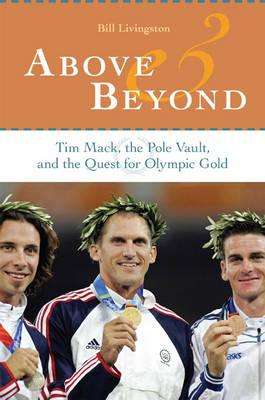
Book Club Claire is back for our summer reading selection: Above & Beyond: Tim Mack, the Pole Vault and the Quest for Olympic Gold by Bill Livingston. Tim Mack won the gold medal at the Athens 2004 Olympics (perhaps a surprise winner), and this book details his very long journey to the top of the podium and the unique training methods he developed that helped him achieve his goal. Livingston also takes the opportunity to look further into the world of pole vaulting. He tackles safety issues and rumors surrounding the tremendous success of legendary vaulter Sergey Bubka.
What did we think of the book? Listen to the show to find out! In the meantime, check out Tim Mack’s vault:
Our next selection is A Team of Their Own: How an International Sisterhood Made Olympic History by Seth Berkman. This tells the story of the combined Korean women’s hockey team that competed at PyeongChang 2018. We’re looking forward to reading a story that took place during the life of this podcast! Get your copy now, and look for this episode to drop in November.
Also on today’s episode, we have news on the one-year anniversary of the Paris 2024 Games. Ice hockey will have blended officiating teams at Milano-Cortina 2026. LA plans to become more accessible. The World Games had its first torch relay.
Reminder: you can watch World Games 2025 online at the World Games’ streaming platform. The World Games start on August 7, 2025, and we’ll be talking about them on the podcast!
In news from TKFLASTAN, we hear from:
- Fencers Lee Kiefer, Lauren Scruggs, Nick Itkin, Alexander Massialas and Gerek Meinhardt
- Racewalker Evan Dunfee
- Wheelchair tennis player Charlie Cooper
- Goalball player Calahan Young
- Shooter Sagen Maddalena
Thanks so much for listening, and until next time, keep the flame alive!
Note: Where possible, we use affiliate links. If you purchase something through one of these links, we may earn a commission.
TRANSCRIPT
Note: This is an uncorrected machine-generated transcript and may contain errors. Please check its accuracy against the audio. Do not quote from the transcript; use the audio as the record of note.
402-Book Club Claire on Above and Beyond-Tim Mack
Theme Music: The greatest festival of our contemporary society, the Olympic Games, is about to begin. This is gonna be close. Oh, they’re all completely gas. They’ve given everything on
Brilliant. Brilliant, brilliant.
Ready.
Jill Jaracz: Hello, and welcome to another episode of Keep the Flame Alive, the podcast for fans of the Olympics and Paralympics. If you love the games, we are the show for you. I am your host, Chi Jarris, joined as always by my lovely co-host, Alison Brown. Alison, hello, how are you?
Alison Brown: I am very well, and I’m especially well because I was reposting all our Paris episodes to go with the one year out.
Mm-hmm. Or the one year since, and at this point last year. We were both sick. Oh.
As I’m listening back to some of the show, I thought to myself, I sound so exhaust. We both, we sound exhausted, we sound sick, but it actually, and yet we were both so excited.
Jill Jaracz: Yeah. That was a hard thing. it was hard being sick because there was so much going on.
Alison Brown: It was really funny because it. To hear ourselves and be so far removed from Rick, I’m like, oh man, girls go get some rest, but don’t miss anything.
Jill Jaracz: I might still have that throat spray I had with a massive plunger on it. That
Alison Brown: was good.
Jill Jaracz: Stuff was good stuff.
Alison Brown: If you ever find yourself sick in France with a cold man, do the Parisians have good cold meds in their pharmacy?
How you can do our show sign-off!
Jill Jaracz: Right. Just go and ask. They will be happy to help you. speaking of help, have you noticed who’s been helping us the past couple of weeks?
Alison Brown: Some of our fantastic patrons?
Jill Jaracz: That’s right. We have had some listeners do the outro for us, saying Keep the flame alive at the end of the show, which is so much fun to hear. And that is a patron bonus for those at the $10 a month level. So we appreciate those patrons who have done that. We will hopefully have more sprinkled in throughout the year.
And if you would like to take. Part check out patreon.com/flame Alive pod. For more info. We have, uh, a lot of, bonus. Items at many different levels. So, uh, you can choose what works for your income situation. And we, uh, really appreciate the patrons because they do keep the show going on a weekly basis with their contributions and they help cover, uh, our operating costs, which is it.
Extremely helpful to say the least, considering that we’re going into, another Olympics and, have some other costs coming up that, uh, relate to those games as well. Italian cold medicine, possibly pro, possibly. Possibly.
Coming up on our Patreon “Can you learn how to become Olympic in your endeavors” series
Jill Jaracz: And, and this year, Patreon patrons are learning all of. All about whether we can learn how to become Olympic based on, uh, Olympians memoirs.
And, uh, coming up real quick will be our episode on Ibtihaj Muhammad’s Proud, my Fight for an Unlikely American Dream. And Ibtihaj won a medal in fencing at Rio 2016 and she is, famously the first, uh. Woman in a, who wears a hijab to be a, a medalist, not only a medalist, an Olympian, so, well she was the wor, the first team USA Oh, right, right, right, right, right.
First, um, team USA and that broke a big barrier. So she is an icon to many, and we’ll see what we can learn from her. Again, that’s patreon.com/flame live pod.
Book Club Claire on “Above & Beyond: Tim Mack, the Pole Vault and the Quest for Olympic Gold”
Jill Jaracz: Speaking of books. That’s right. Book Club Claire is back for our summer reading selection. We are talking about above and Beyond Tim Mack. The pole vault and the Quest for Olympic Gold by Bill Livingston book came out in 2008. Take a listen to our conversation.
Claire, welcome back. We are talking above and beyond Tim Mack, the pole vault and the quest for Olympic Gold by Bill Livingston. What do you got for us?
Book Club Claire: I have a book that doesn’t know if it wants to be about pole vault or about Tim Mack. I can I go first? Usually, I, I bounce it to you guys. I would like to go first.
Okay. So the first thing I, I have had this book for a while and I finally said, okay, summer read, I’m gonna get through the book. Um, a short book, you know, nice to have that, read the, pro law, the introduction. learning a little bit more about pole vault and all of the intricacies, but then, our author gives us this clever little section, mentioning about the Sydney games in 2000 when women were introduced to the pole vault.
But he says the arrival of women with their skimpy costumes and record setting binges bought a whole, brought a whole new set of fans to the sport, and I immediately went. It’s gonna be one of those books, isn’t it?
Jill Jaracz: Can, can I say when I read, go for it. When I read that line, I put the book down for like a couple of weeks.
I just was like, I am not dealing with this. it does not bode well. And just set it down. Came back to it. Got past that. Got to something good. But there, there’s, keep going, Claire. ’cause there’s a lot to talk about.
Book Club Claire: Yeah. that, that was the first thing and just every time he tried to interject something clever, quote unquote, and quote unquote funny, it was basically a miss.
There were a couple of hits here and there, but you know, there was another section where he talks about how, oh, this is the time before everybody got participation ribbons and trophies. And I’m like, oh, okay. It’s gonna be one of those books. And it was, it was just a bit frustrating, uh, when he decided to glean away from the historical facts and the biography, which were very good, and decide to, you know, be clever.
And it was not clever at all. Um, my guess is, as I was reading this, was that he wanted to do a book about Tim Mack, but then realized how vanilla Tim Mack is. And said, I don’t have enough for a book, so I gotta fill this with a lot of other stuff. So every other chapter is not about Tim Mack and he had to fill it in with even more words, you know, adding those clever little touches that ended up bringing the book down, in my opinion.
So that’s what I thought. I would like to know what you all thought. I, you know, Jill has given her kind of hints as what she felt. Alison, what’d you think?
Alison Brown: So two thoughts. One. There were several times where I felt like the book was written by, Steve Carell’s character from the office. Like he did not know that he wasn’t funny and was actually being incredibly offensive.
And two, this could have been two Sports Illustrated feature articles and been done. It was. A disservice both to Tim Mack and the sport of pole vaulting because when we spoke to Katie Moon, the way she sold that sport to us was so incredibly beautiful. And this was not that. This did not make me wanna watch pole vault.
And I like pole vault. I like the jumping, uh, elements of track and field.
Jill Jaracz: I, I do wanna say this book came out in 2008 and Bill Livingston, Tim Mack is from the Cleveland area. So Bill Livingston was a sports columnist from the plane dealer here, and he retired in 2018 after 34 years at the plane dealer.
and he was old when he got here, or he was like 35. So this is an old school sports writer. And I could just picture him chomping on a cigar using two fingers, maybe at his word processor, and typing out this book and, and I would imagine he is beloved. Was beloved at the time and beloved in his circles.
But boy, like his style of writing did not age well for me as a woman. there were so many kind of digs at women. The skimpy costumes was the first one, and uh, he kind of got there again. Oh, he made reference to, the Cavaliers, the Cleveland Cavaliers cheerleaders, the TNA show and things. Ooh.
Yeah. And, and I totally agree with you, Alison. This could have been a couple of long feature articles You know, when the story was about Tim Mack, it was interesting ’cause that was the focus of the book.
It was supposed to be the focus of the book, but like you said, he had to pad it, so he padded it with, pole vault safety That sounded like he had been assigned a feature article. ’cause the main part of that took place in Pennsylvania. I’m like, oh, did you get a feature article? And all of a sudden you’re like the pole vault guy in this area.
So we’re gonna take all the stuff I did in pole vaulting and put together a book and here we go. And then he talks a lot about Sergei BCA and even seems to interview him and. There were elements in that I, there were elements about Sergei Bubka, like a very, vague accusations of doping going on there.
I don’t know what was going on at the time. I don’t know what the word on the street was at the time back then. the other element that I didn’t like about his Sergey Bukka stuff is that he kept throwing in like American football references. Baseball references in these things, and obviously Sergey Bka was not understanding the sports metaphors he was talking about, and how that got past the final edit was beyond me.
And then the, the last thing I got was, oh my gosh, just again with chewing up the scenery, there were so many lines that I started highlighting them and what. The superfluous language, like, oh, his biceps are Popeyes after a spinach infusion, And, the almost alone among athletes pole vaulters slipped the bonds of earth and gravity pole.
Vaulters began as lost boys who dreamed of flying with Peter Pan. The pole vault, the most technologically advanced, adventurous event of them all represents all the innocence, bravado, and magic of childhood. And it’s just sentences like this that happen time and time through again throughout the book, which are very, I can see people just fawning over this writing, but I also see it that it doesn’t necessarily age well and it’s a lot of like, like you say, we, we gotta fill some pages.
Book Club Claire: I’ve read my fair share of old timers books. you know, my dad had a few, uh, one biography about alkaline. I’ve read it like four times, and the fourth time I read it, I went, huh, this is a little. Little racist here and there, things like that. You know, it was written in, I was, I guess it was written in the seventies or eighties.
and then, you know, a few, mostly Detroit Tigers stuff, because that’s the, those are the best books and that’s the best team. But it’s very interesting to see how those old timers wrote and sometimes they do a really great job and it kind of transcends time. And then there’s others like this where you, it was.
a split of, okay, we’re gonna talk a little bit here, a little bit there, and throw a joke in here and there. take away Livingston for a second. Um. Let’s focus on Timm chapters, uh, because I did enjoy Timm. Tim Max seems like a very nice guy. he still, I went on YouTube and googled him for some of the, uh, for some of, of his jumps.
You can see his gold medal winning jump, but not much else. Uh, and he actually is still speaking around the United States. Uh, so it seems like a very, you know, pleasant man. And that came off in the book. what were your thoughts on Tim Mack?
Jill Jaracz: I thought it was like the quintessential underdog. Somebody who came who wasn’t really pole vaulter, physique necessarily kind of fell into the sport in high school.
Not the greatest high school pole Vaulter. Didn’t get a college scholarship. Well wait. He did get a college scholarship to a lower level school, so he spent some time there and kind of maxed out what he could with that coach and moved on. But. Everything was scrappy, pull it together, failure, setbacks. And then he managed to overcome stuff and he, he developed his own coaching system, which I thought was really interesting.
He developed his own method methodology and he had to learn how to trust his methods to make his gold medal happen. And it just, I thought that element was really, really fascinating because of that, Tim Mack. Was like eternally focused. I mean they, he was really reaching for some stories like gimme some Good, Tim Mack was a crazy, wacky guy.
Stories, and there’s not much of those. But what he did really. not shook the world of pole vaulting, but really was something to point to and say, wow, if he could figure out how to do it and be good with all these kind of obstacles in the way, maybe I can too.
Alison Brown: The biggest thing I thought was missing in terms of the writing about Tim Mack was I never really understood why he was doing all of this.
Like what was his. Motivation. Like why? Why pole vault? You know, it just didn’t seem, I mean, he says certain things throughout and I don’t know if that’s just, he’s kind, and I don’t mean to say he’s a simple person, like he’s not intelligent. He’s obviously a very intelligent, very thoughtful man, but I don’t know how self-reflective he was.
And so that’s reflected in the writing. That, like I didn’t come away from it. Understanding why he put himself through all of this. Yes. The gold medal, I got that, but I felt like I was missing something of what was behind Tim Mack behind the, okay, you want the gold medal? That’s great. You wanna be better.
That’s great. But why?
Jill Jaracz: Right. And you missed Atlanta. Why keep going when you don’t have resources behind you at this point?
Alison Brown: I wanted to ask Jill, though, about the depiction of Cleveland in this book. If you felt like either it was accurate, it was, it was properly referenced. I was just curious as, ’cause obviously you’re there.
Oh
Jill Jaracz: yeah, yeah, yeah. Uh, I mean, St. Ignatius is I’m pretty sure it’s boys only, but it’s a Catholic prep school in the middle of the city, basically, and very well known for sports. It’s, it’s a very good school and that Got it. I mean, he’s from a suburb, a couple suburbs away from me, so he is not that far.
Like 10 minutes away would be where he grew up. And yeah, just kind of basic Midwestern. Suburban town. Nice. PI would imagine nice family upbringing but you’re going to a school where there are expectations I would say and, let’s look to Excel and, and, they’re very well known for that element.
But, you know, during the year 2004, Cleveland, you know, that’s not. LeBron James is coming. I think he was there by that point. So that’s the hope. Yeah. So there, there’s a hope and stuff is turning around. But I think Cleveland was also still going through a ton, ton of trouble. it will continue to go through a ton of trouble, but I don’t think you got that side of cle. Do you got the scrappiness? Cleveland and that there are great things about the city. So I, I that depiction of Cleveland was was on for me.
Alison Brown: And to your point, for me, the depiction of the boys’ Jesuit school. Was so on, on point because I grew up, uh, I went to a grammar school where a lot of kids, a lot of the boys went to Fordham, the Fordham High School. My husband went to the Boston College High School. So the, this boy’s Jesuit High School has a very specific personality and he absolutely captured that to a t.
So that was, that was very successful in terms of, we’re complaining about writing, but. Just, just as an example, at BC High, you don’t get detentions, you get jugs, which are judgments under God.
Book Club Claire: I’m sorry. Wow.
Alison Brown: So I think, I think I and, and I went to a Jesuit college, so the depiction of Saint Ignatius was.
Probably my favorite part of the entire book,
Book Club Claire: man. I went to a Lutheran prep school for high school. No, and we didn’t get that. We didn’t have that.
Alison Brown: Oh, the Jesuits are not like anything else.
Jill Jaracz: Yes. If I, if I look at the, the Google description, you know, forming future leaders since 1886, so you know, you have very much tradition excellence, all that jazz.
Curious and yes, it is a, it is a, a young men’s school.
Book Club Claire: I wanted say, you know, I, I thought that Tim Mack, was a very interesting character, even though he might not have been interesting enough to warrant an entire book for him. Uh, which is too bad because does have that mindset of I’m gonna get this done no matter what.
I mean, his, when, when they mentioned he got a computer and he set up. Email and I, I love that so much because I immediately highlighted that, like, this is a very old book.
Jill Jaracz: Oh, wait, you mean the a OL?
Book Club Claire: Yes, the, the Golden
Jill Jaracz: Athens account.
Book Club Claire: Like he set his himself up, you know, he made a website. Oh my goodness.
You know, these, these newfangled things that in apparently the two thousands was crazy and just. You know, it, hearing about that and, and how, but he was so committed to, to getting this done and, and getting a golden Athens that even when he failed for, for Sydney, he was still, you know, trying hard, um, doing.
The lowest of low jobs, just so that he could still train and achieve that. And then ended up, you know, hitting the, you know, with Olympians you have to have that cycle and you have to be hitting your stride at just the right time. And for him it was perfect. And for everybody else that he was competing against, it wasn’t, and he was able to, you know, get to those heights that, that.
He had been striving for at just the right moment, and I think that was, to his credit, a lot of his doing. It wasn’t just, well, this guy was sick or this guy was injured. It was Tim Mack made a commitment. He wrote down what he needed to do and he did it, and I appreciated him for that.
Alison Brown: and we’ve talked to, enough athletes where people will say, there’s no such thing as luck.
Luck is simply being prepared in an opportune moment. And I think Tim Mack was very much that, that character in Athens, he was the most prepared and then circumstances helped him along. But that wouldn’t have happened if he hadn’t done all of that. Work both physically and mentally and intellectually in terms of planning out how he was gonna make this happen.
Jill Jaracz: I wonder if it would’ve been more interesting to take out the stuff about pole vault safety, take out the whole Sergei Bka background and, and take takeout. Bill Livingston obviously went to Olympia for the shot, put competition at Athens and had to tell us all about it. This was also LeBron James’ first games, and if LeBron James is a Cleveland player and is making good coin, the juxtaposition of LeBron and.
at the height of earning power, and Tim Mack, who has no earning power as a pole vaulter. I wonder if that would’ve been interesting to kind of explore that route a little bit better. And then of course we have LeBron and you could sell more books.
Book Club Claire: I wholeheartedly agree with that.
That that makes a lot of sense. And, and I, I think his reasoning for including this stuff, besides the I need more stuff, is the fact that pole vaulting doesn’t get a lot of play in the United States. People don’t know what it takes. So he felt like he needed to include those chapters. You know, we need to show how dangerous that is.
This is, we need to show who is at the top of the sport even. Several years after his retirement, we, you know, we need to include all of these things so that when we get into Tim Mac’s story, you understand a little better the difficulties or the things that he was coming at. And I can understand that.
But I do see your point being. Almost making more sense, you know, get, get the readers in with James, but also, you know, get them to see how important Tim Mack was to his sport. Re re respectively. And there, there were probably a few other Clevelands, sports Olympians that year that he could have talked about.
I mean, if Cleveland Plain dealer is anything like the newspapers I’m aware of, they usually have an entire Olympic section. And one of those sections is dedicated to their local. Athletes. So it, it’s definitely something that they probably could have done a little more, but it was probably more like, Hey, we gotta get a book out for Beijing.
Let’s talk about this guy. Go. And that was all of the, uh, the lead that he had. So, uh, although I think Jill, you already makes more sense.
Jill Jaracz: Yeah. And there were, there were actually, a decent number of people from, the Cleveland Akron area in Athens. At that time, there could have been maybe some. Look at Cleveland for 2004, and maybe you don’t talk about that that much, but it, it does feel like Mack is very alone in his endeavors and once he leaves the college fold, there’s not much for him except for him.
So then I guess it becomes kind of a lonely book in that sense.
Alison Brown: But I wonder how much of that is still true. I’m also curious, I almost would like an epilogue of this in the sense of now that there’s much more money in track and field than there was that, you know, we have the Diamond League, we have other events where they’re making, you know, even pole vaulters are, are, if you’re in the top 20 in the world or the top 10 in the world, you can live on that.
And what does that look like now? That’s kind of an epilogue that I’d be interested in, and also the safety issues that he brings up. I actually liked that chapter a lot for myself, but not in the context of this book. What does that look like now? You know, have those changes been made? We, we know they don’t wear helmets, but they were talking a lot about soft box and changing the size of the pits and certain changes that have been made.
And I knew pole vault was dangerous, but this was scary and is it better now? And that’s kind of my own follow up I need to, to do when finishing the book.
Book Club Claire: The other part of this book is that you have. Things that are being stated about world records and things like that, that we’re reading now in 2025 that are non-existent now, thanks to what’s been happening recently.
Uh, between Sam Kendricks and Monda Deis, kind of leading the charge on this new era of Pole vaulters. A lot of the, the book, uh. Talk is set to the side because it’s like, okay, yeah, he might have been doping, he might not have been doping, but it doesn’t matter ’cause his world records are gone.
And it’s kind of interesting to, to take that with the context that we have nowadays. were there any points in the book? You’re kind of like, oh, that doesn’t matter anymore. Because I, I, as soon as we got into world records and things like that and six meters being the ultimate goal, I was just kind of like, eh, keep reading.
Skip, skip, skip.
Jill Jaracz: the hard bit I had was living stints, insistence on talking in both feet and meters, and I think I get, at the time there is less American understanding. Of what meters is, and I think we have evolved a little bit more as sports fans to understand the pole vaulting metrics, so to speak, we understand what’s a six meter jump and, and that, but to, to go back and forth, I really got hung up in this many feet and, and inches and, fractions of an inch versus.
6.5 meters or whatever. And I, I also got the impression that Livingston did not appreciate that.
athletes, IE Serga, Sergey Bukka would get the world record by just a tiny fra, a few centimeters or one centimeter, and then continually break that record. And I. Think you can correct me, Claire, or Alison because I think you guys have a better handle on this.
Doesn’t somebody nowadays and maybe back then too, give them a bonus for every world record broken. So you don’t wanna break it by whatever you can do. You want the money, so you break it by a little bit and then keep breaking it. And
Book Club Claire: that is something that DUP Planti has done consistently the past three or four years.
Mm-hmm. Is break it by centimeters. Uh, yes, that is, that is very common. And Boca did it dup, Planti learned. I think sometimes it’s the country will shell out the money. Um, I think in the book it does mention. This, that I think Nike was giving out bonuses. but I think, you know, whoever is giving it out, they’ll give it out every time you break the world record.
And so, yeah, between Boca and De Plantes, they, they have made quite a amount of good amount of coin from breaking World records just a little bit.
Alison Brown: And then you also have the kind of the back room bonus of. 10 time world record setting. You know, they get a headline every time they break that world record.
Why would you break it by a foot? Why wouldn’t you just break it by a centimeter each time? Because then every time you compete, you get back on the sports page. You know, you get the attention all over again. So it’s just good business and to do it by a little.
Book Club Claire: That’s the thing about high jump and pole vault is you can go by little bits, whereas when it comes to running even long jump, uh, or any of the throwing events, you’re kind of basing your on your body and you can’t be as exact.
When it comes to you getting to that goal as opposed to those other two events where it’s like, I know exactly where my body needs to go, I just have to make sure I can get there. So it it, yeah, those two are interesting.
Alison Brown: And then also the, the way the competition is structured, the way po Vault is structured, you know exactly where everybody has landed, where certainly any running race you gotta be faster than everybody else.
And then even the way the, the other jumps and throws are done. You’re kind of going in. So unless you are the last thrower in the rotation for the competition, you can never really know what the other people are gonna do. So you always have to make sure you’re far enough to win, not just the world record.
Where I think it was the last time Deis won or broke the world record, he just did an extra jump like he had already won. Mm. And he was able to, to just be like, no, no, no. Set it for the world record. So I think it’s also just the nature of how the, the competitions that pole vault allows you to do these little increments.
Book Club Claire: And I do think, that runners are trying to almost mirror that idea when you have the lights on the track. Have you seen those? Okay. Yeah. Diamond League will do that where they will, they will have lights on the track, sometimes two different sets of lights. One is for the world record if it’s achievable, and the other one is for like a national record or for the, the meat record.
And so they can see with their own eyes what they need to do instead of just working on pacers, um, or people yelling at them from the stands, what, what, how much faster they need to go. So there, there is that exact science about, track and field athletics events that just, I think that’s why I love it so much and why I’m such an apologist for athletics is because how of how detailed it can be, but how raw it can also be where it’s just like.
Run fast when the gun goes off and throw as hard as you can and jump as high as you can. But there’s also so many other little things that, going back to the book that Tim Mack was able to learn and, and record in his notebooks and take and end up winning a gold medal. So
Alison Brown: I did love the notebook. Yes.
Yeah, I did love how, because we’ve spoken to many people who do this like very detailed record keeping, you know, now often it’s spreadsheets. But I loved the idea of everything’s in a little notebook and you’re writing it all down and you’re keeping track. And that he was trying to eliminate whatever the variables were.
really tiny variables. Like did I have a cup of milk before the competition? Or three quarters of a cup of milk, right? And, and was it 72 degrees in the bedroom when I slept, or 74 degrees? It was so interesting, all the, why was this a good day? I thought that was my takeaway from this book actually, in terms of, what did I learn.
Tim Mack was saying, I’m gonna make it a good day ’cause I’m gonna figure out every single variable that sets me up for success. now I have a notebook and I’m gonna sit at my desk and I’m gonna figure out what is my optimal. Office temperature. And I don’t mean that sarcastically. I mean that seriously.
Like am I able to concentrate when it’s one degree warmer or one degree? Take all those things away. And that’s what we were saying about Tim M is an interesting guy. Take all the stuff away and make your own luck. Make your own best day when you need it. And for him, it wasn’t avan.
Book Club Claire: There’s a high jumper, um, from Australia and that’s where I first saw it, how the notebooks take effect.
Um, her name is Nicola Ola. I think, uh, that’s her married name. I think she was McDermott, that’s her maiden name. But when I was watching, I think it was Tokyo for sure. I would watch the full competition because I’m a weirdo like that. And they would show her jump and, you know, she was, she was always so peppy and happy and then she’d immediately go open up her notebook and record what happened with the jump.
And that’s kind of the first time I, I heard about it. So when Tim Mac was also mentioning a lot about notebooks and note taking, I’m like, oh, it’s kind of very similar. And again, you know, pole vault and high jump, they work side by side with each other. So, um, anything else you wanna talk about when it comes to this book?
Alison Brown: Well first I’m gonna say Claire, not ’cause you’re weird like that because you are a Shukla star. Not sure. We all are weird like that. That’s why we exist.
Book Club Claire: Well, I just, uh, laminated my Paralympic posters that I made for last year today, so I’m like, I have to, I have to save these for the next Paralympics.
And that just, you guys on the podcast will understand that that’s important and whereas everybody else is just like, what are these weird pictures? So I appreciate you.
Jill Jaracz: What is Para, what is the Para Olympics?
Book Club Claire: Don’t get me started. Is that like the Special Olympics? All right, final thoughts.
Jill Jaracz: after I picked it back up after the, in skimpy costumes line, there were elements of the book that I really liked. Then there were times where it was really hard to get through, and it reminded me in a sense of when we read Munich 1972 by David Clay Large, where there was a lot of the book that I had struggled getting through because he obviously did not like writing about it.
I think Bill Livingston liked writing about all of this. Maybe he had to sit down and think like, oh boy, you know, I need 5,000 more words. Where am I gonna find them? But. You could tell when that happened, you could tell like he really wanted to write about Tim Mack and just didn’t have enough. The Tim Mack element, I think it’s great and I’m glad he got a book dedicated to him.
I mean, uh, we talk about lucke, some of the stuff is luck on that element too, and having that moment in time and that approach to, training. Documented. but, you know, I’d check it out at the library if you can get it on your, if you got a, a, a library with Hoopla, it’s on Hoopla and it’s not a hu huge long read, but it, it’s one that you might have to put, pick up and put down and, and if you want just the Tim Mac chapters, it’s like
Book Club Claire: every other chapter.
Yeah. So it’s only like five chapters long. It’s perfect. Yeah.
Alison Brown: Yeah, I think, uh, bill Livingston’s editor needs a jug after not doing enough on this, on this book. The other thing I would say is I do wanna read now a book on women’s pole vault, because I think Livingston was very dismissive and it wasn’t, we hadn’t had that many Olympics with women’s pole vaulting in, so he didn’t have anything to work with.
He also didn’t look for anything. To work with. So the women’s game got no attention except for a couple of Stacy Grr dimensions and one mention of a high school girl who got very seriously injured. So editors, we know a lady.
Jill Jaracz: Mm-hmm. Who could
Alison Brown: be the subject of your book and even just go listen to the Katie Moon, moon episode and kind of hear what’s going on in pole vault on the women’s game, I think is, is where I wanna go with that one.
Jill Jaracz: I don’t think we need jugs. I think we need juts judgements under Stan. And, and this, this book does get a little jut from me. And I think I recommended it, or I think I asked for it. You did, you did. You did. Again, we have to stop me. Please. We have to stop me because I am recommending a lot of the, the books, I’m, I am so ashamed that I, who needs it Jug as this girl for recommending these books.
Not horrible. It’s not as bad as some other ones, but yeah, it, it, there’s a jut for this for me,
Book Club Claire: I’m glad that it was a short read, but. Not because of the subject matter. I love pole vault. I appreciate Tim Mack. If, if this book was meant to be consumed, to appreciate Tim Mack more, then it succeeded because I do appreciate Tim Mack much more than I did before I started this.
So if, if anything, Jill, take that and enjoy that. Thank you. So thank you.
Our next Book Club selection
Alison Brown: So what’s next, Claire? Well, first is it another? Wait, is it another Jill pick? Because we could change, uh, no. What’s, what we’re doing?
Book Club Claire: I believe this was one of mine. Uh, because Okay, we just had the 400th episode. Congratulations again, by the way.
Alison Brown: Thank you. Thank you for coming. Thank you for being a part of it.
You’re welcome.
Book Club Claire: And the, the mention was, well, where did you first start or when did you first start listening to the podcast? And we mentioned, uh, a few of us mentioned that we were listening during 2018, uh, when the Pyong Chang Olympics were taking place. And that’s where I started listening. So we’re actually taking something from the Pyeongchang Olympics.
We are going to be reading a book about the unified Korean women’s hockey team. It’s called a team of their Own, how an International Sisterhood Made Olympic History, and it’s by Seth Berkman. It is on hoopla if you like your digital. Library books like I do. That’s literally where I’m looking at it right now, and, uh, I’m looking forward to it because I remember there was a lot of, hype about this and I really am looking forward to seeing how it all came together.
And I’m, since it is only seven and a half years away, I’m curious to see. Like when it exactly got published, how much got hidden in the weeds, um, because you are talking about, you know, very divisive, two countries and you know, what is, what was allowed to be published and what wasn’t. So it’s gonna be very.
Very curious book to, to take in. And I hope that there is a little meat in this book, uh, as compared to some other books that might just be very shallow. So that’s what I’m hoping for. I hope you guys enjoy it.
Alison Brown: I’m hoping for, if we’re talking meat, maybe I will get some Korean barbecue to accompany it.
Jill Jaracz: Delicious. I’m excited because it’s a book that’s been on my shelf for a little while and we will finally read it. And this is the year of Stan helping Jill read the book she actually owns. So I am excited to look forward to this too. Thank you so much, Claire. We’ll have you back on, probably around Thanksgiving ish.
Again, that works for me because that tends to be a a good time for reading and thinking about books. So thank you so much and we will see you next time. See
Book Club Claire: you when it’s colder.
Jill Jaracz: Thank you so much, Claire. Claire is CNET Travels on Insta and YouTube. You can check out her travel log videos. They are fantastic. And, uh, if you wanna get that book, above and beyond is available on our bookshop.org site. We’ve got lists of, uh, all the book club books that have been on the show.
That’s book shop.org/shop/flame, a live pod. You can also, if this one, it happens to be on back order a lot. So you can also find it on your library if, if your library has hoopla, you can get it from your library. So check it out there and, uh. Reminder that next time we will be reading a team of their own, how an International Sisterhood Made Olympic History by Seth Berkman.
That is also available@ourbookshop.org site. if you shop through the site and you don’t have to buy just the books on our lists, uh, you can buy any book through our. bookshop.org/shop/flame live pod, uh, we get a commission off of any purchase made through that link, and that goes to helping us build the funds that it takes to, get to Milan, Corina, and to other games in the future.
So we greatly appreciate, uh, all of you who support us that way.
Paris 2024 News: The one-year anniversary of the Games
Jill Jaracz: we have been having a lot of one year anniversary celebrations in Paris for the Paris 2024 games. So Kirsty, Coventry, and Tebo we’re in Paris to celebrate, and they celebrated with, uh. President Macron, just like you did. Just like I did and I am. I look at Macron every day. I have our picture framed.
I was not invited. Remember the moment we had the statues from the opening ceremony, as we said a few weeks ago, they are now, uh, installed in the 18th ar Mont on the Ru de la Chappelle. That, and then the area in front of the Adidas arena has been renamed to be the Alice Milia Esplanade. Nice.
Alison Brown: And that’s a big space. ’cause a lot of that was fenced off when we were there.
Yes. We you were directed very into very narrow spaces, but that was a big open space there, so that’s nice that, that she gets a little credit.
Jill Jaracz: Exactly. Unfortunately. France is having some budget problems, namely a lot of public debt, and that is expected to be 116.2% of the country’s GDP this year. So the country said we have to make some sacrifices, tighten the belts.
Sports is going to take a hit on that, and the that means that the government will invest less in sports going forward, which was. It’s sad because that was a hope, that would be a legacy of the games. So they will be, decreasing their investment by 300 million euros in funding for sport, youth and community life.
Obviously the French National Olympic and Paralympic committees are not happy about this, but there’s not much you can do. Lamond has al also been reporting different legacies that says behind a paywall. So I can’t see what they’ve done with the venues and hopefully we will be seeing. That in the future come out through other, reporting.
But one noteworthy development that Lamont talked about is that the Paralympics caused a lot of public excitement and increased participation in Parasport, but it has brought little improvement to disabled people’s everyday lives, and that also is behind a paywall. I really wanted to know what happened because the city was making a lot of investment into getting.
Different neighborhoods better for, accessibility. The bus lines better for accessibility. And, uh, I, I kind of wonder what is going on.
Alison Brown: Well, we worried, we worried about that very thing. So it’s, it seems to be a constant problem with the Paralympics in that everyone gets super excited about the competition.
Then they move on.
Jill Jaracz: Yeah. And it’s really hard to maintain that momentum. So hopefully France can, they can get past these budgetary problems and, make something happen. But we’ll see, because they’ve got another games coming up. And that’s another issue with the funding for sport, is you’ve got another games coming up in 2030.
Where’s the money gonna come from for that?
Alison Brown: Well, it’s gonna come from Italy and Netherlands, where they’re having speed skating.
Milano-Cortina 2026 News: Ice hockey
Alison Brown: Ooh, okay. It
Jill Jaracz: is. It’s the same word. Well, that is helpful. We have, so a little bit of news from Milan Corino. It’s gonna be slow for a few weeks I think, because, uh, Italy goes on vacation
Alison Brown: in August,
Jill Jaracz: including the
Alison Brown: entire country. The entire Olympic committee, the entire organizing committee, no.
Jill Jaracz: They get a break. So the International Ice Hockey Federation announced that officiating crews for the men’s ice hockey tournament will be a mix of IIHF and NHL referees and linesmen. The last time this happened was 2014, of course, which was the last time NHL players were part of the Olympics. In August, the two groups of officials will start working together and training on skills and team building because the.
The rule sets are similar, but there are some differences in international play and everybody’s gonna have to get on the same page with everything. NHL play tends to be more physical than IIHF play, so that’s one of the things they said they’re gonna be working on is judging the intensity of the physicality.
Alison Brown: I’m wondering about trash talk. Oh, that’s because the NHL is, is. Oh yeah. Wild. But do you think, do you think international is just as bad and then they just do it? Well, you do it in multiple language in the NHL too. Yeah. Maybe they just don’t, don’t get it.
LA 2028 News: Accessibility Commitment
Jill Jaracz: We have a little bit of news from LA 2028. Um, You are part of our Facebook group. You saw that Alison posted the ceremonies director has been hired a man by the name of Peter Rice, I believe. Yes. Dunno anything about him. No. And it, it’s not like he personally, he has a, a lot of, uh, in show business, I believe, but hasn’t personally put on a ceremonies or directed that kind of thing.
And from what I read in that article, it was. He will be a good manager of the whole thing. So they’re going to tender out, companies who specific, tender out to, a company that specifically does ceremonies production.
Alison Brown: He’s not doing the artistic, no
Jill Jaracz: guiding of this. He is not,
Alison Brown: he’s the business guy.
Yeah,
Jill Jaracz: he’s not to Marshall Lee. That would be interesting if they got him back. Oh God. What did he do?
Alison Brown: I mean, he had death threats the first time around. Can you imagine what would happen here? Oh, I don’t
Jill Jaracz: think that’s gonna happen.
Alison Brown: No,
Jill Jaracz: no. But we’ll look for something to, you know, they’ll be putting out contract bids in the very near future, I’m sure, because four ceremonies is a lot. And if you’re putting one of them across two.
Venues also a lot. So we’ll see what happens. Also, The LA City government announced that Mayor Karen Bass signed a games host city accessibility to commitment to ensure what they’re calling a games for all end quote. This includes a games accessibility plan and the appointment of the city’s first accessibility chief within the office of major events.
So they realize that, hey, we’ve got this Americans with Disabilities Act, which. Ensures some form of accessibility, but we can do a lot better and there’s still a ways to go and they’re going to try to make those improvements during this time.
World Games News: Torch relay
Jill Jaracz: I forgot to put what I sang the last time we had World Games News.
Alison Brown: world
Jill Jaracz: Games. World Games. World Games.
Maybe I can just mash that up. So that’s gonna be our world game sounder.
Alison Brown: Well, remember we called the. One of the world games mascots, like the dime store. Bing, dw, DW
Jill Jaracz: that port do think. So we’ve got
Alison Brown: a dime store sounder for World Games, which is not fair ’cause these athletes deserve better than that.
Jill Jaracz: They they do. So we’ll work on that. And get something because the World Games are coming up, they will be coming up, uh, starting August seven.
So get ready for some World Games coverage from us. And Chengdu 2025 hosted the first ever World Games Torch Relay. And I will say like with most communication from the World Games, I don’t understand what they’re actually trying to say because I think this was a one day event. Okay. And, and that’s cool.
But if, if you’re gonna do a one day event, why do it on July 26th when the games are on August 7th?
Alison Brown: I don’t know. Maybe that’s when Jackie Chan could show up.
Jill Jaracz: So this took place in, uh, Shewan Province, featured 120 Torch Bearers, who each symbolized quote, society excellence and Global Connection End quote, per their press release.
Torch Bearers did include Jackie Chan, actor and notable Matt Stutzman fan.
Alison Brown: Oh, that was great.
Jill Jaracz: Wasn’t that, that was so much fun. Uh, Olympic figure skating Champ, Han Kong and two time Olympic table tennis champ, ma Long and then several world game stars also took part. Rightly so, I thought including Karate Champ Sandra Sanchez, Muai Athlete, Sophia Olafson, and Lifesaving Champ, Marcel Hass Meyer.
So, the World Games is gonna be an opportunity to see flag football and lacrosse and squash ahead of LA 2028. So if you’re interested as to what those will look like, uh, tune into World Games coverage, they have a platform. Of World Games Live, so everything is gonna stream. We’ll make sure that’s on our Facebook group, we’ll put it in, blog posts and on social
not many Americans are going to the World Games. I will say that
Alison Brown: I’m not surprised.
Jill Jaracz: I, I’m not surprised either. we’ve noticed on the Facebook group, some other nations have separate world games committees like the U-S-O-P-C and other National Olympic committees and Paralympic committees. We do not, but I was hoping that Tom, uh, Scott would be going for karate and it’s, his name was not on the list.
So we’ll see what happens. I’m excited. I’m excited to see some of these fort again. You did love lifesaving. I did. Lifesaving was cool. When I saw on the list fin swimming, I was like, oh yeah, fin swimming. And remember that wild uh, canoe.
Alison Brown: Where they had to carry the canoe.
Jill Jaracz: Yeah. And they ran on the beach and, uh, then put it, that’s exciting.
And the different
Alison Brown: gymnastics that you don’t see in the omp where you get tumbling and the, and the pairs and that stuff is really fun. Yes.
Jill Jaracz: That’s fun to watch. And, um, some of the different ball sports that you don’t see mm-hmm. Orienteering is fun to watch. And I’m really excited to see Dragon Boat.
Oh yeah. Because that’s new for new, for Chendu. So look forward to that. We will be having a couple shows dedicated to World Games coverage, so we wanna hear if you’re watching along and what you think.
Team Keep the Flame Alive News direct from TKFLASTAN
Alison Brown: Welcome to Stan.
Jill Jaracz: It is the time of the show where we check in with our team, keep the flame alive. These are past guests and listeners of the show who make up our citizenship of Shuk
Alison Brown: Stan. We got some results from the FIE fencing world Championships. Lee Kiefer won her first world championship gold in women’s foil and then took the team gold with Olympic teammate Lauren Scruggs and newcomers Jaylin Li and Emily Jing.
Men’s team Foil with Nick Ikin, Alexander Maci. Garrick Meinhardt, and someone I haven’t talked to. Bryce Louis, uh, they took silver in the team event losing to Italy. 43, 2 42 in the final.
Jill Jaracz: Race Walker. Evan Dunphy, like he’s the Mondu Duplantis of race walking. I think he broke his own record to win the 3000 meters at the St.
Jerome Classic
Alison Brown: wheelchair tennis player, Charlie Cooper has been awarded a wild car entry into the men’s wheelchair draw for the US Open. I was so excited when I saw this. I know he’s moving up.
Jill Jaracz: I and Wheelchair Tennis is back at the US Open because they didn’t put it in last year due to the Paralympics being right ahead of time.
Congratulations to Gold ball player, Callahan Young, who married Eliana Mason, who is also a gold ball player. They got married on July 19th. Callahan and Team USA’s Gold Ball team is playing at the 2025 America’s Championship in Sao Paulo, Brazil, now through August 8th. You can watch the games on the IBSF YouTube channel.
That’s at IBS A Blind Sports. We’ll have a link to that in the show notes. Hopefully you’ll get a link to that because I might be watching the show, watching some goalball instead of editing
Alison Brown: the show. Not a bad honeymoon.
Jill Jaracz: No.
Alison Brown: And Getwell wishes to shoot her, uh, Sage and Madelena who had surgery on her shoulder last week.
She posted a few things. She’s looking in good spirit, so get wealth’s quick.
Get in touch and coming soon!
Jill Jaracz: And that is going to do us for this episode. Let us know how you are training for LA 2028.
Alison Brown: We love hearing from you, and you can chat with us and other listeners on our Facebook group. Keep The Flame Alive Podcast. Email us at Flame Alive pod@gmail.com.
The voicemail and text line is always open at 2 0 8 3 5 2 6 3 4 8. That’s 2 0 8. Flame it and if you need more Olympics and Paralympics in your life and who doesn’t sign up for our newsletter@flamelivepod.com, we’ll have a link to that in the show notes.
Jill Jaracz: You know, are you gonna start a training notebook for LA 2028 today? I drank this, I slept this. We, I
Alison Brown: think I should. What did I eat before the show today? Right?
Jill Jaracz: We podcast this. What did you eat before the show
Alison Brown: today?
Jill Jaracz: I, I had some watermelon because I went for a bike ride, but I don’t think I’m gonna be bike riding that much in la but I think a, uh, training notebook is in order.
I will not be biking in. We still gotta get you bike riding period. So next week we are going back to Sydney 2000 as it is the 25th anniversary of the Sydney 2000 games. I, I have been working on my story. I can tell you I had, uh, if anybody saw me in the car yesterday with my jaw open. Like for 30, 40 minutes, it’s because I was listening about eventing horses.
Yay. So that’s, that’s my side. What, what are you gonna be doing? Do you know? Okay. Well anyway, we will have that, we will have, uh, some equestrian and more coming up next week from Sydney. Be sure to tune in for that. And on that note, thank you so much for listening, and until next time, keep the flame alive.
Note: Where possible, we use affiliate links. If you purchase something through one of these links, we may earn a commission.