
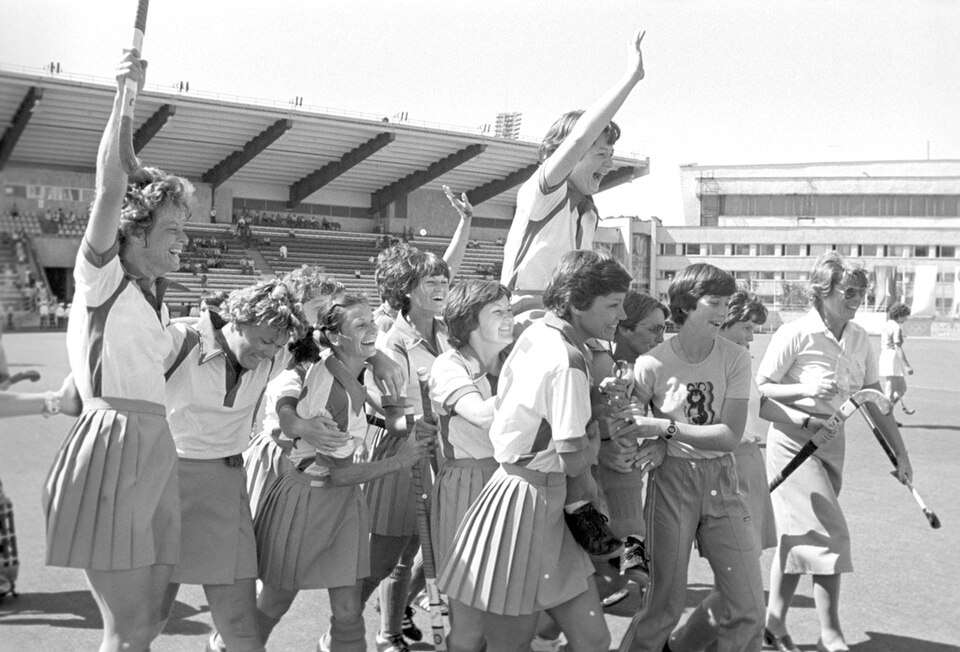
A new nation surprises at its first Olympics
by Alison Brown
This week on the podcast, author Tommy Phillips fills a big black hole in our Olympic knowledge when we discuss his book, The Moscow Olympics: A Day-by-Day History. What do you know about the boycotted Games of 1980? For us, it wasn’t a lot, so this book fills in the gaps.
One of the great stories that came out of those games involves the first gold medal for Zimbabwe in the unpredictable women’s field hockey tournament.
A new nation joins the Olympic Family
In 1980, Zimbabwe was making its first Olympics appearance under the country’s new name. Rhodesia had been banned from the Olympics after 1964 because of its white-minority rule and extreme racist policies. The Rhodesian civil war, called the Rhodesian Bush War or Zimbabwe War of Liberation, pitted the white-minority government against two opposing black-led rebel groups. Battles and skirmishes raged across the country and neighboring nations in Southern Africa from 1964 until 1979. The Lancaster House Agreement, signed in December 1979, paved the way for free elections and the formation of a new government. A new constitution with black majority rule was established on April 18, 1980, allowing the new nation to become part of the Olympic fold. The IOC quickly granted Zimbabwe provisional membership and invited the country to send a team to the Summer Olympics in Moscow.
But many nations stay home
At the same time, in March 1980, the United States announced that it would boycott the Olympic Games in Moscow, to protest the Soviet Union’s invasion of Afghanistan. Throughout the spring of 1980, 64 countries joined the boycott. What would this mean for Olympic competition?
The first women’s hockey tournament
Moscow 1980 would be the first time women would be playing field hockey at the Olympics. The tournament included six teams in a round-robin format. Teams were selected based on the results of the International Federation of Women’s Hockey Associations (IFWHA) 1979 World Cup. Set to compete: Soviet Union, Netherlands, West Germany, United States, Great Britain, and New Zealand.
One by one, these countries announced they would not be coming to the Moscow Olympics. Organizers turned to teams further down the results from the 1979 event: Australia, Argentina, Japan, Belgium, and Canada all boycotted as well. Organizers added Austria, 7th at the World Cup, Czechoslovakia (9th), and India (13th). Eastern bloc Poland agreed to send a team. With only three weeks until the opening of the Moscow Olympics, organizers invited Zimbabwe to send a women’s hockey team.
Will Zimbabwe have a team to send?
Zimbabwe had formed a women’s hockey team earlier in the summer to compete in South Africa in a small provincial tournament. When they got the call to come to Moscow, the team had little time to organize uniforms, passports (most people did not have passports from the new Zimbabwean government), travel arrangements, and time off, never mind train and practice. The 18 women on the team, all white, had full-time jobs outside of sports. They did not even get to fly to Moscow in a passenger plane; they flew on a cargo plan usually reserved for meat.
The women ranged in age from 18 to 35 and played for eight different clubs around Zimbabwe. None of the women had ever played on artificial turf. They had to buy brand new turf shoes after they arrived in Moscow. Player-Coach Anthea Stewart had little time or resources to research potential opponents, so the Zimbabwean women knew little about what they would face on the pitch. The team had only played together for a few weeks of practice and had no tournament experience. They would have to adapt on the fly and rely on their tenacity, determination, and athleticism.
Captain Ann Grant led the enthusiastic players, eager to introduce their new country to the wider world. They marched in the opening ceremony in their hastily gathered bright blue uniforms behind a new flag featuring the Zimbabwe Bird.
A fairytale for The Golden Girls
In their first game, Zimbabwe defeated Poland 4-0. They tied Czechoslovakia 2-2 then defeated the host Soviet Union 2-0. The Zimbabwean women were most worried about their next opponent, India, but managed a 1-1 tie. Going into their final match against Austria, they were the only undefeated team in the tournament. Under the rules of the round robin format, if they won the game, Zimbabwe would win the tournament.
At first, Austria proved a challenge. After the first half, the score sat at 1-1. In the second half, Zimbabwe broke the game open, scoring three more goals. Zimbabwe claimed its first Olympics gold medal.
Welcome home
When “The Golden Girls” returned to Zimbabwe, they were welcomed as heroes by the new nation, with huge crowds at the airport. Zimbabwe’s First Lady Sally Mugabe promised each player an ox. Thankfully, they received a package of meat instead at the official state reception. For a new country just months removed from civil war and still rocked by racial tension, this team brought Zimbabwe together.
It would be the only Olympic medal for Zimbabwe until now-IOC President Kirsty Coventry won a full set (gold, silver, and bronze) at the 2004 Summer Olympics in Athens.
What other stories do we discover from the Moscow 1980 Summer Olympics? Be sure to listen to this week’s podcast and find out!
Photo attribution: RIA Novosti archive, image #556180 / Vitaliy Saveliev / CC-BY-SA 3.0