
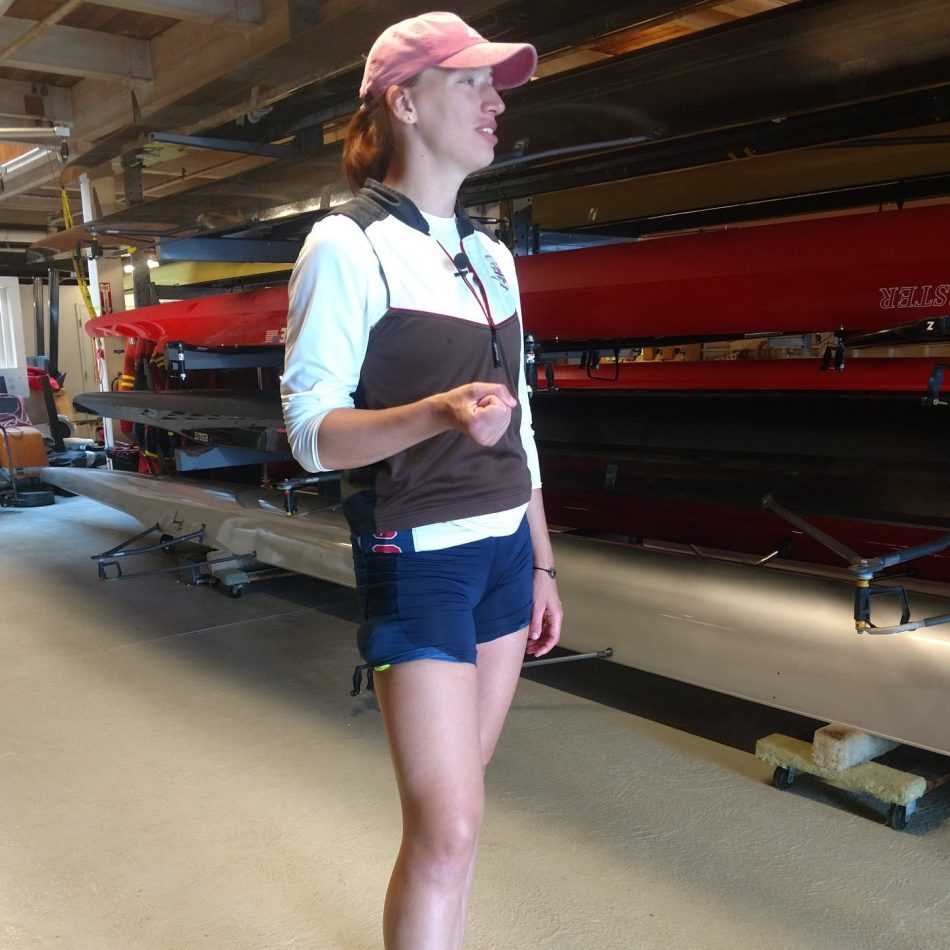
We’re on a boat! This week Jill and Alison head to Boston to get a rowing lesson from Rio 2016 Olympic gold medalist Tessa Gobbo. Tessa was part of the USA’s women’s 8 boat that beat out Great Britain for the gold, making it the third gold medal in a row for the US womens’ rowing team.
Learn when Tessa found out she was Olympic caliber, what training for the Games was like, how the water in Rio actually was and perhaps pick up some rowing tips.
We also learn just how difficult it is to row a boat, even if it is a tubby training boat.
Did you know that New Hampshire honored Tessa by declaring September 9 Tessa Gobbo Day? Listen to learn how to celebrate it!
DISCLAIMER: OLYMPIC® is a trademark of the United States Olympic & Paralympic Committee (“USOPC”). Any use of OLYMPIC® in the Olympic Fever podcast is strictly for informational and commentary purposes. The Olympic Fever podcast is not an official podcast of the USOPC. The Olympic Fever podcast is not a sponsor of the USOPC, nor is Olympic Fever associated with or endorsed by USOPC in any way. The content of Olympic Fever podcast does not reflect the opinions, standards, views, or policies of the USOPC, and the USOPC in no way warrants that content featured in Olympic Fever is accurate.
TRANSCRIPT
Note: This is an uncorrected machine-generated transcript and may contain errors. Please check its accuracy against the audio. Do not quote from the transcript; use the audio as the record of note.
47-Rowing with Olympic Gold Medalist Tessa Gobbo
USOPC Disclaimer
Jill Jaracz: [00:00:00] Just rolling with the gold medals. Thank you The greatest
Theme Music
Jill Jaracz: Hello, and welcome to another episode of Olympic Fever. I am your host, Jill Jaracz, joined as always by my lovely co-host, Alison Brown. Alison, hello, how are you today?
Alison Brown: I am still alive.
Jill Jaracz: That’s right. I didn’t drown. We didn’t drown.
Alison Brown: Nobody went in the drink.
Jill Jaracz: Nobody went in the drink, which is good because we don’t wanna go in the Charles River-at this time. Lovely as it is to look at, the Charles is not [00:01:00] a river to swim in. No. Sadly.
Rowing with Tessa Gobbo
But we did go rowing with Tessa Gobo. Tessa won a gold medal at the 2016 Rio Olympics in the eight woman rowing competition. Her run-up to the games took 10 years, starting in high school, and then she joined the crew team at Brown University, which, uh, earned an NCAA championship during her time there.
And then after college, she joined the national team and eventually made the crew that won the US’s third straight gold in the sport. [00:01:30] Recently, Tessa and her husband, Hank, took us out rowing. Take a listen to our expedition.
So we are erging first.
Tessa Gobbo: Yes.
Jill Jaracz: Yes.
Tessa Gobbo: Okay. This is the indoor rowing machine. It’ll tell you how fast you’re going and stuff like that. Okay. So I’m just gonna demonstrate really quick, and then you guys will take a turn getting on. This is the catch. This is the most unstable part [00:02:00] of rowing, but we’re gonna be out in boats that it’s gonna be really hard to flip, so don’t worry about it.
You want your sort of shins to be parallel, and then this is the drive. Okay? So this is- So
Jill Jaracz: you’re pushing with your feet, basically.
Tessa Gobbo: Yes. Okay. And this is when the blade’s in the water.
Jill Jaracz: Okay.
Tessa Gobbo: So then you sort of tap down. So sort of legs, body, arms- Okay … which, like, is the easiest way of doing it.
Jill Jaracz: Okay.
Tessa Gobbo: And then arms, body, legs.
Arms. And then this is the finish. [00:02:30]
Jill Jaracz: Arms, body, legs. All right. It’s a big cycle.
Tessa Gobbo: It’s a big cycle. Okay.
Jill Jaracz: We got- Don’t look at me. This was your idea. Who wants to go first? I’ll go first. You’re
Tessa Gobbo: going first.
Jill Jaracz: All right. This was your
Alison Brown: idea.
Jill Jaracz: Do you warm up on these things?
Tessa Gobbo: So we do a lot… Each country’s different- Okay
but we do a lot of training. I did a lot of training on this, and we’d spend about, I don’t know, a ver- a, a lot of ti- a lot of time. So you’ll warm up on this, and then you’ll [00:03:00] also just train on it. Okay. It’s like a fitness tool.
Jill Jaracz: I did the one in my gym a few weeks ago. Yeah. It had games. I’m like, “Oh, it’s got games on it.”
Yep.
Tessa Gobbo: You can play
Jill Jaracz: the fish game. The only way I was excited. Yeah, I did play the fish game. I sucked.
Tessa Gobbo: We did it. I, I’m not good at the fish game either.
Jill Jaracz: That makes me feel better.
Tessa Gobbo: Okay. So you wanna pull into your, sort of your bra band is what I tell people. Okay. And then your arms away, and then your body [00:03:30] over, and then…
Yep. That’s perfect
Alison Brown: So you were saying different countries do
Tessa Gobbo: different things. Different countries train different ways. The bike’s also really effective So yeah, just keep thinking legs, body, arms.
Alison Brown: So are you out on the water all year, like when the US team is training?
Tessa Gobbo: Each quadrennial’s a little different, so each four years, and I was only in there for four years.
But we would go to California for, I guess it was three [00:04:00] months. So we were able to go be on the water pretty much until December in New Jersey where we lived for most of the year, and then we’d go to San Diego for three months and train at the Olympic Training Center.
Jill Jaracz: Okay.
Tessa Gobbo: So that was really cool, too. I didn’t like it so much.
I kind of like being in one place, but some people really like it.
Alison Brown: Okay, so say it again.
Tessa Gobbo: Arms up. Yep. You wanna keep it sort of like at the same pace right here. Okay. And then you’re gonna push off with your legs while kind of keeping your body stiff. Yep.
Jill Jaracz: And then the arms are [00:04:30] last.
Tessa Gobbo: Yep. Right? So- And then arms
arms, body, legs. Legs, body, arms. So you, uh, got your arms in there a little early. Okay. So arms away. Yep. Now legs, body, arms. And the whole idea is that you’re sort of hanging your weight, right? So you’re just sort of like hanging off of the water and, like, leveraging the boat forward. So if you’re like physics people, your blades go in the water, and then your body moves but the blades don’t move.
So and you’re, like, [00:05:00] moving the boat forward. Good.
Alison Brown: Now, do your elbows go out or down?
Tessa Gobbo: Just keep them hanging straight.
Hank: As you draw in.
Tessa Gobbo: Yeah. Oh, yeah.
Hank: Kind of-
Alison Brown: So because it could be here or
Hank: here. Yeah. Yeah, chicken wing. Like, kind of there. Kind of there is fine.
Alison Brown: Okay.
Hank: Yeah. You don’t wanna be like- You don’t wanna be, like, tensing your shoulder, right?
But just kind of natural.
Tessa Gobbo: So-
Alison Brown: I can’t believe I’m thinking this hard.
Tessa Gobbo: Yeah. But it, it’ll like, it’s all about practice, like with anything. So it’s like you’re certainly not thinking about it as much [00:05:30] later on. Like, in theory I should be thinking about my technique all the time, but it’s a lot of thinking. So this is like you’re gonna get in a boat and do a very similar movement.
Okay. But you’re gonna have blades, so it’s just gonna feel completely different. You’re just gonna be like, “Oh, my God. One more thing to think about.” So that’s the very basic, basic erg indoor rowing situation. So this is how a lot of rowers… There’s, like, a couple different ways you [00:06:00] can get on the scene, for sure, and, like, sort of prove where you stand.
Jill Jaracz: Mm-hmm.
Tessa Gobbo: This is probably the easiest way to do it just in terms of, like, this is how powerful I am. Like, you can teach me how to row later and then, like, whether or not you can teach everybody to row is a different thing. You’re, it’s like becoming popular in CrossFit. I don’t know. Oh, yeah. I don’t really do CrossFit, but this machine shows up a lot, so, like, we’re getting rowing starting to get people that are very good at CrossFit and then, like- Oh, interesting
it’s like, [00:06:30] oh, so that’s how, like, this is how good I am. You can teach me how to row later. So for like all of high school and probably half of college, and I guess some people would say even after college, I couldn’t row very well. But I was very, like- Powerful … strong. So that’s definitely how I did it.
Other people, and especially, like, slightly smaller people- Mm-hmm … like, you’re not really gonna find many rowers that are under 5’10” at the Olympic level or national team level, will do smaller boats. So those are like the… [00:07:00] This is a tubby over here, but the thinner boats are, like, the racing shells.
Jill Jaracz: Right.
Tessa Gobbo: And they’ll race in those and sort of prove themselves through racing. I would argue when you start rowing, one of the most important things to do is keep your oars together- Okay … like this, and your hands on the oars. Yes, that’s the other thing. Sometimes-
Jill Jaracz: Oh, ’cause if they slip out, you can’t really grab them.
Tessa Gobbo: And also, like, sometimes your instinct when you tip is to, like, hold on to the [00:07:30] side of the boat-
Jill Jaracz: Okay …
Tessa Gobbo: and that’s not gonna help you.
Hank: So if you guys keep your hands on the oars, like, the oars aren’t gonna necessarily go anywhere. Okay. But if you, like, go, the boat’s gonna lose less stability.
Tessa Gobbo: Oh, okay. Right?
So. Okay. In theory, right, when you go up to the catch, you’re gonna come up here. Nope, that’s the finish. You’re gonna come up here, and then you’re gonna s- feather your blades. Okay. You’re gonna stick it in, you’re gonna drive, and then you’re gonna pull out your blade and lay it on the water like that.
Jill Jaracz: Okay. [00:08:00]
Tessa Gobbo: So you can
Jill Jaracz: take
Tessa Gobbo: off your shoes. I mean, you can even leave them on if you want.
Hank: So I would, I would just get your butt down low early and onto the seat-
Tessa Gobbo: Yeah. And it’s like you don’t really need. Okay, you’re not on the seat yet. So you’re gonna wanna pull yourself up. So put your hands back on the gunnels, which I know is the opposite of what I told you.
Jill Jaracz: This?
Tessa Gobbo: Yep. [00:08:30] Oh, sorry, yep, that’s the gunnels.
Jill Jaracz: Oh, I see. And
Tessa Gobbo: now you’re on the seat.
Jill Jaracz: Oh, wait, I’m up, man.
Tessa Gobbo: Yep.
Jill Jaracz: I feel like I, I…
That’s it. Wow, it’s like I feel like I’m on a little throne.
Tessa Gobbo: The other thing is you wanna put your hands all the way into the cart.
Jill Jaracz: Okay.
Tessa Gobbo: And then push against… Yep. Okay. So you’re in it.
Jill Jaracz: I’m in a boat.
Tessa Gobbo: You’re in a boat. I’ll walk you down. So now put your hands up. Great. So that’s what’s gonna feel the most stable.
Okay. So you’re gonna want to just sort of sit on the top of the- Okay … thwart
Jill Jaracz: [00:09:00] right
Tessa Gobbo: here.
Jill Jaracz: Okay.
Tessa Gobbo: And then if you wanna go ahead and take a stroke. So you gotta… Yep. Hey. Yep.
Hank: Good. Yep, you’re good. We’ve
Tessa Gobbo: never got legs back on. This is tippy.
Hank: I’m gonna pull you back in.
Tessa Gobbo: Okay. You guys did a super crash course.
Hank: Yeah.
Tessa Gobbo: Like, this would usually take, to get to this point-
Hank: This would take, like, [00:09:30] four or five with our novices We did it in, like, 40 seconds. Yeah.
Tessa Gobbo: Yeah, we did it, so, like, yeah, this is… You’re on a super fast learning curve.
Jill Jaracz: It’s a little freaky.
Tessa Gobbo: Okay, so move your hands back up a little bit, and try and just think about being on the earth, right?
So you come up to the catch, and then you put your blades in, so you gotta feather ’em. Yep, or square ’em up. And then, yep. Good.
Hank: Think about trying [00:10:00] to press from your legs for as long as you can with your arms straight. Okay? So grab your legs and keep your arms straight out.
Alison Brown: No, I was just try- I was watching the oars.
So the, the oars don’t have a turn, that’s your hands turning them.
Tessa Gobbo: Yes. You turn them with your hands, and you can sort of feel them click into place usually. But in all honesty, you might be thinking about so much that you don’t feel it right away. If you wanted to, you could just leave them straight up, but I feel [00:10:30] like when I first, like, was learning, the stablest place was feeling like your oars are on
Hank: the
Jill Jaracz: water.
Tessa Gobbo: Sorry. That’s okay. Okay. Ready to go again?
Jill Jaracz: Yeah.
Tessa Gobbo: Okay, cool.
Jill Jaracz: I feel really short.
Tessa Gobbo: Try and keep your hands on the blue part at all times.
Jill Jaracz: All times. Press,
Hank: press the
Tessa Gobbo: oars in. So, like, yeah.
Jill Jaracz: Okay. Good.
Tessa Gobbo: Oh, okay.
Jill Jaracz: I’m gonna turn you-
Tessa Gobbo: So it’s
Jill Jaracz: oars out …
Tessa Gobbo: just a little bit.
Jill Jaracz: Okay.
Tessa Gobbo: Okay. Be free. Be free. Like a bird. There you go.
Jill Jaracz: [00:11:00] Getting there. You know, it’s hard to keep them, like, even.
Tessa Gobbo: I mean-
Jill Jaracz: Although I’m- Or we
Tessa Gobbo: don’t … No. You don’t wanna go for- Ah. That’s true, we do have sound. ‘Cause
Jill Jaracz: you have to keep the- Yeah … oars, like- Who’s stout rowed it? … shoved into the side- Yeah … of the, the oar handles. Yeah, it’s the
Tessa Gobbo: sound. That’s what I wanna know.
We’ll call, we’ll call it the sound.
Jill Jaracz: Is it easier on an eight when you only have one oar to deal with?
Tessa Gobbo: I, that’s how I learned, but I think many people would say that learning like [00:11:30] this-
Jill Jaracz: This is easier? … is better. Oh, okay.
Tessa Gobbo: The thing about this is that you are doing everything.
Jill Jaracz: Yeah.
Tessa Gobbo: So all of the movements and, like, adjustments that you make- Mm-hmm
are gonna be immediate.
Jill Jaracz: Mm-hmm.
Tessa Gobbo: And you can tell.
Jill Jaracz: Oh, okay.
Tessa Gobbo: The thing with an eight is that you could be doing anything-
Jill Jaracz: Yeah …
Tessa Gobbo: really, and it would get a little hidden.
Jill Jaracz: Okay.
Tessa Gobbo: You’re, like, getting some speed with it.
Jill Jaracz: Keeping everything coordinated seems really hard. And I do feel like I need to be about six inches taller.
You guys- I do. I feel like I need to be about [00:12:00] six inches taller to, to like, get a good leg press. Yeah.
Tessa Gobbo: Okay, so
Alison Brown: how do you decide if you’re a right or a left oar?
Tessa Gobbo: Like, somebody hands you an oar, and then that’s your side. Oh,
Jill Jaracz: there’s, there’s no-
Tessa Gobbo: Yeah …
Jill Jaracz: science behind it?
Tessa Gobbo: I got handed an oar.
Jill Jaracz: Yeah.
Tessa Gobbo: I think in high school, I started rowing when I was 15.
In high school, I was a port. And then, um, I could do both [00:12:30] sides. And in college I could a little bit, too, but by the time college was over I was really only on starboard side. I think it’s really interesting how your body develops, too. You, like, very much end up on one side. And, like, I would have, like, a, a five-pack as I was, like, rowing because I was just used to going like this.
Jill Jaracz: So the whole boat is mic’d up? Yeah. Anything here?
Tessa Gobbo: And sometimes they’ll be, like, under the seats.
Jill Jaracz: Okay.
Tessa Gobbo: But that one’s just, like, out and about.
Jill Jaracz: What seat were you? You were four or five?
Tessa Gobbo: I [00:13:00] was five.
Jill Jaracz: You were five.
Tessa Gobbo: Which is … It was quite nice. What seat- I liked, I liked where I was. I mean, at the end of the day, like, you’re in a boat and it’s great.
Jill Jaracz: Yeah.
Tessa Gobbo: You just wanna be there. But then there are certain parts of the boat where people feel more comfortable. The further back you go- Mm-hmm … the more likely you are to get splashed.
Jill Jaracz: Okay.
Tessa Gobbo: Um, which is not my favorite thing. And then seven seat I rowed in France the year before, which turned out fine.
Jill Jaracz: Mm-hmm.
Tessa Gobbo: But I was just like, I felt like I [00:13:30] had the pressure to really be longer and translate my stroke seat to who was behind me.
Jill Jaracz: Okay.
Tessa Gobbo: And she was an incredible rower from Princeton. She … Actually, also from New Hampshire, and she just, like, was 6’3″ and had, like, the perfect length.
Jill Jaracz: Uh-huh.
Tessa Gobbo: So I was like, “Okay, I gotta keep that length in seven seat or in five seat and three seat, where I’ve also been a lot.
I’m just like, “Let’s, let’s keep this moving. Let’s keep this power on it.” And then I was never really in bow.
Jill Jaracz: And those are one and two, three and-
Tessa Gobbo: Those are one and two. [00:14:00] Um, three seat I was in a lot. Five seat I was in a lot. One and two, I feel like- I mean, everybody needs to know how to row. I think it’s a little more important that you’re, like, very stable and a really good technical rower in one and two.
Yeah. And that was never the name of my game, you know? It was just sort of like, “Let’s do it.”
Jill Jaracz: What, what was- Oh, yeah.
Tessa Gobbo: No, yeah, that was another very… Okay, so here’s the thing about the Americans, I think, and Hank said this once when I was talking with him and I was, like, really down about my technique. [00:14:30] And he’s like, “Nobody really looks at the American boat and are like, ‘Wow, they, like, just look so beautiful.
They row so pretty. Like, I just wanna be in that boat and it’s gonna feel good.'” You, like, look at that boat and you’re like, “That’s a very strong set of women, and they’re gonna play to their strengths,” which is strength and not so much, like, really good rowing. Like, we’re good, but- We can
Jill Jaracz: power
Tessa Gobbo: through … so who’s the pretty boat?
I, I would say New Zealand. Do you think Great Britain?
Hank: Great Britain. Oh, yeah, [00:15:00] when they got their… After their silver, silver medal, like, all the boats, like, came into the medal ceremony and then had to row back out. And their boat gets back in the boat and
Tessa Gobbo: it’s just, like, flopping around.
Hank: We were tired. You were
Tessa Gobbo: all- Everybody was tired, yeah.
Hank: And the Great, the British eight, they all are, like, waving to the fans and stuff as they’re rowing perfectly balanced with, like, one arm.
Jill Jaracz: Wow.
Tessa Gobbo: Yeah, that’s
Jill Jaracz: not- I mean, maybe if they were all wiped out, they wouldn’t have gotten [00:15:30] silver.
Tessa Gobbo: They, I’m sure they were tired. They also came out of nowhere, right? Oh, yeah.
Like, at the end of the four-year cycle we were all, everybody was, like, not worried about them and then we got to the year of, like, the, the summer of and we’re like, “What happened?” You know? Like, we were supposed to win gold, but the two crews that came in second and third- Mm-hmm … like, they were not favorited.
But yeah, they, Great Britain was very, very good. Yeah. New Zealand also. New, I think New Zealand rows very well, and they [00:16:00] row in small boats a lot.
Alison Brown: So the early morning is the, is the thing.
Tessa Gobbo: I mean, yes. Or all the
Alison Brown: way.
Tessa Gobbo: For m- it’s early morning or the evening, right? Like, I definitely adjusted to rowing in the mornings after college, but my college team mainly rowed in the afternoon.
But most places, you’re rowing in the morning ’cause the water’s best, and also ’cause of classes and stuff. But when we were training, we’d get up, we’d row. I’m a huge sleeper, so I would go nap for, like, two hours and I’d rush home to, like, get to my nap. [00:16:30] And then we’d go and row again and then maybe lift.
So it was definitely a two-a-day. I’ve heard some countries will do the majority of their rowing in the morning and then bike in the afternoon. But in all honesty, I don’t wanna, like, say I was very self-centered, but I, like, was putting all of my energy towards figuring out what I could do and I wasn’t really worried about, like- What other things were happening and, like, what other countries were doing because [00:17:00] ultimately it is, there’s, like, no defense in rowing.
So it’s like even if I know what they’re doing, you just gotta sort of trust what my coach had us doing, and he’s r- he was an incredible coach. Still is.
Hank: Maybe say you have to trust the process.
Tessa Gobbo: You did it.
Alison Brown: Yay.
Hank: All right.
Alison Brown: Okay, so you said I have to use my socks?
Tessa Gobbo: No, you can do whatever you want.
Alison Brown: Okay, good.
Tessa Gobbo: As you get in, like, fancier boats, they’re gonna have shoes in them.
So just because everybody’s feet have been in them, you’re gonna wanna [00:17:30] wear socks. But this, this guy’s fine.
Alison Brown: Okay.
Tessa Gobbo: So- So is it
Alison Brown: easier to put your feet in first-
Tessa Gobbo: Yeah … or your butt? I would step here.
Alison Brown: Okay.
Tessa Gobbo: And then sit down, yeah. And a lot of it depends on how, like, flexible you are too.
Alison Brown: Flexible I can do.
Tessa Gobbo: You were very, you did that very nimbly.
Alison Brown: Okay. I’m gonna-
Tessa Gobbo: You don’t really have to, but you can do that. Ooh. Which I did. Am
Alison Brown: I on?
Tessa Gobbo: You’re on. Okay. Okay. So I’m gonna push you [00:18:00] out, and you’re gonna do your thing.
Alison Brown: I love how, yeah, you’re gonna do your thing, like I know my thing.
Tessa Gobbo: And then you put your blades in. You got one in.
Alison Brown: My blade went in the what?
See, I’m left-handed, so I’m confused.
Hank: So press, press the left your-
Tessa Gobbo: Press outward …
Hank: yeah. So you see … Hold on. Really quick, you see how the, uh, the collar on the oar isn’t pressed against that gate yet? You want both of those to be pressed against the gate. Okay. There you go. And now-
Alison Brown: I’m thinking too much.
Tessa Gobbo: Yep.
Hank: Yeah. Yeah, just [00:18:30] relax.
Alison Brown: Okay.
Tessa Gobbo: Now put those blades in, so- Like that? Yep, and push with your legs.
Hank: There you go.
Alison Brown: That feels, yeah, you’re going. Like, I’m, like, moving.
Tessa Gobbo: You are.
Alison Brown: I don’t know which hand’s on top.
Tessa Gobbo: Oh, that’s a good point. Left or right?
Alison Brown: Hey, looking good
Tessa Gobbo: So the other thing to think about is, and this is like a little [00:19:00] advanced, but you’ve got your Oiz pretty high up. So what you wanna do is like, you put your, you put your Oiz in, right? You think like you’re 16 and you have a beer in your hands, and you slide it across the table, and then you just put it just under the table ’cause your parents came in the room.
You don’t wanna like wave it around ’cause then they’ll know you did something wrong. So you just slide it, tap it down, and put it under
Jill Jaracz: Good rowing tip.
Tessa Gobbo: The key to good rowing The key to good rowing is- [00:19:30] My high school, my high school coach taught me that.
Alison Brown: Kayak.
Hank: Kayak- Yeah … a
Alison Brown: good amount, so I’m like, I’m thinking kayak rowing.
Yeah.
Hank: A bit, yeah. It’s very d- Kayak
Alison Brown: oaring, which is obviously extremely different.
Hank: You’re facing out the opposite
Alison Brown: way. That’s really bothering me- Yeah … that I’m moving backwards. We were talking about this last night. Okay, so I need to think more. And I feel, I agree with you, Jill. I feel really short. Like I don’t- Yeah
I feel like I fit- Yeah … in the boat.
Hank: So right now, stick your arms out, like [00:20:00] straight out in front of you. Okay?
Alison Brown: Okay. Okay.
Hank: And you can, don’t even, don’t be afraid to even let the hands come out like that. You’re going, like, around a pin, right? Both oars are going around a pin, so it’s an arc, not like a straight line.
Jill Jaracz: Okay.
Hank: So don’t be afraid to have the hands come out, hands like that. It’s gonna lengthen you out a lot.
Tessa Gobbo: And you wanna push against, push out. There it is.
Jill Jaracz: There
Tessa Gobbo: you go. I think a lot with this stuff. Like, I’m always thinking it. That was the opposite [00:20:30] of my problem. I never thought at all.
Jill Jaracz: You just did?
Tessa Gobbo: I just did, which is, like, not really great when you’re trying to teach somebody how to row
Oh, I knew from the erg. So when I was in high school and they put me on, and they had, like, the distance that you do for the most part when you r- like, when you race, you do 2Ks in the s- in the spring season and at the Olympics. In the fall, there’s longer distances. And so they put you on, and they’re like, [00:21:00] “Do a 2K,” and then they can tell from that score w- where you stand compared to other people in the country.
So I got on, did a good, got a good score, like, went pretty fast my freshman year, and my high school coach called up my mom and was like, “We might have something here, but we’re gonna try and prevent Tessa from knowing that for as long as possible.”
Jill Jaracz: Oh, wow. So- So you had no clue?
Tessa Gobbo: I mean, I knew that I was better than the other people I rowed with, but [00:21:30] they did a great job of, like, keeping me kind of humble.
I was, in high school I was a very sore loser, so I had to, like, figure out that aspect and just, like, grow up a fair bit. And then, like, by the time I finished high school, I was pretty clearly gonna row in college, and probably, probably one of the top recruits of my year.
Jill Jaracz: Okay. So. Did you get a scholarship?
Tessa Gobbo: It depends where you go. So the Ivy Leagues don’t do scholarships. Okay. And I think if I had, like, really… I wouldn’t [00:22:00] change anything I’ve done, but when I think about how much college costs now, working at one, I was like, “How did I not…” Like, I could have gone someplace and gotten a scholarship, but instead I was like, “I wanna be close to home.
I wanna win the NCAAs,” and Brown had the best record, so. And it was, like, two and a half hours from where I grew up and, so. But yeah.
Jill Jaracz: And you won the NCAAs?
Tessa Gobbo: Yes. My sophomore year we won the team trophy and I was so [00:22:30] excited. Yeah. That was also … I had a … There’s a woman who rowed. She’s, uh, a bit older than me and we overlapped with training some.
I’m not sure if we ever actually raced in the same boat. And she went to Princeton and she was like, one of the most important things to me was when she won the NCAAs at Princeton. And I was like, that’s silly. You have a gold medal. And then looking back at it, when I think of some of my best rowing memories, it was in college at the NCAAs.
Oh, yeah. And I think it’s like, because you have that set four years, it’s [00:23:00] very team oriented. Whereas when you get to the national team level, it’s still team oriented and you want the best for your country, but y- it’s a lot more competitive- Okay … in terms of trying to get in that boat. So you
Jill Jaracz: like- when you get to the national level, do they just
Are they pulling eight people and trying to figure out how they work together? Are you all working together at the same time?
Tessa Gobbo: Um, we definitely are all training and working out together at the same time. With our system. Each country is different and as like the years go on, it’s different. But for the most [00:23:30] part, most countries everybody lives together and trains together all the time.
So there was like about 30 of us. Okay. And then the traveling team would get picked out of that 30 group. And then you’d go to California longer maybe if you were doing well, and we’d have like 25 people in California. And even that’s changed since I was there. And so they would pick out of that group.
So it’s hard because you’re training together all the time and you know how much work everybody’s putting in every single day. [00:24:00] And then they’ll pick out of that group. Okay. So you’re competing to get picked into the travel team group. And then suddenly a month before a race, or even two weeks before a race, you’re like, “Okay, we’re a team now.”
So you kind of always have to be a team, but you also have to get onto that travel team. Okay. So.
Theme Music: Good. That was good.
Tessa Gobbo: I think it d- it depends who you have there, right? So I think the four years that I was there, it was a pretty chill group that really [00:24:30] all, all wanted the best for the country. I think depending on what personality types you have, that can change.
Jill Jaracz: When you’re in a boat, what, can you feel a difference with your team depending on who’s in, who’s in there? Um, I could in a- Like that team magic or whatever.
Tessa Gobbo: Yeah, yeah. I could in a four and a pair. I think in an eight you can just tell if it’s strong or not. Um, you can definitely hide stuff in an eight.
Which is why when you talk about rowing pretty, it’s like great that GB could be that pretty. Mm. But at [00:25:00] the end of the day, it, you gotta be really strong in an eight. A pair is the toughest boat. I like, I still think … Like, I love Hank. I’m so happy we’re married. I’m like, all about my life partner. But when I think about one of my most functioning relationships, it was with my pair partner for two years, Tracy, who’s still rowing and incredible.
But I was like, we were, like, we had to work through some stuff. Yeah. So-
Hank: Now try taking some strokes, and then when you finish off a stroke, rotate the top of [00:25:30] the handle to you and the bottom away
Okay, good.
Tessa Gobbo: That’s the other part of it. Your, your wrists feel like they’re in a very weird position. Oh. You’re tethering. Oh, yeah,
Jill Jaracz: I keep
Alison Brown: doing it ’cause I forget It’s okay. So remember,
Hank: the top of the… So you’re gonna rotate. When you’re coming at the square, rotate the top of
Alison Brown: the
Hank: blade in. So there. There. And there.[00:26:00]
Yeah,
Jill Jaracz: you’re fine. You’re fine. And now square it up.
Hank: The only thing about getting the blades squared before you cut the wood
Jill Jaracz: When your coxswain is, like when they, when they say to take the stroke up, how do you know how to … Well, I guess erg machine, you learn how to-
Tessa Gobbo: Yeah, you definitely learn- Learn the stroke rate. Yeah, you learn to, um, hit the stroke [00:26:30] rate. When it, when we’re racing- Mm-hmm … it, it’s just like you go when you hit it.
Okay. And you, like, do your start sequence and everybody’s, like, every crew is different. Mm-hmm. Like quarter slide, quarter slide, half slide, so that’s, like, a little bit advanced. And then that’s all about getting the rate up. Okay. And then you kind of hit your stride. Uh, the stroke rate comes with power- Okay
for sure, which is why, interesting when you watch lightweight, lightweight rowing. Because they’re all the same size and the power then is, like, about the same, [00:27:00] it’s like almost who can get the stroke rate higher. Who can get more strokes in? But yeah, so when I think about getting the stroke rate up, I’m like, “I gotta get more pressure on my legs, and then I gotta get around faster.”
Jill Jaracz: Okay.
Tessa Gobbo: But the greatest thing about eights is that you just do what’s the person in front of you is doing.
Jill Jaracz: Okay.
Tessa Gobbo: And because I was never in stroke seat, I like, even, like, sitting on the line at Rio, I was like, “Just do what Moose does.” Like- The woman … the woman in front of me. Yeah. I’m like, [00:27:30] “If you do what she does, you’ll be fine.”
Whereas we all would get a stroke rate up together at the same time, I’m just, like, doing what she does. Okay. So I don’t know how Amanda, who’s actually the youngest in the boat, she’s probably three months younger than I was and still is. She was our stroke seat, and she just, like, just went and did it, and, like, vomited at the end, you know?
Wow. She was, she was really quite a good rower, and still is. I’m talking in the past tense ’cause I’m not rowing anymore, but, [00:28:00] like, a lot of these people are still rowing.
Jill Jaracz: What made you decide to
Tessa Gobbo: stop? A lot of stuff. I think I was pretty … I miss it. I miss it more now being two years out, but I was pretty burnt out by the end, I think.
I wanted to move to Boston and live with Hank and get married. I was also really worried about the transition out of rowing, um, and I kind of wanted to do that when I was younger rather than when I was a little bit older. [00:28:30] I think physically my body could’ve done another four years. I think mentally I was really, I was pretty done.
Jill Jaracz: How long were training days?
Tessa Gobbo: We would be training about three hours in the morning total, like from like get there to leave. Yeah. Maybe three and a half. Um, and then I’d go home, I’d eat really quick, and I’d sleep for two hours. I think of all of my teammates I, I slept the most, which I just think is like an interesting thing.
And then I’d wake up [00:29:00] and we’d go back and we’d probably train for another two hours, and then you’d lift on at the end. Okay. So that was kind of how it worked. That was kind of how training worked for us. There would be a couple days of the week where they’d smush it kind of to be all, to sort of be done by noon or 1:00.
So and then Sundays some- sometimes we’d have off, sometimes we’d do like long steady state. So that’s meant to be like kind of chill, get some volume in. Um, so that was sort of how my training, training worked when I was there. [00:29:30]
Alison Brown: I didn’t die. You
Jill Jaracz: didn’t die.
Tessa Gobbo: We made
Jill Jaracz: it. And you didn’t
Alison Brown: fall in. I didn’t fall in.
You made it. I was thinking really hard though. It’s, it’s tough. It’s a
Jill Jaracz: lot to coordinate.
Alison Brown: It is. And they always make it look so simple. Like it’s such a- I know … it’s not a natural movement at all.
Tessa Gobbo: There’s a lot of hours behind that. Yeah. There’s
Alison Brown: just … It, it looks so natural, like you would think there would be more flow to
Jill Jaracz: it.
No, but that whole like think of the cycle of your [00:30:00] body has to make and then switch your hands or flip your wrists so that- I- … the oars are, you know, you gotta coordinate that oar.
Alison Brown: I was having a lot of trouble which hand went on top.
Tessa Gobbo: That makes sense.
Jill Jaracz: Yeah. It’s all- That was
Alison Brown: hard …
Tessa Gobbo: again, if you guys, even if you were to do this two more times, stuff like that, you’d be like, “Okay, I’m not gonna think so much about that anymore.
It’s just gonna happen.” We did this all very
Alison Brown: quickly. We believe in crash courses.
Tessa Gobbo: Yeah. This was all very quick. Should we grab a double?
Hank: We can grab a double. We can put you in bow in one [00:30:30] of them, and Stern.
Tessa Gobbo: Yeah.
Hank: Okay. All right.
Tessa Gobbo: I love these boats. indestructible. So this is-
Jill Jaracz: Not a tubby, I can
Tessa Gobbo: tell you that This is, yeah, this is not a tubby.
Jill Jaracz: Oh, and there are shoes in there for you.
Tessa Gobbo: Yep, these are, yeah, your, this is, I don’t wanna say a real boat, ’cause, like, all the boats are real- … but, like-
Jill Jaracz: This is a more real boat.
Tessa Gobbo: Yeah, y- you-
Jill Jaracz: I, I mean, w- do they glue those down, or do they just leave them in so that people- [00:31:00]
Tessa Gobbo: Oh, yeah, you should, like, get in there and look around.
Nothing’s really glued. All of it is sort of done through nuts and bolts. You can move them forward or backward depending on how tall or short you are.
Jill Jaracz: Okay.
Tessa Gobbo: You can move them up and down.
Jill Jaracz: Oh, I see, okay. Sure.
Tessa Gobbo: I think some coaches are, like, tinkerers, you know? Okay. Yeah, yeah. There’s a lot you can tinker with here.
There’s really definitely-
Jill Jaracz: I see, so the, the shoes are kind of planted in the boat.
Tessa Gobbo: Yeah, and they’re kind of grody, um, which is why you- Why you want socks … why you [00:31:30] want
Jill Jaracz: socks, yeah.
Tessa Gobbo: If I were, had the brain capacity, one of the things that I should have spent more time thinking about would’ve been rigging and sort of all that goes on here.
Jill Jaracz: What are rowing shoes like? Or do you even tell ’cause they’re always
Tessa Gobbo: just- There’s not, like- … in the boat … it’s not like how you, how your sneakers have cushions in them. Yeah. It’s not like that, for sure. It’s very much a, the more cushioning you have, the more it can absorb stuff.
Jill Jaracz: Uh-huh.
Tessa Gobbo: They’re always, like, you’re always gonna be able [00:32:00] to get out of them easily-
Jill Jaracz: Okay
Tessa Gobbo: in case you do flip. That’s what this is for. You just pull right up. You also have these things called heel ties in the back, and a lot of rowers undo them while they’re rowing. I never really worried about it. So they could get a more, bigger range of motion. But then, um, when you’re racing, they always check y- your heel ties- Okay
’cause it’s, like, a safety thing.
Jill Jaracz: Oh, okay. Okay, I’m gonna get in first. Okay.
Tessa Gobbo: So you wanna have them kind of flat. All [00:32:30]
Jill Jaracz: right. This is now scary. Wait. Okay, butt, seat.
Tessa Gobbo: Okay, so you don’t wanna step in the bottom of the
Jill Jaracz: boat. Okay.
Tessa Gobbo: I should have told you that
Jill Jaracz: sooner. Okay. Why not? ‘Cause that more tippy?
Tessa Gobbo: Because your foot can go right through.
Jill Jaracz: Your foot… Oh, ’cause this is really thin?
Tessa Gobbo: Yeah. So the stablest part of the shell is sort of like-
Jill Jaracz: This middle-
Tessa Gobbo: Yeah … plastic thingy. It’s got, it’s almost got like a skeleton to it, like-
Jill Jaracz: Okay …
Tessa Gobbo: a human, I guess. Okay. [00:33:00]
Jill Jaracz: That’s good to know. So we’re-
Tessa Gobbo: I should have told you sooner.
Jill Jaracz: I’m sorry. That’s okay.
Tessa Gobbo: Luckily, you’re a relatively light and gentle moving person.
Okay. So I’m gonna… Are you strapped in, or- No, my shoes are on. Strapped enough? Yeah, mine are undone too.
Jill Jaracz: I feel how short I am in these shoes, ’cause my feet will come right out of
Tessa Gobbo: them. This is, I think this is a men’s boat. Oh, okay. Uh, if that makes you feel any better, and they also just, the shoes will run larger bec- Okay, go ahead and try and take another stroke.
Okay. [00:33:30] This is good.
Jill Jaracz: Oh, I need to lean way back further on this thing.
Tessa Gobbo: I tend to lean pretty far back, and that’s way too far back. Ugh. You don’t have to lean that far back.
Jill Jaracz: I feel like I can’t get the boat, I can’t get the oars out like
Tessa Gobbo: that. Oh, you’re feeling like they get a little stuck? Okay. Well- Think about that beer on the
Jill Jaracz: table.
Okay. But I, I get about here, and I feel like I gotta go back [00:34:00] further to get- Yeah. Okay.
I want to go, Mama.
Tessa Gobbo: Hang on for a sec. I’m gonna steer us just a little bit[00:34:30]
Elena, stop. The other thing I want you to think about, if you can look at my oar for a sec, is your oars are going pretty deep under the water. Uh-huh. You only need it to go, like, here.
Jill Jaracz: Oh, okay.
Tessa Gobbo: That’s it Okay. Be free[00:35:00]
Okay. It’s gonna feel, the water’s gonna feel a little bumpy
Get better[00:35:30]
Yeah. It’s weird ’cause you’re pushing out and you feel like all of your movement should be forward
Sam z tyłu
Again, you, you guys have done probably a month of progression in one day
Jill Jaracz: Wow.
Tessa Gobbo: In like an hour Okay. I’m gonna have you wind up. [00:36:00] Sorry, wind up means stop.
Jill Jaracz: Are there different types of oars for different-
Tessa Gobbo: There are definitely different types of oars. Most people are using a Crocker or Concept2, which is the brand.
There’s a Tulip, which is sort of a circular blade, but I don’t see those used
Jill Jaracz: that
Tessa Gobbo: much. Okay. Okay. I’m gonna turn us around a little bit. You’re a quick learner.
Jill Jaracz: Oh, thank you.
Tessa Gobbo: I’m just letting you know. It’s- You’re a natural, Jill … it’s [00:36:30] making this experience
Jill Jaracz: easier. You know what it is? It’s my gold
Tessa Gobbo: medal butt.
Okay. Good job, Jill.
Jill Jaracz: Thank you.
Tessa Gobbo: I always, I’m a notoriously slow talker just ’cause, like, boats are so expensive. How expensive are they? Hank would know better than I. This is a decent boat. Uh-huh. I mean, maybe 20,000. Holy cow. Maybe 10,000. Somewhere between 10 and 20 for this guy, I bet. Wow. I think a [00:37:00] single’s probably about 8,000, but I also could be completely off mark.
Okay. Hank, how much does a double cost?
Hank: Like, a
Tessa Gobbo: high-end double? Yeah.
Hank: Uh, like,
Jill Jaracz: 20,000, 25.
Hank: Okay.
Tessa Gobbo: Wow. That’s what I was thinking. 20, 25. What about an eight?
Jill Jaracz: $60,000
Tessa Gobbo: for a boat. I gotta make more money. Well, that’s the thing. No rower’s really making that much money.
Jill Jaracz: [00:37:30] Yeah,
Tessa Gobbo: right. What kind of
Jill Jaracz: stipend did you get? Did you get stipends from both US Rowing and the USOC or how does it work?
Tessa Gobbo: Pretty much only US Rowing. The USOC definitely if you win, they get you some, some change.
Yeah. You could start to make a living once you’re in an eight, for sure.
Jill Jaracz: Okay.
Tessa Gobbo: I mean, once you’re, like, in the Olympic boat. Okay. You can get out if you want. And then, but, like, when you first start rowing, it, when you first [00:38:00] start rowing, it’s, like, exciting when you get healthcare, you know, from the team. Oh, gosh.
So that’s kind of how it works, and it also changes throughout the years, right, on how you’re doing, which also makes it a little trickier. But yeah, it’s definitely, it’s doable once you’ve established yourself and if you’re doing well on the team. And the other part is they’re definitely, they’re doing the best they can.
Right. So it’s hard to, like… I never really got a, like I knew nobody’s in [00:38:30] it for the money.
Jill Jaracz: Right.
Tessa Gobbo: We would row in Princeton, New Jersey, and there’s a lot of great families there.
Jill Jaracz: Mm-hmm.
Tessa Gobbo: So I lived with a family while I was there for three years. So that’s, when you first start out, they get you housing, and by the time I was done, if I wanted an apartment, I could do it.
But, like, after three years, I was a part of that family, and they were, like, very much my support system, so. And they’re, it, it was just very lucky. So, like, Hank went and worked with the men’s team for a [00:39:00] little bit and volunteered, and then he, like, lived with that family. Oh, wow. And now Hank’s back in the basement.
You
Jill Jaracz: did so good.
Tessa Gobbo: Thank you. That was fun. I-
Jill Jaracz: You got some speed.
Tessa Gobbo: Yeah. You definitely were. You picked it up very fast. Like, you have to, like, you have to understand, this, getting to what we just did- Yeah … like, that progression, if we had the time and we were like, “You were in this for the long haul, like, I am gonna become a lifetime rower,” we would’ve taken much [00:39:30] longer to get to that point.
Oh, wow. So. No, you looked-
Jill Jaracz: Watch and learn … like you knew what you were doing. That was awesome. Thank you.
Tessa Gobbo: Like, I think my mom started rowing when I guess she was 60. And she was in this tubby just for, like, two years. Oh, wow. So it was just, like, kind of… She-
Alison Brown: Did she start rowing because you were
Tessa Gobbo: rowing? I think so.
I think she definitely got introduced to it that way. I have a twin brother who also rowed, um, at Bates. So we were both rowing, and she was at a lot of races. Okay. All right. Thanks, Coach Hank. Thank you, coach. Just let go.
Hank: [00:40:00] Yeah, people who like to work hard and kind of like to-
Tessa Gobbo: You have to be okay with the monotony of it, I think.
Hank: Yeah. Yeah. I- And not, you can’t be ob- obsessed with, like, individual stats-
Tessa Gobbo: No … as
Hank: much.
Tessa Gobbo: I think the hardest part- Yeah … not that, it’s not an inherently fun sport. Like, a lot of the fun comes from winning, and a lot of that, w- I was explaining this to somebody that I play roller derby with, that, like, it sounds horrible, but the fun also is, like, knowing that you’re ahead and you can [00:40:30] see that you’re ahead.
Where in, like, running, you can’t always tell. Like, you know you’re winning, you know you’re doing okay, but you don’t see the people behind you. Okay. So that’s kind of fun. It’s fun, yeah. And it’s, it’s nice. If you like the outdoors and you like the water, I think anybody can row, for sure.
Jill Jaracz: I think some people- So when you guys were far enough ahead at…
Okay, so I was w- I was watching your Rio race last night, and you were behind. We were- But that was probably game plan … we were behind for a lot. Was that game plan?
Tessa Gobbo: There was no game plan. The, the game, the [00:41:00] game plan is pretty much, like, get in front and stay in front. So I, people, I think all athletes do some, some amount of self-talk.
I think that people ask me, like, “Do you just, do you just, like, go black when you’re racing?” And I think some people do, but others, like, do self-talk. And I think my way of dealing with situations like that when we’re not winning and we’re favorited is just to be like, “Third place is okay. You still get a medal.
It’s fine.” And then, like, eventually, we were, [00:41:30] we were a strong crew, and it did happen where the coxswain, Kate, Caitlin said, “We are the USA eight,” or something like that, and then I think all of us sort of realized, like, w- we have more, we are a little faster than this. Like, we’re a little bit anxious, and then we were able to pull ahead.
Also, when you’re, a race strategy, when you are dealing with a crew that is expected to be the fastest, I think a lot of other crews are like, “Let’s see if we can freak them out and just go as hard as we can in the beginning.” Mm-hmm. And I think you see a lot [00:42:00] of that at the Olympics especially. I think you see it sometimes at championship racing, but especially at the Olympics when it’s really all or nothing, you go out really hard in the beginning and hope that you can either freak out your competition or just hang on as long as possible.
So I think that’s why it wasn’t until halfway through the race, even a little bit later, that we were able to be where we were.
Jill Jaracz: And then you could tell, you knew you were, you got the gold before you got the gold?
Tessa Gobbo: Probably in the last 300 [00:42:30] we all knew, but at the same time, it’s not over till it’s over.
Right. Like, anything can happen. You’ll see races where people touch a crab, so that’ll be, like, when the oar gets stuck under the water, and it’ll just, like, fling you out. Like, stuff, stuff happens. So I, I definitely, I wasn’t like, “We have gold” until it was over.
Alison Brown: But you can see everybody’s behind you.
Tessa Gobbo: Yes.
But also, I think I struggled at, and again, everybody’s different. I think I struggled with really having to, like- [00:43:00] shut off my emotions to get through that time period and to get through selection. So it really wasn’t until probably September that I was able to, like, really accept what had happened and appreciate all of the situations and be really excited.
So it took, it took me a really long time, and I don’t think it’s like that for everybody, but I was just like, hanging. I got in a taxi after the eight to go see my parents, and I was, like, to go see my family, and I was just like, “I, [00:43:30] I should be happier. Like, I should be more excited,” but I just didn’t have it in me, so it took a while, but- Didn’t
Alison Brown: sink in.
Tessa Gobbo: Mm, exactly.
Jill Jaracz: Wow. Let’s see. We have some que- like, listener Jacqueline sent us enough questions for her own interview. She is really excited. Favorite warmup drill?
Tessa Gobbo: Favorite warmup drill?
Jill Jaracz: Yeah, do you have a favorite? Like, what, do, did you have a routine?
Tessa Gobbo: My favorite warmup drill. I would definitely erg for a good chunk of time beforehand.
[00:44:00] I liked to be a little bit tired by the time we raced. I liked to have really felt like I’d found my rhythm in the warmup in order to try and hit it again later. So I definitely would take some hard strokes, like, like 30 strokes or so, if not more. But also, the great thing about being in eight is that I didn’t really have to worry about so much.
I just did what I was supposed to do so…
Jill Jaracz: What about food? Your pre-meal. Um- [00:44:30] Pre, what did you eat before? What do you have after?
Tessa Gobbo: I would always be a little too nervous on race day, so I would try and eat a lot the night before. I’d definitely eat a lot of carbs. And then in the morning, I’d eat probably some oatmeal, a little bit of protein.
I think protein is probably the mo- one of the most important things for rowers and women athletes is to just make sure you’re getting a lot of protein throughout the day, and the right amount of protein. Not too much or too little. But it was probably my second year on the team I got a nutritionist, and [00:45:00] that really changed the way that I eat, I ate.
In college, I got away with a lot of bad eating so I’d, like, eat a bag of Oreos and have a cup of glass of milk and call it dinner So that, the eating progression was big for me starting in high
Jill Jaracz: school Did you get, like, a lot of… Once you hit the, the national or national stage, was it like, “Here’s… Make sure this is how you eat”?
Tessa Gobbo: We always had sort of the freedom to eat what we wanted to eat. I [00:45:30] think all of us realized that fueling your body was a pretty serious thing you had to do, so I had to give up my Oreo habit. So yeah, where we went, we didn’t have specific things we had to eat. We kn- Mm-hmm … we knew enough. I think it was really helpful to get that education from the nutritionist, like, “This is what you need to eat,” so.
But you can
Alison Brown: eat Oreos
Tessa Gobbo: now. I still, I try not to, ’cause I’m not working out the same amount, but yes, I love Oreos.
Alison Brown: And that’s what we love. So that’s what we eat for Tessigobo Day.
Jill Jaracz: Yeah, ’cause we were gonna [00:46:00] ask how do you… Tessigobo Day is coming up.
Tessa Gobbo: Tessigobo Day is coming up. I, I just- That was a very, very sweet thing that New Hampshire did They gave me a day, September 9th, I think.
Um, so yeah, Tessa and the Go With It is coming out. I will celebrate with Oreos and a nap. I’m very excited. Love that. I th- I s- I would like everybody to do that, yeah.
Jill Jaracz: How was processing at Rio? Let’s talk about Rio for a little bit. Like- Like, when you go in, you get your swag. That’s what, that’s what we wanna know about.
Tessa Gobbo: [00:46:30] So I made the boat. There’s a lot… I was not prepared. I had prepared myself so much for not making the boat that making the boat, I hadn’t prepared myself for, and the media that goes with it. So I really struggled with that, mainly because it happened during nap time, and I would’ve rather been napping than like…
I just wasn’t ready for it. So processing felt like a lot of that, but it was also very cool. So you get taught sort of the social media aspect. You get taught, like, don’t wear the flag like [00:47:00] a cape, you know, stuff like that, which of course everybody… It goes out the window once you win, right? Because you forget.
You’re so excited. You learn to, like, really try and, you learn a bit about the country, you learn a bit about Olympics, you learn about Rio a little bit. And then they give you this, this sheet of paper, and it’s sort of like you go through the stations. You go through the Ralph Lauren station, which is a huge station.
You go through Nike, which is hu- a huge station. And they really, Nike, like, really did it up. And they give you all this gear, and you get to sort of pick your gear. And depending on, like, what kind of [00:47:30] style you have, you can change it up for the men’s gear. They did… It’s not, I can’t imagine it’s easy to fit athletes because everybody that comes through that station is either really little, really big.
Like, you don’t have sort of the average sized person unless you have, I don’t know, a shooter or an archer. It’s definitely a struggle to fit all those athletes, I bet. And they, like, you walk into your fitting room, and they have, like, your name there. And they, like, figured, they really know how to make you feel special.
They did, Nike did a great job. And [00:48:00] then you also have sunglasses. You get the ring. So there’s, like, a jeweler there, and you go and, like, you pick out the ring you want and whether you wanna, how you… Like, you can sort of pay up a little to get a nicer ring. You can not. Everybody gets a ring, though. And then you get watches, and you have, like, you leave with these two huge duffel bags of just stuff, so.
And I thought, I thought I was gonna be like … It was so appealing at the beginning, all of that [00:48:30] swag, but by the time you get there, it has, you’ve, you’ve just put in so much that it’s just, it’s not as exciting as it was. The idea of it was not… Like, it’s still really exciting. Don’t get me wrong. It’s so nice that they do all that for the athletes.
But at the beginning, you’re like, “I gotta do it to get that really cool sweatshirt.” And by the time you’re there, you’re like, “I, I put everything in for other reasons.” But it was really, they did a great job taking care of their athletes. Everybody did, in America, in Rio, everybody did the best they could to take care of the [00:49:00] athletes
Jill Jaracz: How was, how was the village?
Tessa Gobbo: The village was… So I sort of, you see it from two different perspectives, right? Like, our village got put up real quick, and when we were there before racing, you are, you are only in your room. Like, it’s very regimented. You’re always together with your boat mates. And we were really careful about the water.
But the next week we weren’t, and everybody was fine. Like, [00:49:30] so I think they really, the village really did the best they could, I think. But it’s a lot of athletes, it’s a lot to prepare for. Hank had the idea when we were talking a while ago about just, like, having maybe four home bases for the Olympics, so that way, like- Oh, okay
the same place would get, yeah, used over and over again. Because I don’t know what’s happened to that village now, so I don’t think it’s, it’s great. But yeah, it was definitely livable. It was a nice place to be, so. [00:50:00]
Jill Jaracz: Was it cold, ’cause it was winter-ish? It was
Tessa Gobbo: not cold.
Jill Jaracz: It was not cold. Okay.
Tessa Gobbo: It was not. It was probably not much different than it was, is now.
Jill Jaracz: Oh, interesting. Anything else? No, I’m good. All right. Oh, thank you. Oh, my
Tessa Gobbo: God, Tessa, you are the
Jill Jaracz: awesomest. Thank
Tessa Gobbo: you for- You are awesome.
Jill Jaracz: Yes. Thank you, Hank. Yeah,
Tessa Gobbo: thank you. You made this happen. Thank you. No problem. That was really cool, and you really- I really tried. You, you picked it up very, very quickly.
And okay, [00:50:30] you were… I don’t wanna, I don’t want this to come off wrong, but, like, that boat was moving with strength that I wasn’t expecting. Oh. So, like, when you did get your blade in, you were very connected. And I was like, “Oh, Jill’s got some power.” So- It’s a
Alison Brown: gold medal butt, I’m
Tessa Gobbo: telling you. It is. It’s a skate butt.
I believe it.
Alison Brown: I think, I think that.
Tessa Gobbo: I believe it. That was a lot of fun. Thank you.
Jill Jaracz: Thank you so much, Tessa and Hank, for taking the time to teach us some rowing basics. And I wanna give another shout-out to Mark Gillespie [00:51:00] out at WhiskeyCast for microphone advice, which I really appreciated on this one because I had no idea how to get us all mic’d up when we were on a boat.
So if you love all things whiskey, check out his show at whiskeycast.com. This was pretty amazing, I have to say.
Alison Brown: Okay, so first, you were so much better than I was. You really had some flow. I was terrible. Just my body is so not made for [00:51:30] rowing in any way, shape, or form. Second, I think Tessa may be my favorite Olympian that we’ve interviewed.
Jill Jaracz: Really?
Alison Brown: She was so lovely and just wonderful, and Hank was fantastic, and they were so interesting and articulate and so much fun. And for me, the best part of the whole day, besides hearing all the stories, was I got to be the Al Ulbrickson and go on the launch with
Jill Jaracz: [00:52:00] Hank.
Alison Brown: And I’m like, “I feel like I’m the coach now.”
That was the best part of the whole day.
Jill Jaracz: Better than getting to hold the medal?
Alison Brown: Um, okay, not close.
Jill Jaracz: Okay.
Alison Brown: Close. That medal was pretty fabulous. And I love how she’s like, “Oh, here, yeah, it… I just carry it around with me. It’s fine.”
Jill Jaracz: Right, right. Oh, gosh. So I gotta say, uh, Al- Alison, you posted video up on our Facebook page, so, you know, go find our Facebook page [00:52:30] @OlympFever and check that out.
I keep watching that video and seeing where I could improve, and now I wanna get back on the boat. Because I look at me rowing and I look at her rowing, and I see, like, how smooth her stroke is, how her blade is just a little bit above the water, and how it’s all even. And, and I realize she’s got, like, years and years of experience on me.
But I, I tell you, I could get better. [00:53:00]
Alison Brown: You were very natural in the boat. You had a natural flow.
Jill Jaracz: You know what was not natural? Getting in and out of the boat, I will tell
Alison Brown: you. Yeah. See, I had no trouble with that. Tessa was laughing at me ’cause she’s like, “Oh, you gotta be really flexible to get in and out of the boat.”
And I’m like-
Jill Jaracz: Yeah,
Alison Brown: you got
Jill Jaracz: that in spades …
Alison Brown: I, I was like, “Pssh, flexible? I will do…” Yeah, so she was pointing, she’s like, “Oh, you got in the boat great.” And I’m like, “Yeah, but now I don’t know what to do with my thumbs.”
Jill Jaracz: Yeah, ’cause I missed… In, in the tubby boat, [00:53:30] ’cause first we did what they call tubbies, and they are much bigger boats, and they’re, like, plastic, I would say.
Yes. Right? Okay. So they’re, they’re more indestructible, and they’re ideally for beginners because you w- well, like, you’re not as prone to tipping. Right. So you get in the boat just fine. I get in the boat. I miss the seat. I can’t find the seat. I finally get my butt there, get out. We go and, and later they pull out a real [00:54:00] boat for whoever wants to, to try it.
So I get in the boat with Tessa, and I step in, and she immediately goes, “Uh, yeah- Don’t step on the bottom. You gotta step in the middle because the bottom … And you can feel it, totally feel it. Well, A, okay, first you’re in your socks because the shoes are already in the boat. They are attached. So you are sharing
Well, I guess they would be your shoes, but if you were using just a random boat in your clubhouse, you know, you are sharing [00:54:30] shoes with whoever has put their feet in that boat. It’s like
Alison Brown: going bowling on the water.
Jill Jaracz: It i- it is like going bowling on the water. So I step in the bottom of the boat, and you feel how thin that skin is.
Yes. And c- and, and she’s like, “Yeah, don’t, don’t do that because you could put your foot right through it.” So-
Alison Brown: Yeah, I didn’t hear that conversation-
Jill Jaracz: Oh … ’cause that’s when you guys were- Oh, yeah … riding the boat- Yeah, yeah … and you were putting- And that’s like, and that’s, you know- We were getting on the launch
that, that boat’s five figures. I did not wanna put my foot through that. Uh, uh, because then, you know, the, the thing was, “Don’t fall in,” suddenly [00:55:00] got out of my brain. “Don’t put your foot through the boat,” got into my brain. And what did I do getting out of the boat? Stepped right on the bottom- And stepped in it Like a moron.
Alison Brown: Yeah. And those racing shells, what surprised me was, okay, first of all, the actual shell was so, so narrow and so long.
Jill Jaracz: Yeah, right?
Alison Brown: I don’t know why, I mean, if you’ve gotta fit eight very tall people in this shell, it’s gotta be long. Mm-hmm. They [00:55:30] were huge.
Jill Jaracz: And then the- So- … the front and the back are also, I don’t know what you, the fore and the aft maybe, nose and the whatever, the rear, tail?
Now you’re just
Alison Brown: showing
Jill Jaracz: off. I don’t know. I’m not showing off, I’m guessing. But the front and the back also had to be majorly long too because the boat is so narrow that you need the length to balance it.
Alison Brown: Yes. But they were beautiful, and Hank and Tessa were just so incredibly generous
Jill Jaracz: and sweet. Oh, they were.
Oh my [00:56:00] gosh. And- It was fantastic. And it was really peaceful being out there on the water- It was … with the, the, being in the, the shell and you see the, it pointing out in front of you, and you just look ahead and you see river and it’s, it’s really cool.
Alison Brown: Yeah, it could’ve been because it was 6:00 in the morning.
Jill Jaracz: Maybe.
Alison Brown: And, you know, at 6:00 in the morning only really insane people are
Jill Jaracz: up. So
Alison Brown: that’s my, maybe why it was so peaceful, but no, yeah, it … I could’ve stayed on that launch for a [00:56:30] while.
Jill Jaracz: Yeah. Kind of
Alison Brown: liked that. That was pretty fun.
Jill Jaracz: I do, well, one of the other cool things was that we got to hear a team go out and practice, and I got to hear – did you hear the coxswain-
Alison Brown: Yes
Jill Jaracz: start talking? They, he started talking to the team and telling them what they were gonna do and, and it’s really cool because they, they’re just talking on, like, a wireless mic thing, and you hear it kind of booming out the sides of the boat. ‘
Alison Brown: Cause they
Jill Jaracz: have mic-
Alison Brown: They, they
Jill Jaracz: have- … they have speakers … speakers.
Yes, so that everybody- At every s- at
Alison Brown: every [00:57:00] seat was it? Y- yeah … or
Jill Jaracz: every other seat? Yeah. So you can hear what’s going on and hear what you need to do. Amazing.
Alison Brown: So no pounding on the bottom of the boat.
Jill Jaracz: No, not anymore. Like
Alison Brown: from, from The Boys in the Boat, yeah.
Jill Jaracz: But-
Alison Brown: It’s, it’s a little more high-tech …
Jill Jaracz: little, yes.
Alison Brown: But that was great.
Jill Jaracz: Exactly.
Alison Brown: So Tessa, you are fabulous. We adore you. What’s her roller derby name?
Jill Jaracz: Her roller derby name is Lactose Monsta.
Alison Brown: I love it. I love it.
Jill Jaracz: She’s
Alison Brown: just, [00:57:30] she’s fantastic. So that was a lot of fun.
Jill Jaracz: It was a… And you know, we get to celebrate coming up, Tessa Gobo Day. Oh, yes. That’s right- Yes
because in New Hampshire, they set up a day for her to celebrate after the Olympics, but it shows up on my, my league’s roller derby calendar that September 9th is Tessa Gobo Day. This year it falls on- Which should be
Alison Brown: celebrated with-
Jill Jaracz: Oreos and a nap …
Alison Brown: and a nap. That’s what Tessa
Jill Jaracz: said, that- …
Alison Brown: that [00:58:00] Tessa Gobo Day should be celebrated with Oreos and a nap, and I am all over that.
Jill Jaracz: A- a- and it’s on a Sunday this year, so what better, what better day of the week to have Oreos and a nap than Sunday? Ugh. So make a plan. Perfect. We are gonna celebrate. Absolutely. Well, I think that’s gonna wrap it up for this week.
Alison Brown: I know. I’m feeling all good and happy now. I know.
Jill Jaracz: That was so much fun. It was so much
Alison Brown: fun.
And I didn’t drown.
Jill Jaracz: We’re gonna have to find another Olympian who’s [00:58:30] crazy enough to take us out and show us their sport.
Alison Brown: Yeah.
Jill Jaracz: We’ll work on that. If you are an Olympian who would like to show us your sport, email us at info@olymfever.com. We can make something happen. We would love to learn how you do what it is you do so well and share it with our- ‘Cause we won’t
Alison Brown: do it well
Jill Jaracz: oh, and share it with our listeners. Oh, and I gotta say, okay, besides thank you, like, I cannot say thank you enough to Ben, who juggled all [00:59:00] these wireless mics and managed the levels and the sound for several hours while we sh- while we taped. But also thank you to listener Jacqueline for, like, the, the multitude of questions.
We couldn’t even ask them all, and they were great. So we appreciate Jac- Jacqueline, we appreciate all your interest in the sport, and hopefully Tessa came through and answered some of your questions. Just makes me feel, it makes me feel golden inside.
Alison Brown: I know. Well, you know, doesn’t it make you happy that somebody [00:59:30] so wonderful has a gold medal?
Jill Jaracz: Oh, yeah, right?
Alison Brown: I was thinking about that on the drive home. I’m like, “I am so happy that not only that people like Tessa exist in, in my world now-
Jill Jaracz: Mm-hmm …
Alison Brown: but that she got that and she got to experience that.”
Jill Jaracz: Yeah.
Alison Brown: Yeah. It is nice. They’re not-
Jill Jaracz: It is nice to see.
Alison Brown: They’re not all Ryan Lochte peeing in the pool.
Jill Jaracz: Right.
Alison Brown: But I wish NBC would tell more of those stories-
Jill Jaracz: Right … and less
Alison Brown: of- [01:00:00]
Jill Jaracz: Right …
Alison Brown: that.
Jill Jaracz: Right. We had, last week we talked about judo and how little attention that receives in this country.
Alison Brown: Right.
Jill Jaracz: And rowing only gets so much attention. I think The Boys in the Boat helped put that a little more in the conversation, because people are still reading that book, like us.
Yeah. But it, they only do, it only does so much, so being able to enjoy and celebrate with them is a lot nicer, and we need more of that in our lives, [01:00:30] I think.
Alison Brown: I think so too. All
Jill Jaracz: right. Well, let’s end on, on that happy note.
Alison Brown: Yeah.
Jill Jaracz: Well, thank you so much for listening everybody, and we will catch you back here next week with more Olympic tales.
And in the meantime, keep the flame alive. We love to hear from you. Email us at info@olympfever.com or leave us a voicemail at 530-763-3837. That’s [01:01:00] 530-70FEVER. You can also interact with us on social. We’re olympfever on Facebook, Twitter, and Instagram. Thanks again for listening, and until next time, keep the flame alive.
Be free. Like a bird