
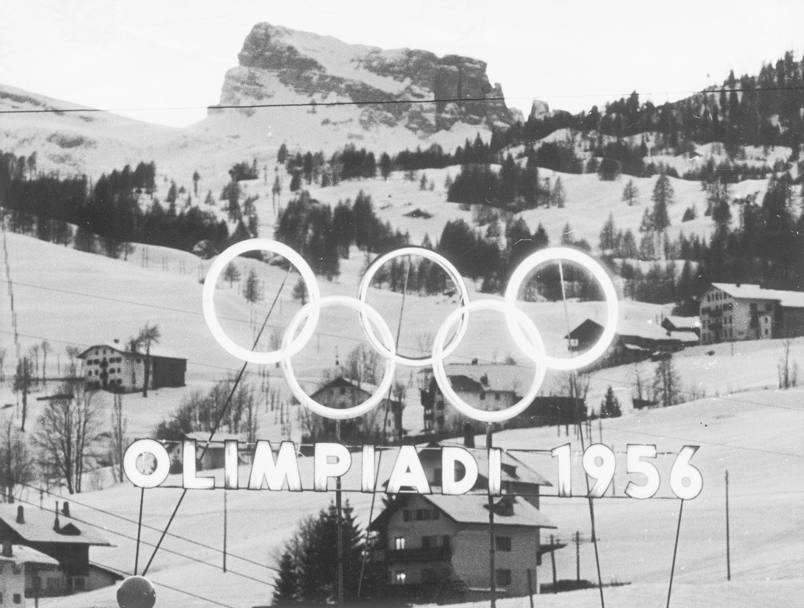
“Olympian” and “criminal” are two words that aren’t often used together in the same sentence, but in our year-long look at the Cortina d’Ampezzo ice, we found an interesting true crime tale.
A Winter Olympic ice hockey tournament is one of the biggest events in the Games in terms of the number of athletes involved, so during our episode about the Cortina 1956 tournament, we didn’t touch on many individual stories.
However, when I looked at the Italian roster, one story stood out to me.
The Cortina Canadians
The story of the Cortina Canadians was widely told in the Canadian press ahead of Milano Cortina 2026. A man named Bill O’Donnell has been working on a documentary about the group, and a few of them are still alive and were interviewed for various stories, but no one really talked about Carlo Montemurro.
Recently, we talked with Lindsay Huban from the U.S. Olympic and Paralympic Museum about how some Olympians’ stories get lost to time. Once I read about Carlo on Olympedia, I wanted you to know his story too.
What happened to Carlo Montemurro after the Games?
According to Olympedia and hockey historian Patrick Houda, once Carlo Montemurro retired from playing hockey in 1961, he moved to Val-d’Isere in France and opened a discount store. That did not go well because he kept the store open well past local closing hours and got fined for that.
Then he opened a bakery, which burned down. He reportedly sued the local cops and firemen about unjust treatment but then got arrested for suspected arson.
Montemurro returns to Canada
Eventually, Montemurro made it back to Canada, where he started a life in Ontario and got into finance. Between 1972 and 1980, he had five licensed investment firms that catered to the elderly, but in 1980, they collapsed. Investors lost $35 million in the collapse, the likes of which Canada hadn’t experienced since 1923.
Sixteen months later, the 47-year-old Montemurro, his wife and seven directors of these firms were arrested and charged with conspiracy, fraud and theft. Montemurro was found guilty in 1984 and sentenced to six years in prison. The Ontario government reimbursed some of the defrauded investors.
Montemurro finds another scheme
Even so, Montemurro has continued to pop up with different schemes. In the late 1980s/early 1990s, he found a loophole in the law where he could sell property to people, and then ask them to divide up portions of that property and bequeath it to Montemurro’s cronies in their wills. At the time, it was completely legal to subdivide land in a will, a process called “testamentary devise.”
Typically, Montemurro’s targets were terminally ill people and people who didn’t have a lot of money, so the idea of having some land that they could give to their loved ones as an inheritance may have been an attractive concept. They may not have realized that Montemurro and friends would be the big winners.
Needless to say, the Ontario government closed that loophole in 1990.
Trying again
Montemurro resurfaced in 2019, wanting to sell some land in Pelham, Ontario to a builder for a development, but the town’s chief building official denied the permits saying the land had been a testamentary devise and that it contained no streets, so you couldn’t build a subdivision on it.
Montemurro sued the town in 2021, but a judge ruled against the 88-year-old in 2022.
That doesn’t seem to be the end for Montemurro and his brushes with the law. I haven’t quite been able to suss out the full details, but a 2025 petition on Change.org says that Carlo, now age 92, and his grandson wanted to use some of their land to establish an indigenous cemetery.
Somehow, something went awry. The land may have been designated woodlands, were improperly cleared and now the Montemurros may be facing stiff fines and jail time because it was their land. At least, that’s what the Change.org petition claims.
Seeing as how Carlo Montemurro got in trouble with the law, it might not be a surprise that he played defense at Cortina 1956. He racked up 10 penalty minutes in the group stage. In the consolation round robin, he did skate one clean game, but in the other two, he sat in the penalty box for another eight minutes.
On paper, he came across as a hockey bruiser. I guess once a bruiser, always a bruiser. Even if the law catches up with you.
Photo: Wikimedia Commons via Picryl