
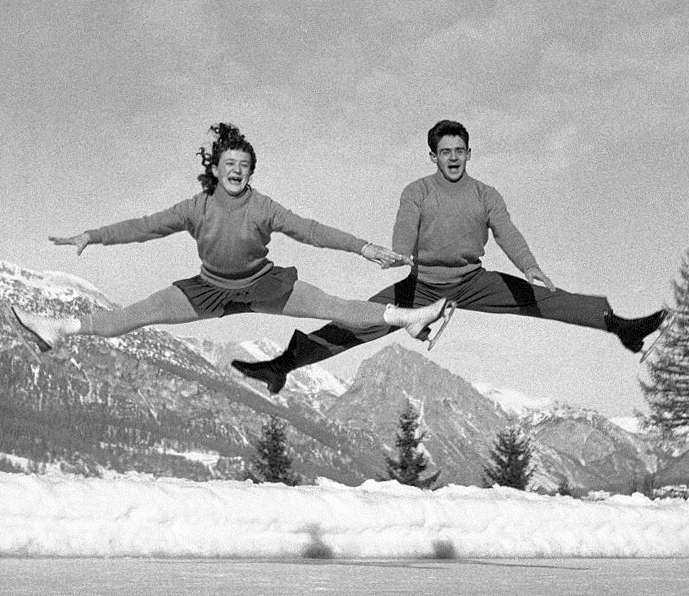
In our year-long look back at the Cortina 1956 Winter Olympics, we’ve come to the figure skating competition. Surprise! Figure skating had controversial judging back in the 1950s! Are you shocked?
Cortina 1956 was the last time that the figure skating competition took place on an outdoor rink. Cold, sun and shadows all played with the athletes’ ability to execute their figures and programs. The women even had to deal with snow for their figures competition. Look in the background of this video, and you can see people with snow movers at the ready to clear off the ice:
Skating at Cortina 1956 was both different and similar to Olympic competition today. Back in 1956, compulsory figures accounted for 60% of a skater’s total score – but just for men’s and women’s competition. Pairs didn’t have to do figures. This meant that skaters had to be exceptional at tracing shapes in the ice. Luckily at the Olympics, skaters had known for months which figures they had to perform, so they had plenty of time to perfect them. [For any skating nerds reading, the men had to do figures 22a, 36b, 21a, 38b and 41a. The women did 23b, 20a, 37b, 38a and 40b.]
American men were dominate at this time, with Dick Button’s heir apparent Hayes Alan Jenkins ready to step up to the top of the podium. The debonair skater, competing in his second Olympics, was a master at figures, which helped him when it came to staving off nerves ahead of the free skate. He had tough competition from Ronnie Robertson, who wowed the crowd with an exceptional free skate. Hayes’ brother David Jenkins was also a contender for the podium, but Cortina 1956 wasn’t quite his time.
On the women’s side, reigning world champ Tenley Albright had a scare when she badly injured her ankle in a fall during a practice ahead of the Olympics. Luckily, her father was a surgeon, and he flew to Italy to get his daughter into competition readiness. Albright was up against her rival Carol Heiss and had to dig deep to pull off the performance of a lifetime to get the gold.
Meanwhile, in the pairs competition, a battle between Austrians Elisabeth Schwartz and Kurt Oppelt and the Canadian pair of Frances Dafoe and Norris Bowden came down to judging. The Austrians had a classical approach, while the Canadians pushed the envelope in ways perhaps the judges didn’t always appreciate. The crowd didn’t understand, and they repeatedly didn’t agree with other pairs’ marks, which culminated in an uproar on the ice that’s hard to believe today.
Read on or listen to the full episode to get the full story!
Get more great stories in our free weekly newsletter!
Sources
Beth Israel Lahey Health. “NEBH 2022 Gala: Together with Tenley Albright, MD.” June 29, 2022. Accessed November 9, 2026. https://youtu.be/NAki0dmLs5A?si=heyfqbqKoOnxGPB4
Hartman, Travis and Adolfo Arranz. “The lost art that gave figure skating its name.” Reuters. Feb. 20, 2026. Accessed Nov. 2, 2026. https://www.reuters.com/graphics/OLYMPICS-2026-FIGURESKATING/egvbenmxxpq/
Hines, James R. Figure Skating: A History. University of Illinois Press and the World Figure Skating Museum and Hall of Fame. 2006.
Greenspan, Bud. Frozen in Time: The Greatest Moments at the Winter Olympics. Santa Monica, CA: General Publishing Group. 1997.
Judd, Ron C. The Winter Olympics: An Insider’s Guide to the Legends, the Lore, and the Games. Vancouver Edition. The Mountaineers Books. 2009.
Laguerre, Andre. “Lessons of Cortina.” Sports Illustrated. February 13, 1956. P.21-25.
The Manleywoman SkateCast: https://www.manleywoman.com/episode-55-frances-dafoe/https://www.manleywoman.com/episode-55-frances-dafoe/
Official Report of Cortina d’Ampezzo 1956. https://digital.la84.org/digital/collection/p17103coll8/id/12644/rec/25.
Olympedia. https://www.olympedia.org/editions/35/sports/FSK And each individual competition page, along with athlete bios.
Olympics.com “Frances Dafoe.” Accessed November 9, 2026. https://www.olympics.com/en/athletes/frances-dafoe
Stelitano, Antonella and Adriana Balzarini. Le Donne di Cortina 1956. Bologna: Minerva Soluzioni Editoriali. 2025.
U.S. Figure Skating. “The Olympics: 1956.” Skating Magazine. Accessed November 9, 2026. https://skatingmagazine.usfigureskating.org/article/Skating_196003_03
U.S. Olympic Committee. United States 1956 Olympic Book. New Haven: The Walter Rackliff Co. 1957.
Photo: Wikimedia Commons via Picryl
If you liked this story, be sure to check out these episodes:
TRANSCRIPT
Note: This is an uncorrected machine-generated transcript and may contain errors. Please check its accuracy against the audio. Do not quote from the transcript; use the audio as the record of note.
Cortina 1956-Figure Skating
Jill Jaracz: [00:00:00] Hello, and welcome to another history episode of Keep the Flame Alive, the podcast for fans of the Olympics and Paralympics. If you love the games, this is the show for you. I am your host, Jill Jaracz, joined as always by my lovely co-host, Alison Brown. Alison, hello. How are you?
Alison Brown: Hello. I am looking forward to this one.
Well, I look forward to all of them because I never know what you’re gonna come up with. But this one is gonna be a fun one for me ’cause I’m wondering if there are [00:00:30] names that I know.
Cortina 1956: Figure Skating
Jill Jaracz: Oh, okay. Well, you know, it’s figure skating this month for our history episode. all year long we’ve been looking at Cortina 1956, as it is the 70th anniversary of those winter Olympics.
And it also worked nicely because of Milano Cortina hosting the Winter Games this year. But we are talking figure skating today, and I’m always worried when I talk figure skating because- Oh, that the- … you are well more well-versed than I am.
Alison Brown: Well, not when you get into the [00:01:00] 1950s, that’s for sure. But I’m curious if there’s gonna be some familiar names coming up because I th- I think there are, so I’m kind of interested to see what you come up with.
Jill Jaracz: I think so as well.
Patron of the Week
Jill Jaracz: But before we get into this month’s story, we’d like to give a shout-out and thank you to our patron, Sam Bacon. Sam has been a longtime patron of the show, and he keeps our flame alive by being a Patreon patron. sadly, there are no Sams in today’s story.
Alison Brown: That’s a surprise.
Jill Jaracz: Yeah, you would think.
Sam would be a popular
Alison Brown: name of the era.
Jill Jaracz: Yes, [00:01:30] exactly. But Sam, thank you so much for being a patron and keeping our flame alive. we couldn’t do this show without you, so we greatly appreciate your support.
Cortina d’Ampezzo 1956: Figure Skating
Jill Jaracz: Right, so we are getting close to the end of our year with Cortina d’Ampezzo, 1956. We’ve come to our last sport, figure skating.
Figure skating in historical context
Jill Jaracz: So I, I do wanna take a few minutes to set the historical stage because figure skating today is vastly different than it was back in the, back in the day. you mean you didn’t see [00:02:00] quads in 1956? No. No, you did not. so we haven’t talked much about World War II and its effects on sport, but we’re 11 years out from the end of the war, and it really seemed to have done a number on figure skating.
according to skating historian James R. Hines, there weren’t many skating rinks left in Europe after the end of the war. in the early 1950s, Belgium, Holland, Norway only had one rink in the entire [00:02:30] country. Hungary had two. Sweden had rinks in two cities. Austria, France, Russia, Switzerland, Czechoslovakia, they had more. Poland opened its first post-war rink in 1955.
Alison Brown: Wow. That is so fascinating because you don’t think of, you know, you think of cities being destroyed certainly, and, and obviously all the people who were killed.
But something as simple as an ice-skating rink that was [00:03:00] lost. And probably low on the totem pole to replace. Exactly. That’s not gonna be the first thing you rebuild when you’re trying to rebuild an entire country and its infrastructure. But that 1955, wow. And, uh, wow That’s a surprise that it would’ve taken 10 years to get to the ice skating rinks.
Jill Jaracz: Yeah. so this obviously had an effect. Americans were dominant in the sport, especially in singles skating.
Cortina’s figure skating setup
Jill Jaracz: So at Cortina [00:03:30] 1956, figure skating was held outdoors. This is the last time that would happen at an Olympics. cold, wind, sun, glare, and shadows could all be factors for these skaters, which is, you know, when you’re doing jumps, even, you know, they’re not doing quads like they do today, or triples like they do today, but they’re still doing some pretty tough jumps, and trying to land that.
And shadows doing compulsory figures- Yes … would really mess you [00:04:00] up. And snow, but we’ll get to that. And hockey lines as well, because this is also the hockey rink, and you have hockey, paint underneath this. So it’s, it’s kinda interesting. the competition was just men’s, women’s, and mixed pairs. No ice dance yet.
And then competition for the men and the women uh, included compulsory figures. So we had figures and we had a free skate. No short programs at the time. No short program for pairs. No figures for pairs. [00:04:30] They had one skate, and that was it. So if you do not remember competition with compulsory figures, you’re not missing much from the spectator side.
Alison Brown: Which is pretty much why they got rid of them, because you, you can’t watch people skate around doing a circle with a little loop in it- Right … and it being too exciting.
Jill Jaracz: Yes. but figures are the foundation of the sport, and they are curved patterns in the ice that skaters trace using just one edge, and on a very basic [00:05:00] level, figures require skaters to skate, along a curve, turn, change direction, and change edges.
And they help the skaters develop strength, balance, and edge control, elements that are very, very important for the sport. But, especially the way they filmed them, because they couldn’t have overhead, cameras at the times, you never saw what they looked like. So you just saw skaters kinda trace around in a, a little figure, and they did it very slowly because you had to, and, that was the [00:05:30] show.
It was not good.
Alison Brown: Not much of a show.
Jill Jaracz: No. they were last in the Olympics in 1988. Which I remember. I, I loved it when figures went away
Alison Brown: You know, I wish they would bring them back now to the extent of skaters are losing edge quality. I think we wouldn’t see Flutzes if people were still doing compulsory figures.
Jill Jaracz: I agree with you on that, and I’m curious if coaches teach them. Right. I [00:06:00] mean, you don’t need to know them, but yes, they are essential for developing edge and balance and all that. So- Yeah, I mean, it’s a double-edged sword when you think about it. You take away the- No, it’s
Alison Brown: a
Jill Jaracz: single edge. All right, all right. So, uh, the International Skating Union, which is the international federation running the show here, they really took Pierre de Coubertin’s, to participate is more important [00:06:30] than to win philosophy to heart because skating’s– the Olympic competition structure was not as difficult as world champs.
At world champs, the compulsory figures portion of the competition required skaters to do six figures that were selected the day before competition.
Alison Brown: Wow.
Jill Jaracz: At the Olympics, skaters did just five figures, and the ISU announced these months ahead of the games. Plenty of time to practice. Not surprisingly, according to the [00:07:00] official report, the ISU found that performances, particularly in figures, were more even across the board compared to a world championships.
That’s not to say the judging was even, and we’ll get into this.
Alison Brown: Oh, geez, judging controversies in figure skating.
Jill Jaracz: Who knew? I know, I know. the amazing thing, the ISU didn’t even have a judge’s handbook for compulsory figures until 1961 And handbooks for judging free skating and pairs came out in 1965 and [00:07:30] ’66 They were just making it up as they went along.
I think so. I think so. of course, we can’t have a Cortina story without some fun commentary from the official report. technical delegate Vladislav Kap wrote, quote, “Which then were the new tendencies to be noticed at Cortina? Triple jumps and high-speed spins were performed with perfect artistic expression by some of the best skaters.
But of course, acrobatic perfection cannot be reached by all skaters, as good as they may be. Triple jumps and [00:08:00] high-speed spins therefore may have reached their peak of development, at least for the time being.” End quote.
Alison Brown: He was a little behind the times.
Jill Jaracz: Yeah.
The men’s competition
Jill Jaracz: We will start with the men’s competition ’cause that’s what came first at Cortina. And on, figure skating’s historical timeline, American Hayes Alan Jenkins followed Dick Button in becoming the world’s leading figure skater. Hayes had competed at Oslo 1952, coming in fourth, but then won the first of four world championships the following year.[00:08:30]
And then in Ame- in 1955, American Ronnie Robertson placed second to Hayes, and then Hayes’ brother, David Jenkins, came in third. So this is a good sign for the US going into the Olympic cycle. All three of them are on the US team. the figures competition was long. Started at 7:30 in the morning With an outdoor stadium, the temperature was a toasty minus seven degrees Celsius, which is 19.4 degrees Fahrenheit.
but the men get [00:09:00] trousers and sweaters if they want, or jackets, and they do wear ties, and some of them are wearing hats, gloves, because they’re just, you just have to watch what the feet do. as the day went on, the sun did come out. It warmed up a little bit. Apparently, the ice was excellent, no wind.
That was a good thing. Hayes Jenkins was a little nervous on his first figure. He didn’t score very well, but he recovered, and it went back and forth between him and Ronnie Robertson. But at the end of the day, it was Hayes Jenkins [00:09:30] in first, Ronnie Robertson in second, and David Jenkins in third. Hayes was known for being quite good at figures and really putting a lot of effort into that, which, you know, with 60% of your score going to figures, that’s the important part of the thing.
And I think when, as we were starting to watch figure skating, even though the, over time, the compulsory figures counted for less and less, they still made a difference on how well you did.
Alison Brown: Oh, yeah. you didn’t see [00:10:00] people win competitions in the compulsory figures like in 1956, but you would see people lose competitions by how poorly they had done in figures, and they couldn’t pull up in the short and the long-
Jill Jaracz: Right, and b-
after
Alison Brown: that
Jill Jaracz: And because we weren’t really watching figures, we were watching short and long, it was so hard to understand, especially as a kid. You’re like, “Why
Alison Brown: did th- And then you had the 6.0 figures. Yes. the 6.0 judging system, which was also very confusing.
Jill Jaracz: Yes.
Alison Brown: So, it’s much easier to understand now who’s in the lead.
Yes. That’s for sure.
Jill Jaracz: [00:10:30] Definitely. So, Robertson had a card up his sleeve for the free skate, or maybe his coach, Gus Lussi, did. Lussi told reporters that Robertson was going to be the first to land a triple Axel at an Olympics. And Sports Illustrated noted, that Robertson’s mom was a skating mother who had sacrificed a lot of money.
Robertson’s mom had to work at a restaurant to help pay for his skating, and other coaches thought that Lussi and Robertson were [00:11:00] snobs. Quote from the Sports Illustrated, The snob element, always strong in Olympic gathering, was heavily on the side of the gentlemanly Jenkins against the brash, publicity-conscious Robertson,” end quote.
Alison Brown: Yikes.
Jill Jaracz: Yeah. Weather for the free skate was also cold, made for hard ice. This is not great for figure skaters, apparently. This, along with glaring sun, made it difficult to land jumps. These conditions [00:11:30] really affected David Jenkins, who fell twice. Even so, he was far enough ahead of fourth place to maintain a podium position.
Ronnie Robertson skated and had a perfect program. He wowed the crowd with his jumps and spins, but he did not do that triple axel. Shortly before his free skate, Coach Lussi sent a message up to the press box saying that the triple axel was out of the part, program in part, quote, “Because he is so sure to win anyway,” end quote.[00:12:00]
Oh, don’t ever say that. had he not landed the triple axel, it would’ve been a disaster, but playing it safe paid off. He took six first places in the free skate, putting pressure on Hayes Jenkins. incidentally, the first triple axel landed at an Olympics, can you guess?
Alison Brown: No. 1984, Brian Orser. Oh, that’s right Wow. It took a [00:12:30] long time for that triple Axel to come in.
Jill Jaracz: Right, right. And I think that, in non-Olympic competition it happened much earlier, but Olympic competition, it took a long time. Yes. Wow so Hayes heard the crowd’s cheers in the changing area for Ronnie Robertson’s program, and he knew he had to come up with a great performance to win, but he was really stressed out and it made him tense up.
According to Sports Illustrated, his coach, Eddie Scholven, [00:13:00] told him, quote, “Hayes, skate for sure. Stand up. No terrific risks. Get after it,”
Alison Brown: end quote. Good
Jill Jaracz: advice for
Alison Brown: many things. Yes.
Jill Jaracz: Hayes Jenkins was skating to Scheherazade and started his free skate tentatively, but he loosened up as he went along and finished confidently. Not a sensational performance, but it was graceful. US Skating Magazine noted that his connecting steps were, quote, “fascinating and surprising,” end quote, while noting that [00:13:30] Robertson’s were, quote, “not elaborate,” end quote.
The magazine also noted that European critics loved Hayes Jenkins, saying there hadn’t been such, quote, “an athletic and artistic skater since Gillis Grafstrom.” Oh, our friend- Or Gillis Graf- … Gillis Grafstrom. Yes. And, uh, Sports Illustrated put it a different way. Hayes Jenkins was like Fred Astaire, and Ronnie Robertson was like Jimmy Cagney on ice.
Alison Brown: But isn’t that still the story, [00:14:00] you know, between two skaters. You’ll have one skater who it’s all about the jumps, and then another skater, it’s all about the connecting steps and the presentation and the artistry. It’s that same conundrum of how do you combine the two was there from the beginning of skating competition.
Jill Jaracz: Yes. so Robertson won the free skate, but Hayes Jenkins’ margin for winning the heavily weighted compulsories was still greater, so he got the gold, winning by .64 [00:14:30] points. US swept the podium. I did not realize that. Gold went to Hayes Alan Jenkins, silver went to Ronald Robertson, and bronze went to David Jenkins.
So what happened next? Uh, Hayes won the 1956 World Championship and retired from skating. He went to Harvard Law School, then worked for the Goodyear Company. Robertson turned pro after that year. His mom said he had to earn back the thousands of dollars she invested in him. [00:15:00] She had enough of that restaurant job.
Right. And, Olympia says his contract with the Ice Follies was rumored to be $100,000 a year.
Alison Brown: Which at the time is tremendous.
Jill Jaracz: Yes. And then, David continued to compete. He took the mantle from his brother and won the 1960 Winter Olympics.
The women’s competition
Jill Jaracz: moving over to the women’s competition, which was next, Americans were also the favored contenders. Coming into the games, we have a little bit of a rivalry with reigning [00:15:30] world champ Tenley Albright and world silver medalist Carol Heiss.
Albright started skating when she was six years old, but at age 11 she contracted polio, and luckily it was a mild case, but it weakened her back, legs, and neck. And, she’d been a skater before she’d gotten sick. She went back to skating afterwards, which proved to be good physical therapy. She entered competition, started winning, and was so successful that a- age 16 she won the silver medal at Oslo 1952.[00:16:00]
And the following year she was the first American to world, the world champs. meanwhile, she was also studying pre-med in hopes of becoming a doctor just like her father.
Alison Brown: And when you think about it, in the 1950s, not, not too average. I mean, this woman is no joke about- Yes … you know, competing at a high level of sport and studying pre-med. I mean, that would be hard now, but then with the headwinds she had to face as a woman studying pre-med [00:16:30] would’ve been amazing.
Jill Jaracz: Yes. Cortina 1956 was gonna be her time, but she almost did not get to compete. During practice a few days before competition, Albright was skating backwards and got tripped up in a rut on the ice. As she fell, one of her skate blades cut through the other boot, and ankle down to the bone. Which is the nicer way of putting this injury.
Alison Brown: Yikes.
Jill Jaracz: Um, for most people, that would mean competition o- over, [00:17:00] but her father, as we mentioned, prominent Boston surgeon, Hollis Albright, flew to Italy, bandaged her up in such a way that she could continue skating, and she decided to stay in the competition.
Alison Brown: Of course she did. This, this woman is unbelievable.
Jill Jaracz: Meanwhile, 16-year-old Carol Heiss was ready to make an upset. Heiss’ mother, Marie, was with her, as she was for all of her competitions. The family also had sacrificed a lot for Carol’s skating. However, this trip [00:17:30] was tougher because Marie had terminal cancer. Oh. And, Carol she was one of these people who had a lot of spark.
She had a lot of confidence. Her coaches, took her on as a young kid, and they were like, “Oh, we don’t really take young kids.” And then they saw her skate, and they’re like, “She’s got something.” So that’s Carol. she was ready for competition. who’s gonna win here between these two American women? well, Andre Laguerre in Sports Illustrated had another great paragraph The [00:18:00] leggy Tenley is a more classical skater than Cl- Carol Heiss.
Although some judges consider the younger girl more accomplished. And then we come back to, Robertson’s coach, Gus Lussi. Lussi passed a typical judgment, quote, “One is a lady from Boston, the other girl’s a skater,” end quote.
Alison Brown: Oh, boy. Again, that same dichotomy of the artist versus the athlete.
Jill Jaracz: Yes. So the women did not [00:18:30] have great weather for their figures competition.
It was cold, and although the official report calls the conditions dull- … US Figure Ska- US Figure Skating Magazine noted it was snowing pretty heavily in the morning, and it was difficult for the judges to see the tracings. And there are a few film clips that you can see, like, people in the background with, like, snow scrapers, and you see little, bits that they have plowed, basically, for the, the skaters to do their figures.
So [00:19:00] dull is, is pretty good, way to say it. eventually the snow stopped, allowed the women to finish three of the five figures. They did the other two the next day. and I’m gonna go out on a limb and maybe say it was split because it was also cold, and the women had to wear skating dresses.
Alison Brown: Yeah. That would be a little chilly-
Jill Jaracz: Yes …
Alison Brown: on the legs. I mean, yeah, sure, you’ve got your thick woolen tights, but that ain’t- Yes … nothing like a pair of pants.
Jill Jaracz: Yes. after the compulsory figures, [00:19:30] Albright had a slight lead over Heiss, and thankfully her ankle was stable. She said that it took a lot of mental work to get through her long program, but the audience also helped.
Her program was the waltz, The Barcarolle, from the opera The Tales of Hoffmann, and the crowd began to sing along with the music. And this is in the days of no lyrics, so they just knew the song. They knew the song. That helped her skate through her injury. She made a slight mistake on a double [00:20:00] loop.
That’s one she had to land on her injured leg, but nonetheless, she pulled off the performance of a lifetime. Carol Heiss came close. She had a fast and intricate program, but she made a mistake on a double jump. That kept her in second place. So Tenley Albright pulls off the win.
She became the first American female skater to win Olympic gold. Carol Heiss got the silver. Bronze went to, Austrian Ingrid Wendl, the reigning [00:20:30] European champion who led a strong Austrian team that finished third, fifth, and seventh. And you don’t really hear of Austrian skaters today.
Alison Brown: No, Austria has nothing going on in figure skating, so that’s a surprise.
Jill Jaracz: Yes. and really the story was between the two Americans, who’s gonna get the gold?
so what happened next? world championships was in Garmisch-Partenkirchen a couple weeks later. Carroll Heiss upset Tenley Albright for the win. At the world [00:21:00] champs that year. Yes. Wow. And Vendel took third. Albright retired from skating after that to pursue her medical studies.
She became a surgeon like her father, was first female surgeon at New England Baptist Hospital, where she had been born. she was out a lot at Cortina 2026.
Alison Brown: Yeah, she, uh, I saw her at world championships last year in Boston. She ma- you know, it was Boston, and she’s always stayed very involved in the figure skating world, her and her [00:21:30] flower in her hair, which was her trademark.
Jill Jaracz: Yes.
Alison Brown: And she always shows up to competitions with the flower in her hair. So she’s been out and about, making an appearance, and she’s no spring chicken, but she looks fantastic. She does. And can still fit into her ’56 jacket. I remember that from this year. Yeah, she had her competition jacket on. It was great.
Jill Jaracz: Carroll Heiss’ mother saw her win that world championship, sadly died the following October. Heiss went on to achieve her dream [00:22:00] and win gold at the 1960 Winter Olympics. She married Hayes Jenkins and became a figure skating coach here in Northeast Ohio. the Jenkins aren’t that far from me.
Alison Brown: And also someone who stayed in the system, and you see her making appearances at various events, and- Yes … she’s, she’s still kicking it.
Jill Jaracz: Yes. Vendel turned pro and wound up in the US Ice Capades before retiring in 1971. She became a TV presenter, host, and commentator. So [00:22:30] if you’re from Austria, she’s like the Austrian version of Peggy Fleming.
commented from 1988 to 2000, so, like, around the same time as Peggy Fleming. Then she went on to have a seat in the Austrian parliament from 2002 to 2006.
Alison Brown: That’s the second time we’ve seen, ’cause we, when we, when we were talking on our Patreon show about Irina Rodnina- Yes … who, who also went into the Russian parliament.
So, uh, we might need to explore the ice-skating-to-parliament [00:23:00] pipeline.
Jill Jaracz: Yes, yes.
Alison Brown: If there are others.
Jill Jaracz: Oh, there are because, um, oh my gosh, who did Rulon Gardner defeat in wrestling in 2000? The, the big chiseled man from- Oh … Um,
Alison Brown: Alexander.
Jill Jaracz: Kuralin, Kuralin. Alexander Kuralin.
Didn’t have to look it up. uh, yeah, he went and did something in the government as well. I can’t remember if he was, like, a sports minister or was in parliament, but he also went into government. But yeah, there’s a lot of people going into [00:23:30] government. And we saw on our, Facebook group-
Alison Brown: Teddy Riner …
Jill Jaracz: Ted- Teddy Riner wants to run for French president.
that’s gonna be
Alison Brown: exciting. Who’s gonna, who’s gonna argue with Teddy Riner about anything? Would you? I will
Jill Jaracz: flip you. I’m afraid
Alison Brown: he’d face plant me.
The pairs competition
Jill Jaracz: So now we get to pairs. And it would not be a Winter Olympics without a figure skating controversy. So if you’ve been waiting- Now is the time … here it comes. Pairs only has the free [00:24:00] program, so everything is relying on this one skate, and the big names for these games are Canadians Francis Dufault and Norris Bowden.
They had been fifth at Oslo 1952, but really dominated the scene from 1954 to ’62, including being the first Canadian pairs to win world championships. They were known for pushing the envelope with their skating. They did throw jumps when they were illegal. They did loop twists. They did all sorts [00:24:30] of moves that the judges did not know what to do with.
Alison Brown: Like a good Canadian pair. Yes. Right? You know, Canadian pairs always push the envelope, and that’s what we wanna see from them, so the tradition is long for that.
Jill Jaracz: Yes. their biggest competition here was an Austrian pair, uh, named Elisabeth, also called Sisi, Schwartz, and Kurt Oppelt, who were known for their classical style.
Sisi is also known in the press for being the skater with one blue eye and one gray eye.
Alison Brown: Oh, as you
Jill Jaracz: will. I… [00:25:00] Yes. So it’s a frigid day again.
Alison Brown: Oh.
Jill Jaracz: temps were as low as minus 16 degrees Celsius up to minus three degrees Celsius. 14 pairs entered. Only 11 competed. Apparently during this period of time, there was a drawing for the number of judges that would do the competition.
So they’d drawn… Yes, so the women had, like, 11 judges on their panel
Alison Brown: Oh, so you never knew how many… It wasn’t [00:25:30] just for the judges, it was for the number of judges.
Jill Jaracz: Yes, for the number of judges, yes. Oh. So, in the draw, they drawn seven, and according to a 2012 interview with Defoe, the Canadian judge who was on the panel told her and Bowden that they had a fair shot because there were seven judges.
One of them was neutral. However, when they took the ice, there were suddenly nine judges. Oh. And Defoe said it seemed like manipulation, and that the Austrian Skating Federation was likely good at politicking. Not the skaters, the [00:26:00] federation. the official report here, as much as I love it, does not say much about figure skating at all, and does not say much about the judging system.
So the men had nine judges. The women had 11. And then, the pairs was supposed to have seven, and they ended up with nine.
Alison Brown: Who knows how that happened? Uh,
Jill Jaracz: yes. So anyway, competition got underway, minus the Australian pair of Jackie Mason and Mervin Bower. During practice, Bower hit the wooden side of the rink, fractured his ankle.[00:26:30]
Alison Brown: Oh.
Jill Jaracz: This was not the fairy tale ending for this pair. They were the first Australian team to compete at a world championships. Miraculously, they went to world championships after Olympics. This is, like, two weeks later. Got 11th place.
Alison Brown: Wow.
Jill Jaracz: Yes. uh, Ceci Schwartz and Kurt Opal skated fourth.
They had a very clean and classical program that was a big crowd pleaser, and according to a Google translate of a quote from a La Stampa [00:27:00] article, quotes, “The woman, supported by the hands of her partner, twirled so gracefully in the air, or moved with such precise undulations that it gave the sensation of a dance full of marvelous evocative powers.
The cheerful Vienna, the beautiful Blue Danube, the Prater, a whole distant and lost world, were suggested by the figures created by the two skaters in a perfect execution,” end quote. Nice. following them are the Hungarian pair of Mariana Nagy and Laszlo Nagy, uh, [00:27:30] here for their third Olympics. They are the defending bronze medalist, and apparently there is some confusion over whether they’re siblings or spouses, because there’s no Hungarian interpreter.
And one would think, like, this is their third Olympics. Somebody might know. But apparently not. They are siblings. The press was excited about them, too, and deemed them excellent with great harmony. so the Canadians Dufeu and Bowden skated ninth, and [00:28:00] they did their controversial overhead lifts. According to La Stampa, quote, “They began to heat things up. They were perfect in their movements, precise in their shots, synchronized to a millionth of a second, as if their limbs were guided by a single thread.
But their technique revealed a mechanicalness that didn’t please the public, decidedly favorable to the Austrian’s more imaginative play.” End quote.
Alison Brown: Imaginative play. That’s an interesting way of phrasing that It is,
Jill Jaracz: right? the [00:28:30] Canadians also made a mistake on one of the lifts which caused them to do the disastrous.
They finished their program after the music ended.
Alison Brown: Oh, no. That’s still a disaster.
Jill Jaracz: The audience was not thrilled with their scores, and they were less thrilled after the 10th pair, Germans Marika Kilius and Franz Ningel.
Kilius, who was 12
And at the first of three Olympics, she was 12 [00:29:00] centimeters taller than her 19-year-old partner. That would be a problem today. It was probably a problem then as well. It was. The judges did not like the height difference. The public did not care. They liked the performance. When the scores came out, things went haywire, and no one really wa- knows why this broke the straw on the audience’s back.
But, quote, I think this is also from the L’Estampa. all of the, the L’Estampa [00:29:30] things are from, my book that is paying off, La Donna di Cortina. That I got in Cortina this past winter. Quote, “The announcer hadn’t even announced the first vote, and the loud explosion of whistles had already begun.
Then an orange flew. It fell to the surface of the track, sliding down to the feet of a judge. The example was quickly followed. Oranges and apples, chestnuts, and bottles. The ashtrays thickened in a hailstorm- … [00:30:00] that didn’t reach the nine referees who remained stationary only because the distance separating them from the crowd was too great.”
Alison Brown: They didn’t have any long ballers in the crowd. No. ”
Jill Jaracz: It’s unknown who initiated the imaginary stoning of the jury. It seems to have been a group of German fans disappointed by the vote their representatives received. What is certain, however, is that everyone shot at the nine unfortunates, Americans, British, Germans, [00:30:30] Italians, and Hungarians,” end quote.
It took 45 minutes to clean up.
Alison Brown: I like that the ashtrays got involved. I know. Oh my gosh. Like, they really were digging deep, you know? They were, oh. Never mind just the apples and the oranges. We want ashtrays flying.
Jill Jaracz: Right? it took 45 minutes to clean up the mess and restart the competition for the final two pairs. Well, those poor pairs had to just stand around.
Right. And poor British pair, Carolyn Crowe [00:31:00] and Rodney Ward, they were the unfortunate ones to be the next pair on the ice. They did not have a good outing. She was also 12. He was 14. Not very experienced. It showed. Carolyn fell and hit her head on the rink barrier. She finished in tears. They were last.
here’s where the judging got really controversial. In terms of total points, the Austrians had a .1 deficit on the Canadians. Okay? [00:31:30] 101.8 to the Na- Canadians’ 101.9. This is the closest margin in Olympic history to this point. In terms of ordinals, we have a different story.
Alison Brown: Oh, we gotta love those ordinals. So it’s where you’re ranking each of the skaters.
Jill Jaracz: Yes. So, the Austrians had four first place, five second place. The Canadians also have four first place, but they got three second places and two thirds from the German [00:32:00] and the Hungarian judges.
Alison Brown: Oh, I wonder why the German and Hungarian c- judges did that?
Given we had German and Hungarian skating.
Jill Jaracz: and that meant that the Austrians won.
Hungary, the brother-sister team of Mariana Nagy and Laszlo Nagy, they ended up in third place to repeat as bronze medalists in their third and final Olympics. They had 99.3 points. Their ordinals were one first place from [00:32:30] the Hungarian- Hungary … judge. Zero second place, four thirds, two fourths, one fifth, and one sixth.
And that got them third place.
Alison Brown: Yeah. You know, I watched a lot of skating that still had ordinals. You know, the first 25 years of me watching skating had ordinals, and I still never understood how ordinals worked.
Jill Jaracz: Oh, no. What always bothered me is that it seemed like they gave the [00:33:00] ordinals out with the performance.
So how can you judge that this is gonna be first place- Right … when you haven’t seen the next ones? the German team that caused the big ruckus- Kerfuffle Yes. points-wise they were in fourth with 98.9 points. They got one second place ordinal from the German judge, one third, one tied for third, so they had two thirds.
two fourths, and three tied for fourths, and one [00:33:30] fifth. It was a little nuts. historian, James Hines wrote that these results were a hotbed of debate because the Canadians had been the dominant pair at the time, but some people said their lifts violated the rules. There were questions about the number of revolutions done at full extension, and whether or not Bowden carried Defoe, which apparently was a no-no.
Huh. And, uh, guess what? Over the next several years, the pairs rule book changed [00:34:00] to allow an additional half revolution to, from three to three and a half, like the Canadians did. This controversy also indirectly led to the addition of a short program for the pairs. So that you weren’t just judging them on this single event, that you had more to work with.
Exactly. after the Olympics, the Austrians defeated the Canadians at World Champs. Not surprisingly, because we’re still in Europe. they were the only pair to, uh, defeat the Canadians [00:34:30] during their years at the top. Sissy, the Austrian, loved Cortina.
Alison Brown: Well, why not?
Jill Jaracz: She won. After the games, uh, she often spent holidays there after the games, and- Oh,
Alison Brown: that’s very
Jill Jaracz: sweet
they just loved her, yes.
Alison Brown: Well, you know, we can speak to how lovely Cortina is. Yes,
Jill Jaracz: yes.
Alison Brown: I, I would… Can you imagine Christmas in Cortina?
Jill Jaracz: Oh.
Alison Brown: How beautiful that must be? Oh, yes. With the snow falling down the cobblestone streets, and the restaurants, and you just go in and get some, you know, [00:35:00] some warm alcoholic beverage, and you sit and you watch the snow fall.
Oh, Sissy had the right idea.
Jill Jaracz: Yes. Defoe and Bowden retired after World Champs. They became judges. Oh, no, they became judges? They were involved in some kind of controversy because the two of them were suspended by the Canadian Figure Skating Association at, at one point. And this is a rabbit hole I did not go down, but any figure skating fans who know what happened, are welcome to write about it, [00:35:30] and tell us about it, or send us a voicemail about it.
Um, we’re flamealivepod@gmail.com. 208-FLAME-IT is our phone number. uh, they both got reinstated. she judged at the 1994 Winter Olympics.
Alison Brown: Hmm. Hmm.
Jill Jaracz: In 1984, they were elected to the World Figure Skating Hall of Fame. Francis was also a costume designer who did their costumes. she also did costumes for Kurt Browning, Elizabeth Manley, [00:36:00] Brian Orser, Katarina Witt, Kristi Yamaguchi, Scott Hamilton, Elvis Stojko, Gordeeva and Grinkov, and more.
Alison Brown: Wow.
Jill Jaracz: Another one of her projects, costumes for the closing ceremonies at Calgary 1988. No. Yes.
Alison Brown: Oh, that’s pretty fabulous. Oh, she was a serious costume designer. She wasn’t just- Yeah … dilly-dallying and playing with it. She was, she was the real deal.
Jill Jaracz: Um, the Nagys ended their Olympic careers. [00:36:30] Mariana did ice shows and coaching, and Laszlo became a doctor, and he worked at a specialist sport clinic in Budapest.
the Ger-
Alison Brown: And we still don’t know if they’re siblings or a married couple.
Jill Jaracz: the German pair ended up getting new partners, and they kept competing. Marika did two more Olympics, and she won silver at both, and apparently the 1964 Games has its own crazy story with pairs figure skating. Maybe that’ll show up in the show one day in the future. [00:37:00] Franz competed at 1960 with his wife Margaret, and they finished fifth, so she ended up doing much better than her former partner.
And that is figure skating at Cortina 1956. I
Alison Brown: love that figure skating has not changed at all. It, you know, everything about it has changed, the scoring, the costuming. It’s out, you know, it’s indoor versus outdoor, and yet the stories that we tell about figure skating haven’t really changed. It’s still the [00:37:30] dichotomy of, artist versus athlete and judging controversies, and that’s still what we talk about today when we watch figure skating, that nothing has changed in 70 years.
And I love that about figure skating, that that never changes. You know, these things that were still the issues when I started watching it in the ’70s, was the case in the ’50s, and is the case in the 2020s. Will it ever change? No, and that’s why [00:38:00] we love figure skating.
Jill Jaracz: Well, it gives us something to talk about.
Absolutely.
Sources
Jill Jaracz: Right. Sources for this, Beth Israel Lahey Health, Reuters, James R. Hines’ Figure Skating: A History, Bud Greenspan’s Frozen in Time: The Greatest Moments at the Winter Olympics, Ron Judd’s The Winter Olympics: An Insider’s Guide to the Legends, the Lore, and the Games, Vancouver Edition, Andre Laguerre writing for Sports Illustrated, The Manly Woman Skatecast, the official report of Cortina d’Ampezzo [00:38:30] 1956, Olympia, olympics.com, La Donna di Cortina, a book by, Antonella Stellitano and Adriana Balzarini, and, US Figure Skating, Skating Magazine, and the US Olympic Committee’s 1956 Olympic book.
Alison Brown: Just amazing stuff there, Jill. Thank you so much. Oh. This was a great one.
Jill Jaracz: Oh, lots of fun to get it, and, and I feel like there were about 10 rabbit holes I could have gone down- … and did not go down. [00:39:00]
Alison Brown: Yeah, you’ll, we’ll never see you again. You’ll be-
Jill Jaracz: Right …
Alison Brown: you’ll be digging in the pair skating lore. Well, this is why the Run Through exists.
Jill Jaracz: Yes,
Alison Brown: exactly. Our, our, a podcast that we are both fans of, and if you need to get more into the lore, they literally have a series called The Lore about, you know, pairs, womens, mens and dance, and all the different music and different history points. So they did-
Jill Jaracz: And, and this is,
Alison Brown: uh- 20 hours worth it.
Jill Jaracz: Exactly. It’s fantastic. the Run Through is, [00:39:30] uh, a podcast with one of the hosts is not Olympic champion, Sarah Hughes, who has been on our show before, so we highly recommend that. So yeah, one more show for Cortina 1956, and we’ll take a look at the closing ceremony, and, uh, see what the legacy is. Cannot wait. So that’ll do it for this show. Thank you so much for listening.
Alison Brown: And until next time, keep the flame alive.;
[00:40:00]