
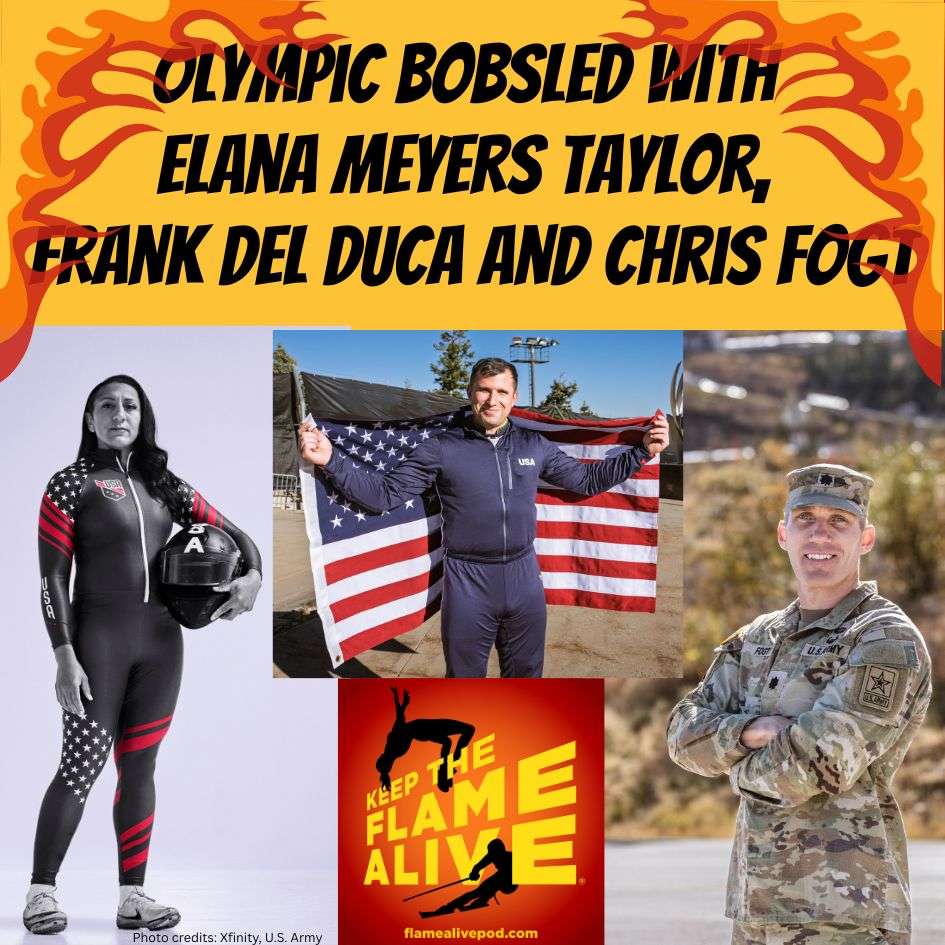
Alison interviews 4x Olympic bobsledder Elana Meyers Taylor on her long career in the sport and being an athlete/parent. Then Jill and Alison interview U.S. Army World Class Program athletes LTC Chris Fogt and SGT Frank Del Duca. Chris Fogt is a former bobsledder turned coach for USA Bobsled. Frank Del Duca is an Olympic bobsled driver looking to qualify for his second Games.
Plus, we get into the hockey stadium drama at Milano Cortina 2026 and the surprise announcement of some Olympic Opening Ceremony artists.
In other Games news, LA 2028 announced the date of registration for its ticket lottery. And we have big updates from Team Keep the Flame Alive!
Thanks so much for listening, and until next time, keep the flame alive!
Photo credits: Elana Meyers Taylor – Xfinity; Frank Del Duca – U.S. Army; Chris Fogt – U.S. Army
TRANSCRIPT
Note: This is an uncorrected machine-generated transcript and may contain errors. Please check its accuracy against the audio. Do not quote from the transcript; use the audio as the record of note.
422-Olympic Bobsled with Elana Meyers Taylor, Frank Del Duca and Chris Fogt
Jill Jaracz: [00:00:00] Hello, and welcome to another episode of Keep the Flame Alive, the podcast for fans of the Olympics and Paralympics. If you love the games, we are the show for you. I am your host, Jill Jaracz, joined as always by my lovely co-host, Alison Brown. Alison, hello, how are you?
Alison apologizes to Canada
Alison Brown: I am fearful that I may have insulted the entire country of Canada.
How, what? What? I don’t wanna say would you do, but like how could that be possible? And I need to rectify this because I made a comment about Sid Crosby being old. [00:01:00]
Jill Jaracz: Oh. Oh,
Alison Brown: uh oh. So I have the utmost respect for Sydnee Crosby, and he is Sid the Kid. And I apologize to the entire country of Canada for denigrating your national treasure like that.
Jill Jaracz: Please Canada accept the apology.
Alison Brown: I know, and you know how much I love Canadians.
Jill Jaracz: Yes.
Alison Brown: I would never, and you love
Jill Jaracz: Sydnee Crosby as well.
Alison Brown: Yes. I was saying we need to protect him because he’s so important. But I misspoke, so please, Canadians forgive me.
Jill Jaracz: I think that was a yes. I hope so. I hope
Patron of the Week
Jill Jaracz: you know what else is a yes. Patron of the week. That’s right. We have, uh, one last patron, a shout out for 2025, and that is the esteemed j Brian Carberry. Brian, you have been such a, valued member of our Patron community. Huge support you always give us, and fun chats
Alison Brown: all year long.[00:02:00]
When we say we can’t do the show without patrons, we really could not do the show without a lot of the support that Brian has given us. So we are forever grateful and just an amazing human being feels like, and he travels and sends us the best Olympic and Paralympic pictures of things he finds all over the place.
Jill Jaracz: Yes. So Brian, thank you so much for all of the support you’ve given the show and for being such a good friend to the show. We really appreciate you and look forward to having you listen for many more years. And if you wanna shout out how do you do it, Jill, you go to Flame A live pod.com/support for more information.
Elana Meyers Taylor Interview
Jill Jaracz: You know who else is a legend? This was exciting. Oh, I, I was so excited for you and quite jealous because, uh, you got to talk with esteemed bobsledder, Alana Meyers Taylor.
I was in a car driving across Indiana or Ohio at the time and could not make it, but, Bring us in for
Alison Brown: this one. [00:03:00] So Alana is the most decorated Olympian in women’s bobsled history and the most decorated black winter Olympian as well. She has won three silver medals and two bronze medals in her previous four Olympic appearances.
She is also mom to Nico and Noah that we do talk about in our chat with husband Nick Taylor, a former bobsled himself. And I spoke to Alana on October 15th as she was gearing up for the new bobsled season. And getting ready to go for Olympics number five. So take a listen.
Alana Myers Taylor, thank you so much for joining us. I am very excited to get to talk to you. I have been watching you probably since 2010, uh, at that first Olympics, so I’ve been a fan for a long time, and.
How has Olympic women’s bobsled changed over Elana Meyers Taylor’s career?
Alison Brown: You’ve been in women’s bobsled pretty much as long as there’s been Olympic Women’s bobsled. So how has that changed over your career?
Elana Meyers Taylor: Oh, it’s funny. I was actually thinking about [00:04:00] that today and it was actually like considering doing Instagram post about it because it’s been such a long career and I’ve. Had the pleasure of seeing a lot of things, but the coolest thing is I’ve had the pleasure of meeting a lot of different people and a lot of different women and being teammates with a lot of different women from all over the country, from all types of economic backgrounds, religious backgrounds, political backgrounds.
So it’s been a really cool experience and I love people. I love being around people. So to have that kind of team dynamic and to be able to see a change and evolve throughout my almost 20 years of competing, it’s been amazing.
How bobsled pushers are selected
Alison Brown: You talk about your teammates. So each Olympics, you’ve had a different pusher.
Mm-hmm. And your first Olympics, you were a pusher, so. talk about having been a pusher, what you look for in your pusher.
Elana Meyers Taylor: So the good news is on my end is I don’t get to choose the brakeman. And I say that’s a good news is because we’ve had a very competitive brakeman pool ever since I’ve been a driver and even when I was a brakeman.
So the decision on who’s the [00:05:00] brakeman and who’s gonna push who in each Olympics is very, very tight margins. And fortunately, the coaches choose it. I wouldn’t wanna have to tell somebody, Hey, your Olympic. Dream is over, or this is your Olympic dream. Although I imagine it’s probably cool to tell somebody they just lived their Olympic dream, but regardless, you know, those margins have been so tight.
So for me it’s all about speed and strength and being able to push the sled fast, but then also being a great teamwork. Teammate and being able to do really good teamwork and being able to work together. Um, fortunately in the sled, we don’t talk to each other, so there’s nothing going on down the track, but it’s all those little things off the track.
If you have someone behind you that you can trust that you know who get the job done, then it makes it much easier for you as a pilot to just focus on what you need to do on the track.
How Elana Meyers Taylor describes herself as a bobsled pilot
Alison Brown: How would you describe yourself as a pilot?
Elana Meyers Taylor: I am a control freak, which is why I became a pilot to begin with. I’m a perfectionist, um, which gets me in trouble all the time because during training runs I try to find the perfect line and I’m trying to do everything I [00:06:00] can to just figure out this puzzle.
And so I lose almost every training session. If you look at a, a time sheet from a training session, you’ll be like, this girl can’t be competitive like I am. Like. Dead last in almost every single training session. And for me it always panics me. I know this is my tradition, but I’m not a practice performer because I’m taking in the track, I’m studying it, I’m changing things.
I’m adapting and doing all this stuff. And then once race day comes, I just let it all go and just clear the mechanism, so to speak, and just go out and have fun and trust the training I put into it.
Alison Brown: Has that changed over your career?
Elana Meyers Taylor: It has never changed. And actually I was a softball player before that, and even in softball.
I was not a good practice performer. I was okay, but I just wasn’t a great practice performer. And then when it came to the game, I could turn it on and I’d go out there and hit dingers or i’d, I’d have a high batting average. But at practice, it just. Never came. And it was frustrating and it still is frustrating from time to time, especially now in a time sport where every day coaches are [00:07:00] comparing and trying to figure out like what you need to do with equipment and brakemen and like how you compare to the other nations and stuff like that.
And I think I’m just frustrating for everyone, myself included.
Elana Meyers Taylor on adding the monobob event for women
Alison Brown: Well, you’ve done okay over the years. Yes. Somehow you’ve managed, where did Mono Bob. Pretty recently, you know, when it became a an Olympic event, what made you wanna do more as you were later on in your career?
Elana Meyers Taylor: Well, the thing about bobsled in general is that men have always had two opportunities to medal the games with the two men and the four men.
And so we as women wanted two opportunities. And so me, uh, my teammate Kelly Humphreys and a couple other female pilots always fought for the opportunity to have two disciplines. we thought it would be the four women competition. It didn’t end up being that, but they gave us the mono bob and so. When we got the mono bob, of course I was gonna jump on it.
Of course, I was gonna give it a try and see how it went. Now, now that I’m 41 years old, I still wish it was the four women, ’cause I’d have a little buffer on that push side of things. But [00:08:00] I’m just grateful to have two events and have two opportunities to come away with a gold medal.
Alison Brown: Do you think we’ll ever see four women?
Elana Meyers Taylor: Here’s the thing I would love to see for women, I think it would be amazing, but. I’m at the tail end of my career and what I tell the younger pilots now is like, you have to make the decision if it’s something you want. I wanted four women, and I think it’s the way to go for the sport. However, I’m not the next upcoming pilots.
I tell them it’s like, this is your movement now. This is your international federation. Now you have to make the decisions about what you want this woman’s sport to look like. Like I’ve done. My part in trying to progress the sport. Now it’s your turn. Do you wanna stick with mono Bob or do you want to go to four women?
And if you wanna go to four women, you have to make it happen and you can make it happen.
Elana Meyers Taylor on traveling the World Cup circuit with her two sons
Alison Brown: Speaking of women’s issues, obviously you’re a mom now and you’ve got two boys and you’re staying in Europe, I saw in an Instagram post for the season. How did that come to, how is that gonna work and how is that come to be?
Elana Meyers Taylor: Oh, it’s gonna [00:09:00] be chaos. so my boys have traveled with me ever since I had him, Nico, my oldest, starting 20 dash 21 season. So he started traveling with me back then, and all he knows is traveling around the world with bobsled. And so my youngest was. At his first Bobs track at three months I went back to Lake Placid and star sliding, so that’s all they know.
Um, so fortunately they’re used to it. my youngest will come to me every couple of days and sign, like, get on a plane, go to the airport. It’s like, no, not yet, but he just gotta wait a couple of days. So he’s used to it. They’re used to it. They’re really great. We have a lot of help and thankfully I’ve partnered with Xfinity and they’ve made it, uh, important to make sure that.
Athletes are able to connect with their families and through their direct support of me, it’s enabling me to be with my family all the time. It’s enabling me to not only bring my family along with me, but also connect with a family that isn’t able to travel with me. So it’s been huge to be able to even afford it and to be able to even do this, to partner with a company that knows how important it’s, but.
Long story short, [00:10:00] it’s going to be chaos. Uh, we have a nanny who travels with us. My husband will pop in from time to time, but yeah, it, it’s, it’s chaos, but it’s fun.
Alison Brown: Did you ever go down the track before you knew you were pregnant so that they’ve actually been in the bobsled already?
Elana Meyers Taylor: So funny. You should ask.
So come to find out doing the math and everything. It turns out I was pregnant with my youngest at the last Olympics in 2022 games in Beijing. I was pregnant. Um, didn’t know and, and. Would’ve made different choices otherwise, I don’t think, you should bobsled his pregnant, so I’m not recommending it to anybody.
But what you don’t know, he’s, he’s a silver and a bronze medalist now, so that’s pretty cool.
How concussions have changed Elana Meyers Taylor’s outlook
Alison Brown: Speaking of some of, choices you might not have made, you do have a history of concussions and how has that changed and affected how you train and how you race?
Elana Meyers Taylor: My history of concussions has drastically changed and affected everything because it’s changed my.
Risk tolerance. and what I mean at that is not necessarily going down the [00:11:00] hill. Yes, I know it’s dangerous. I know bad things can happen, but at the end of the day. Bobsled is a difficult sport. It is mentally taxing and you have to be ready. You have to be sharp and focused in order to go down the track.
And when I was younger, you know, I didn’t put much energy into, if I was feeling off or feeling bad or had or was sick or anything like that, I’d just keep going and go as many runs as I can and not think much of it. Now I’m much more calculated of the runs I’m taking, so I have to be on, I have to feel sharp enough or else I don’t get in a sled.
And does that result in me? My training look different from some of my competitors. Absolutely. But at the end of the day, I have to protect myself. And now I’m not just sliding for myself, like I’m sliding for my kids too. And knowing that if something devastating were to happen to the track uh, with me, then my kids are back at the hotel with the nanny.
And what kind of chaos would that cause if they were trying to figure out, what to do now if I’m, if I’m out of it with a concussion?
Alison Brown: And how fast can Nick get there and how fast can everybody Yeah. ’cause you’re not close. [00:12:00] most of the, the races are in Europe.
Elana Meyers Taylor: Yes. Yeah. So the whole season this year, unfortunately, with us being limited, only two tracks in, in the us uh, none of them are hosting World Cups this year.
So we’re spending the entire season over in Europe, starting on the Olympic track. And what that means is no Christmas here either. So normally we get at least a little bit of. Break, but our timeline is so tight between when they’re choosing the Olympic team and the start of the season, um, that we just don’t have time to come back over.
So we’ll stay over there all season long. We’re still trying to figure out what we’re doing for Christmas. Haven’t figured out peace out yet, but we’ll make it special.
Alison Brown: German Christmas markets,
Elana Meyers Taylor: that’s, that’s the way
Looking ahead to the sliding track at Cortina
Alison Brown: to go. Have you seen the tracking Cortina?
Elana Meyers Taylor: I have not seen the track in person. that’ll be our first stop in Europe.
We’ll leave about November 6th and get over there. and so that’ll be our first World Cup race. I’ve seen a point of view camera going down the track. it looks like a pretty technical track up at the top and pretty long and flowing down at the bottom, so it should be a really [00:13:00] good race.
Alison Brown: How does that fit your style?
Elana Meyers Taylor: Oh, I make every track fit by style, so you kinda have to, at this sport, it, and, and for me, it, it’s a good thing and a bad thing. We’ll have limited runs, which is a bad thing for everybody. But it’s a good thing for me because I have experience having limited runs and I have experience on new tracks, and I have experienced figure things out in a quick timeframe.
So. My driving experience is gonna carry me and, and it’s a huge advantage. Also, a huge advantage is now we’ve got three really strong women’s pilots on the team and we’ll be helping each other, trying to figure out lines together and those types of things as well.
What is Elana Meyers Taylor’s favorite bobsled track?
Alison Brown: I wanna go back to that point, but I wanna ask you, besides Lake Placid, which is obviously your home track, what’s your favorite track?
Elana Meyers Taylor: Favorite track is St. Marie Switzerland. Um, I have a very long history there. I’ve, I’ve won quite a few races there. I think I’ve won more races there than in Lake Placid actually. But, yeah, and then it’s also the place I got engaged, so it, it holds a special memory of my heart. Um, I think I’ve been named [00:14:00] to two Olympic teams there.
We’ve had two Olympic team named Namings there, so it’s, it’s a very special place
Alison Brown: and it’s the only natural track.
Elana Meyers Taylor: Yes, yes. Only natural track in the world. it’s smoothest track in the world and it’s a lot of fun to drive. If I could have my ideal situation after I retire, I’d retire to drive passenger Bobs in Switzerland and just do that.
I don’t know what I’d do during the summer, but during the winter, I’d just drive passenger sleds in Switzerland.
The dynamics of bobsled piloting on Team USA
Alison Brown: I would get in the sled with you then, Alana, you mentioned earlier now you’ve got three pilots on the US women’s team. Talk about how that that changed for you, especially when Kaleigh, came down from Canada.
Elana Meyers Taylor: Yeah, so it’s always an interesting dynamic with the women’s bobsled team. Um, so we’ve always had three pilots. Now we’re at three pilots who are constantly fighting for medals at week in and week out. And so it is competitive within our team. but at the end of the day, the way I look at it is I would have to beat them regardless of what color flag they.
We’re competing under. Um, so Kaylee coming from Canada, coming down to the US and, and [00:15:00] transferring nations, like I would’ve had to beat her if she was a Canadian anyways, so, and the other thing about me is I never really look at it as I’m trying to beat so-and-so pilot. I think too many people within our sport or sports in general get caught up in beating just one person in my sport.
I’m trying to beat time. I’m not trying to beat any individual. I’m trying to beat time. I’m trying to go as fast as I can down the hill at the end of the day. I’ve had plenty of races where I’ve won the race, but I’ve been disappointed because I didn’t do my best to defeat time. and in the other hand, there’s races where I haven’t won, where I might have gotten second or third where I’ve been happy with my performance.
the. 2018 Olympics is one of those cases. I was very happy with my performance. I was dealing with a lot. and also we had some sled malfunctions. The sled wasn’t built for that track. Uh, that made it really difficult to try and come away with a medal. So I was very happy with that performance, even though it didn’t result in a gold medal.
Elana Meyers Taylor’s Milano Cortina 2026 goals
Alison Brown: What’s your goals for Cortina?
Elana Meyers Taylor: Two gold medals easy. And I say that, um, because of course that’s what I’m [00:16:00] gonna go for and that’s what I want. But knowing that it’s not just up to me, it’s not fully in my control whether or not I win a gold medal, I’m gonna do everything I can to put myself in the best position and see what happens.
and then I’m gonna walk away proud because if I do everything I can to win the gold medal, so win, lose, or draw, I’m gonna be happy with it.
Elana Meyers Taylor on being a parent-athlete
Alison Brown: You’re not the only mom on the bobsled team now and I know the IOC has been talking a lot about making things easier for both moms and dads who are, competing.
Are you seeing that in reality?
Elana Meyers Taylor: You see it in reality in that more moms are making it happen, but it largely, uh, the infrastructure still isn’t there to make it happen. I mean, that’s, that’s the reality of it. It is very expensive, especially for me traveling. The whole season, uh, with my two kids on tour and having to be over in Europe and not having the opportunity to come back and needing to hire childcare, it’s not cheap at all.
And, and for most mothers it’s out of reach. It’s just not possible. So I have another [00:17:00] teammate, Jasmine Jones, one of my Brakemen, who’s a mother as well, and it’s just not within her budget to be able to have her daughter over there. And it’s heartbreaking, like she spends her birthday away from her. She spends holidays away from her daughter, and you could tell she just wants to be with her.
She wants her to be able to be at those moments, but it’s not feasible. So we’ve come a long way, but it’s mostly been in the way that people have done it and shown an example and then network together. Like I’ve been able to have the opportunity to talk to Alicia Montanyo and Alison Felix about how they did it and get tips and different things like that.
But at the same time. We’re in a unique position in that we have to spend whole season overseas, um, and a lot of winter sport athletes. So you’ve seen an influx of of summer sport athletes be able to do it, but still very slow on the winter sports side because of the nature of our sports. Um, I think we could do a lot more to create infrastructure and to create different opportunities for female athletes, but I don’t think we’re there yet
Alison Brown: for Beijing.
Was Nico able to be with you because of the COVID protocols?
Elana Meyers Taylor: [00:18:00] Yes. So that is one of the ways IOC has done a lot to try and push women forward is, um, they allowed Nico to be with me because I was breastfeeding. Um, so he was able to come and, and journey with me and everything like that. I was isolated from him many ways, uh, which is kind of crazy.
So I didn’t get to breastfeed him directly, and unfortunately, because I was strictly breastfeeding at the time, I didn’t even have a pump. So being in isolation, uh, for 12 days away from him, that’s kind of where my breastfeeding journey ended. I think it ended a little bit sooner than we both were prepared for, but you know, it’s one of those kind of things where at least the IOC had given me the opportunity to have that chance.
I don’t know what it looks like for. Corina. of course I’m not breastfeeding anymore. I know there are some other mothers who are breastfeeding, and I know there’s some really, uh, mothers like Jamie a Anderson, a snowboarder who are trying to make a comeback and, and have really young children. I think her daughter is five months old, uh, trying to make a comeback, which is just wild to me.
And I’m, I’m rooting for hard. so it’ll be interesting to [00:19:00] see what they come up with. I know there was. Talks about having a nursery at some point like there was in Paris. But unfortunately with the layout of these games, it doesn’t really look like that’s feasible. So if they do have any other ideas or anything coming forward, um, it’ll be exciting to see.
but we’ll just have to wait to see. But team USA has done a little bit to help provide funds. Um, they started a new family fund for mothers, and fathers actually for children under 24 months, which I don’t qualify for either anymore. Kids are a little bit older, to help support those athletes.
So that is encouraging. So there’s, we’re starting to see glimmers of hope and glimmers of different things. I think we just need to do more still.
What’s next for Elana Meyers Taylor?
Alison Brown: I know you’re gonna hate this question, but I’m gonna ask it anyway. What’s next after Cortina?
Elana Meyers Taylor: I don’t hate the question. Um, I think the good news is that I have time to think and that I’ll have time, to take care of that because I will have so much to figure out once I get back.
that, uh, will actually give me a little bit of space. So my [00:20:00] husband says he wants me to compete another year, but at the same time, I’ve gotta focus on what’s going on with the children and, and what’s happening with that. and so. There’s a lot of different things I’d like to do. my passion right now is within the disability space and my kids and trying to figure out if there’s an avenue for that for me to work, to advance.
Disability rights and different things like that. So maybe Special Olympics may be combining my love of both. I’m really not quite sure, but I know when I’ve got back, when I get back from the games and I’ve got school registrations and, you know, Noah one needs to be signed up for gymnastics and Nico needs painting lessons and all these other things.
So I’ll be quite busy, um, while I take a second to try and figure out exactly what’s next. but I’m looking forward to having that time to be able to, you know, just be a mom for a second. if I am training still for the. For the next year or whatnot. Then I’ve gotta get back to training within two months of coming back.
But at least I’ll have a month to try and figure it out
Alison Brown: and just keep weightlifting with one on each side. Mm-hmm. You’ll be, yes, you’ll be balanced. five [00:21:00] Olympics. What’s your favorite memory? from all these experiences.
Elana Meyers Taylor: My favorite memory, hands down is winning the silver medal in the mono bob.
But being able to come home and hang that medal around my son’s neck, hang it around Nico’s neck like that, there’s no moment that could ever take thats place. even if I win a gold medal and Milan Cortina, like that moment of being able to. Have that with him and after we had been through so much in COVID and not knowing how he would handle it, how I would handle it, all that kinda stuff.
So that’s a memory that will last forever.
Alison Brown: See I just manifested, ’cause I said five Olympics. So we’re making, we’re making Milan happen for you Alana. I like it. I think we’re at time, so thank you so much. This has been great. Thank you, Alana. And you can follow her on Insta at Alana Myers Taylor.
Interview with Bobsled Coach LTC Chris Fogt and Bobsled Driver SGT Frank Del Duca
Jill Jaracz: We also talked with a couple of other people from Team USA bobsled thanks to our friends at the US Army World Class Athlete Program. Lieutenant Colonel Chris Volt is the [00:22:00] head coach of USA Bobsled.
He himself is a three-time Olympian and silver medalist in the four man from Sochi 2014, where he was a pusher for driver. Steve Holcomb on the famed team night train and with him is Sergeant Frank Duca, who competed at the 2022 Olympics as a driver finishing 13th in both the two men and the four man.
He is currently working toward earning a spot on his second Olympic team. Both are members of the US Army World Class Athlete Program, so we talk a little bit about that. We talk about coaching, we talk about driving, we talk about race cars. It’s exciting. Take a listen.
Sergeant Frank Duka and Lieutenant Colonel Chris Fo, thank you so much for joining us. We love bobsled, so this is super exciting to get both the driver and coach perspective ’cause we haven’t had a driver on since Nick Cunningham a long, long time ago.
The dymanics of picking bobsled pushers
Jill Jaracz: Sergeant Del Duga. During the season, you’re constantly picking new partners. What are you looking for as a driver from your pushers and separate [00:23:00] out the two man from the four man? ’cause that’s a different dynamic.
SGT Frank Del Duca: Yes, it is a bit different. with two Man, it’s a little more straightforward. There’s of course only two of us.
It’s a little easier to get synced up and generally speaking, it’s just easier to throw the best pusher back there and get some pretty good results. With the four man, there’s a lot more going on. We have to coordinate four guys to jump in a sled at top speed and um, then go hit 85 99, 5 miles an hour and, and make sure everything goes well.
So there’s just more across the board with four Man, there’s more coordination, there’s more planning. There’s sled prep, so there’s a lot that goes into it. And sometimes if you just take the three fastest guys and just throw ’em together, it may not work. You may not make weight. We have weight restrictions, so there’s just a bit that, you know, goes into play there.
And so when we change crews, it’s generally. I wouldn’t say it’s by [00:24:00] primary choice, it’s because something may not be working or we need to see if something could work better. Ideally, we can make a team early on in the season, stick together, build the comradery, get some great results, and just keep, just get into a groove.
However, if that doesn’t happen, we have to find out how to make that happen, and so we will change. We’ll do evaluations. We’ll see where that. puzzle piece, so to speak, is, and how we can rearrange some things to get the best results.
Alison Brown: Now, a pusher’s always in the same spot, or just switching them around from two, three, and four also make a difference.
SGT Frank Del Duca: It makes a difference in, in my experience, it can make a difference. Not always. Some people will always just be a bit better from one position for whatever reason. And sometimes it’s best to just leave them there. But then again, if you are a pusher that can only push from one spot, you better be very, very good at that one spot.
Because if someone comes along that’s faster, you just lost your spot. And if you can’t go anywhere else and can’t contribute to the sled somewhere else, [00:25:00] then you can no longer contribute to the sled, unfortunately. And you have to find a new, A new spot.
Jill Jaracz: What do you have to add to that Lieutenant colonel?
Because you were a pusher. Yeah,
LTC Chris Fogt: I was a push athlete. So. There’s kind of three things we look for. Speed, power, and strength. So that’s kind of a combination of an athlete that possesses all three of those things. especially on a four man sled though, we start to kind of tend a little bit more towards speed.
So as, as, uh, Duka already mentioned, when that sled hits the crest and starts going down the hill, by the time the brakeman loads, you’re going 26, 28 miles per hour. So they have to be fast enough to keep up with a sled and. Make it inside. ’cause occasionally they don’t.
Alison Brown: What’s the difference between strength and power?
LTC Chris Fogt: So strength is the amount of weight that you can typically move. Powers the speed in which you can move weight. So think of a squat versus a um, a vertical jump.
Alison Brown: I [00:26:00] could see Jill’s face. She got the image of the guys missing the sled.
Jill Jaracz: Well, you know, it helps to have that speed in perspective once you need to be in the sled, because that’s, that’s a lot to, to get up to
LTC Chris Fogt: It absolutely is. And then you’re trying to push, you know, bobsled weighs four to 500 pounds. So you’re pushing this thing, and as Sergeant Duka mentioned, you have these four. Large humans trying to coordinate their movement into a, you know, bathtub, size space, wearing metal spikes on their feet. So there’s a ton of practice, a ton of coordination that goes into loading into a sled fast.
Jill Jaracz: I wanna know what happens, if anything, if the four athletes or even the two athletes in, in two men, if you don’t hit that bar at the same time, what happens?
SGT Frank Del Duca: Someone has a very bad time. The guy who’s first has a very bad time because it’s a lot easier to move that sled that’s 400 plus pounds with some help.
And when you hit it alone, it hits you back a bit more. [00:27:00] So, and you can get left as the person who’s, if you’re too late, you go to hit the sled, it’s no longer there and you hit the ice with your, with your chest, and you gotta get up and get in that sled to hopefully be there to pull the brakes. And I’ve actually gone down.
alone as a driver, I hit the, hit the sled and the brakeman, we still don’t know ’cause they deleted the video if they were late or, or what, but they fell and like didn’t know what to do. They were a rookie, so they, they didn’t know should I just get in no matter what I was going. And, um, it’s kind of funny ’cause he’s an incredible pusher and I had heard so much about him, but the sled felt very heavy.
I’m like, man. This guy is not as good as I thought he was gonna be, and I turned back and nobody’s there. And so it was, one of my first days in, in one of our competitive sleds. I was a, development pilot. At the time, and so I was like, well, they just gave me this thing and I’m not gonna just let it go down [00:28:00] alone.
So I’ve gotta figure out how to drive it down with a lot less weight and make sure it doesn’t get banged up. So I took a ride down Park City solo, a hundred kilos light or so, and uh, but it was all good, but that can happen as well.
Alison Brown: When you said you didn’t know, it sounded like the poor man is still on the track somewhere.
SGT Frank Del Duca: Well, he, he was. I mean, he was face down on the ice. When I turned around I was pushing and it felt very heavy. I’m like, I know something had to have happened. This guy’s not pushing nearly as good as, and I turned around and he’s kind of like, you know, like looking over at the sled arms up, like, should I run?
Should I go? Should I stay? Should I put my head in my hands? And. It all worked out.
LTC Chris Fogt: Yeah. And, and with that real quick, we call that the, um, walk of shame when someone either falls trying to load in the sled or they don’t get in the sled. ’cause like you said, the pilot and the sled are going down the track and then it’s just you and everyone’s sitting there watching usually get a little bit of a.
[00:29:00] Slow clap and uh, have to walk of shame Back to the, um, dressing room.
Do American bobsledders still buy their own steel runners?
Jill Jaracz: Okay. It was, I don’t know, a long time ago, years ago when we were talking to Nick. Do you still have to buy your own steals as a driver?
SGT Frank Del Duca: No. No. Now, we are very fortunate. We have some incredible partners with the team who donate resources and time, and they are very, very good at what they do and very generous.
And my understanding is the team. We’ll buy the steel from the IBSF and then we give the steel to our partners who, who cut runners for us. And that’s a huge help because when I got into sport, I’m a big car guy and I sold what was my dream car at the time to. Purchase half a set of runners just to put a down payment so the pilot wouldn’t sell them to someone else.
They were used runners and I could afford half of them when I sold my car. So my dream car was a little cheap and the runners were [00:30:00] pretty expensive. So
Alison Brown: that’s a big difference. ’cause we know there’s so much money in bobsled.
SGT Frank Del Duca: That’s right. And we’re very fortunate to have the, the partners that we have and runners, they’re a little bit like.
Car tires for a race car where there might be different compounds. I won’t say there’s different compounds in the runner, but there are just different tires for different situations. Just like you won’t run the same runner everywhere all the time. So. As an up and coming driver back when I first started and, and prior, you buy a set of runners and you’re like, okay, this is now, this is my set.
And then you’re like, wait, there’s this other set too. And they go fast here, or they go fast. In this situation, I just sold, I just sold my car. I don’t have, you know, so it, there’s a domino effect to some costs when you are trying to get to the top. Because you have to have everything. You have to have the push.
Drive and, you know, equipment as well.
Learning and coaching the new sliding track at Cortina
Alison Brown: On that note, can we talk a little bit about the Cortina track?
SGT Frank Del Duca: [00:31:00] Yes,
Alison Brown: What runners are you using on there, but talk a little bit about how that, track has panned out.
SGT Frank Del Duca: Well, it’s quite tricky, especially at the top and. Sometimes it looks like the corners don’t really line up.
Perfectly, and that’s what kind of contributes to the difficulty, and I think it’s a difficult track without being too dangerous, which is probably the perfect scenario because I love driving and I want to have my job, and I want to show that I work hard and I want to separate myself from other drivers and have a chance at finding some speed.
If it was too easy, it just turns into. You know, the driver really isn’t necessary. We can just push and hop in. I love that it’s challenging. And then it has a couple different characteristics because it goes from being very active and you’re doing a lot at the top with a lot of precision to at the bottom, really letting the sled run and it’s very flowy.
So it’s, it’s a pretty unique track. [00:32:00] And it’s in a stunning location. The Dolomite Mountains are gorgeous and the sliding community in and around Cortina and Italy, they’re very passionate and it really is. I think it’s an awesome thing for, for our sport, for the Italian federation, the the country, and it’s really a fantastic track and we’ve, we’ve had a mixed bag of results, I think.
We had some, some quite good runs and then I also made some mistakes. So I have some things to figure out. Still to fight for medals, but we were fifth place in the two man and have some work to do there and then iron out the four man a bit and see what we can do.
Alison Brown: When you’re learning a new track, how much of it is I’m on the track versus talking to other drivers versus I’m looking at videotape.
SGT Frank Del Duca: With Cortina, no one had gone down it, this version of it. There was the old Cortina track of course, but this track, no one had slid it. So it’s an interesting [00:33:00] process because the drivers will walk the track with the driving coaches, and the driving coaches will really take a look at the corner and basically explain a curved theory and we write down what we think.
Should happen and then we go drive it and make adjustments. So it’s kind of crazy to say that out loud because there are no, we have breaks in the sled, but we don’t use them until the end. So there’s no way to go through this at half throttle. You just go. So it’s an interesting thing.
And I will say, tons of credit to our driving coaches, because of course you make changes as. As the sessions go on and you find more speed, but I think we had a very good idea of what we should do for the track before we took a run, which is just a testament to our, to our staff.
Alison Brown: Yeah. So, so for Chris, I, I was just gonna ask how, how do you coach for a new track?
LTC Chris Fogt: Yeah, that’s, that’s the unique thing about Cortina, is that it was just completed [00:34:00] mostly in March. Really wasn’t fully completed until this October. So. In my you know, my experience going through this, my fourth Olympic games now, this is the latest that a track has ever been completed. So we’ll have the least amount of runs, the least amount of training on this track.
So there’s definitely a little more pressure and a little more, angst and trying to make sure we get the lines right before the games, which are only two months away.
Jill Jaracz: How does the new cortina com track compare to the old one?
LTC Chris Fogt: Yeah, so I actually slid on the old one. I was very fortunate. that was my first race over in Europe, actually was on the old Cortina track, uh, the new one as, uh, Sergeant Duka put it, it’s very complicated up top.
It has some technical places, but it’s more, um, safe than the previous one. Like the all old tracks there was built more. narrow and they weren’t built to handle the speed of the advances of technology and equipment that we have now. So when I raced there in 2008, there were quite a few crashes. there [00:35:00] were less crashes this time around.
So, uh, it’s still a technical track, but not quite as, um, dangerous as the old one was.
LTC Chris Fogt and SGT Frank Del Duca’s favorite bobsled tracks
Alison Brown: I’m curious from both of you, what would be your favorite tracks that you’ve raised on? Um.
LTC Chris Fogt: I, I guess I’ll start. My favorite track is in, uh, Konig a Germany, which has been off tour the last couple years, but it’ll be back on tour. Uh, we’re hoping by next year.
Jill Jaracz: That’s right. there was a, like a nature accident, right?
Yes.
LTC Chris Fogt: A mud slide Landslide. A yeah. Geez.
SGT Frank Del Duca: And actually I raced there as a brakeman and then again, as a driver, I went on a little training trip as a driver. and at the time that I went there, I said, man, this is the coolest track to drive, because it, it seemed like three different people built sections of the track and then got together.
It had three different characteristics. And I like that because I want that. Responsibility up in the front seat to figure things out and try to find speed. And so if you were really good at one part, you had to be good at the other parts too. You couldn’t just be a certain [00:36:00] style of driver. You had to find the speed in the track all the way down.
So, but now, there’s so many tracks that are a true joy to drive and I try to just, I try to make the track that I’m at my favorite track. And that might sound, Cheesy or whatever, but when we go to a track, I obsess over the the POV video and my notes and a lot of times you have at least pretty good memories at the track or the excitement of learning a new track.
So the last survey I filled out, I put Cortina as my favorite track ’cause that’s where the Olympics are gonna be. And we were there at the time and so Corina’s my favorite track now, but we’re in Lily hammer now and I’m really enjoying these runs. So right now the ice is great and I love Lily Hammer. So.
I would say Cortina for now.
What you don’t know about bobsled ice
Alison Brown: What makes great ice smoothness?
SGT Frank Del Duca: I’ll give my opinion. Okay. Okay. Yeah.
LTC Chris Fogt: Smoothness. So that’s what people don’t understand. There’s not, it’s not like a hockey rink where there is a, um, exam bony that smooths out the track. There are [00:37:00] a bunch of. Men and women who work on a track crew with chisels that go down there and shave the entire track.
So it’s very, a very cumbersome process. And when ice is chattery at 85 miles an hour, it feels like you’re in a like paint Mixer in your head is just getting, shaken around and it’s pretty violent and loud and not very fun to take trips.
SGT Frank Del Duca: Uh, exactly. That’s what I was saying too, is just the smoothness of ice is number one, what we notice and then the consistency is another thing we appreciate just because as sleds go down the track, a four man sled is.
Around 1400 pounds and then you’re hitting 3, 4, 5 plus Gs and it can really do some damage to the ice if the ice is soft or brittle or not in that right window for hardness and and temperature. So that’s what I appreciate the most about, about ICE is how smooth and consistent it can be.
Jill Jaracz: Side note, then, what about Sam Moritz, because [00:38:00] that’s natural.
SGT Frank Del Duca: That’s right. That in itself is just so impressive, and it’s the feeling going down that track is so different because there’s no cement expansion joints, it’s, it’s seemingly no noise. You just hear the wind and It’s an incredible experience to slide Sameer. It’s, it’s just unlike any other track, and the ice generally feels very, very smooth.
it’s a bit more weather dependent, but if the sun and the temperature is just right, it’s as smooth as glass and you are flying,
Alison Brown: how loud is it in the sled in general?
SGT Frank Del Duca: It’s, it’s pretty, that’s what surprised me ’cause I watched for years and when I actually got in and did it. I was like, this is so much louder than it seems.
It’s just things are rattling and it’s very loud. There’s a lot of vibration and it, it, it really is kind of violent in the back of the sled.
LTC Chris Fogt: Yeah. That, that’s something just kind of just to highlight too is just people don’t appreciate until you are at a race in person. Just the speed and [00:39:00] the noise and the violence of the sport is just amazing.
Jill Jaracz: I wanna ask about these cement expansion joints. What is that? Is that the equivalent to going on like over a crack in the road?
SGT Frank Del Duca: It’s exactly like that. It would be, you know, and the way it feels like is on a highway, those bridges that will have little expansions in them.
Jill Jaracz: Oh yeah. Okay.
SGT Frank Del Duca: And you kind of feel the car like over it just a little bit.
That can be amplified if the ice conditions aren’t great, because every sled is kind of hitting that, and then it can create a little divot, and then the divot gets bigger each time. Kind of like a little, like mud, like a dirt road with a little mud puddle just gets worse and worse every time you hit it.
Yeah.
Jill Jaracz: if you end up being in a wrong order, you could hit that divot and have fun.
SGT Frank Del Duca: That that’s right. I would say, and it isn’t as dramatic as, like a road falling apart, but you, you would be surprised how large of divots will be created in the ice, and it’s probably [00:40:00] similar to ski racing.
The first few people have a, a really nice surface, and then the last few people to go have a, have quite a different surface than the, than the first few.
Jill Jaracz: all of a sudden I forgot how order works and bobsled. ’cause don’t, don’t the faster sleds go at the end, is it brand and draw?
LTC Chris Fogt: In the first heat you have the faster sleds go up front, but in heat number two, it’s slowest to the fastest in the top 20.
So if you’re ranked higher, you have an advantage in the first heat, but then they try and keep things more equal. So in heat two, you are actually off later on.
Jill Jaracz: Then does that repeat on three and four?
LTC Chris Fogt: Yep. Then heat three, same thing. The fastest are up front, and then the very last heat at at the games is.
Slowest of fastest from 20 to one.
SGT Frank Del Duca: And then Jill, you mentioned a draw That would be more so in a typical World Cup race, a non four heat, like a world champs or an Olympic event will be four. But a World Cup will be [00:41:00] two and the first run will be by draw. The second run will be last of fast.
Jill Jaracz: There are so many variables, like how much, as a, as a driver, how much do you pay attention to, or how much can you even know how the ice is changing from, I mean, are coaches looking at that?
SGT Frank Del Duca: It’s hard to, on, on a race day, but you can, you can see it a bit and you can feel it. There are times where you will make adjustments.
Sometimes it really, it doesn’t matter. It’s just not, not gonna feel quite as smooth, but you do a lot of the same stuff.
LTC Chris Fogt: and just to highlight that real quick, Joe, I think that’s one of the important things about, or the unique things about our sport, it is a, um, outdoor sport. One of the things we try and build into our athletes as coaches is control. The controllables. And so if the ice is breaking down, you’re not gonna get out there and with a hose and try and get the ice fixed.
’cause you can’t. So you just kind of just accept it. But you start to think, oh this ice is terrible. I’ll be slow. You’ll push [00:42:00] slower, you’ll drive worse. You kind of get in your own head. So it’s important to have that mental toughness and that resilience to control what you can and focus on the things that are in your control and still perform the best that you can.
What’s unique about coaching bobsled?
Alison Brown: I’m going to be careful on how I phrase this question ’cause I’m realizing as I’m about to say it, it sounds weird what you’re saying is that what a lot of sports coaches say, but I’m curious as to what’s unique about coaching bobsled, you know, what specifically are you doing? Not at the races, but just sort of that day to day that’s different than what a track coach does, especially because so much of the pushers are doing track like things.
LTC Chris Fogt: that’s a very good point. That’s, you know, with our sport, we can only practice it half the year when we’re on ice. So we spend a lot of time in the, um, off season and during the season just having these types of conversations. What if this goes wrong? What if this happens? And as, uh, Sergeant Lucas said, we spend a lot of time doing, um, mind runs and doing, ’cause we only get two [00:43:00] to three practice runs a day.
It’s not like track and field. You can go out there and run five days a week, do five to eight runs or heats. Just how taxing our sport is and just the amount of wear and tear on the ice. We only get, six training runs a week maximum before we race. You really have to spend a lot of time doing visual drills and watching film and being very precise.
When you have a chance to practice, you have to make it count
and. I guess the, the last thing I’ll say is I think one thing I’ve brought try to bring as a coach is as a member of the Army’s world class athlete program, just really trying to take some of those skills and things that I learned being in the army in some high stress environments, trying to bring those lessons learned to the bobsled team.
And I think we’ve, it’s, it has paid off these past few years and I think helped our athletes perform and kind of absorb that, moment and that stress the best that they can. I agree. So, with
How the U.S. Army’s World Class Athlete Program has benefitted LTC Fogt and SGT Del Duca
Alison Brown: w with Wcap, both of you have, long extended [00:44:00] your initial en enlistment. You’ve both been in this a long time.
So what about the program and being in the Army has been, I don’t wanna say good for you, but good for you.
LTC Chris Fogt: I guess I, I’ll go first real quick, SAR, because I’ve been in for 18 years now and it has been very good for me. I, I could not have had the career in sport that I had without the Army’s World class athlete program.
And for me, first and foremost, be able to wear the flag on both of those uniforms and represent our country in sport and across the world in exercises in different schools that I’ve attended with the Army. It’s just an absolute honor, but I do think that. The mental toughness and the resilience gain from being in the army.
Uh, it’s definitely helps with our sport because again, we’re an outdoor blue collar type sport. We move our own sleds. We crash going 85 miles an hour. We have to deal with pain and cold weather extremes. I think that mental toughness I’ve gained from. Trainings and going to Iraq and different field training [00:45:00] exercise has definitely made me a better, um, Bob Sled.
SGT Frank Del Duca: Absolutely. I’m, six years in and I’ve learned so much about teamwork, team building, personal accountability, and just figuring out a way, basically you presented with a problem, figure out a way. And I think going back to our previous thing about ice conditions, we frame things a little differently.
Of course, we get excited when we get a very good draw and if we have a not the best draw, it’s like, well, we’re gonna go catch some people. You just find a way to frame things for leading a team and, setting a path forward. So I’ve learned a lot with that. And then just immense support from the Army and the world class athlete program.
For myself and my family, I would, I don’t know if I would be able to have a family. I think I would have to, to choose between bobsled, a family, a job, all these things. And the army and the world class athlete program has given me so many life lessons, but also support in life that has [00:46:00] been really second to none.
I have a, a wonderful wife and, two sons, and it’s, it’s been an absolute joy and honor to do what we do.
Resilience in bobsled
Jill Jaracz: A lot of the wcap. Athletes that we’ve talked to their mission is also talking about the program at schools and inspiring students. But, but Lieutenant Colonel, you got deployed. So talk to us about that and, what did you expect and also like how did being deployed help you as a leader? Now as a coach,
LTC Chris Fogt: that’s a great question. So for me, I actually wanted to join the Army before I found the sport of Bob sledding. So my intent was to be in the army all along. I was a college athlete going through, ROTC, and I kind of found Bob Sled while I was in college and figured I could do both be an athlete and be in the army.
So. I actually volunteered for my deployment. So I competed at the Olympic Games in 2010. I was in Iraq about three months later. Uh, definitely a change of pace and a change of, um, lifestyle. I was there for 12 months, but for me, the biggest [00:47:00] thing that I gained when I got back is I just think the mental toughness and my perspective, going back to what, uh, Sergeant Duca said, was just that much.
Stronger. So I would look at my counterparts while we were warming up and just get goosebumps knowing that I had experienced and done things they’ve never done. And I am more mentally strong than they ever will be having been through what I’ve been through. So I just gave me that edge and I felt way more confident and became a much better athlete after my deployment, mostly for the mental strength and just that change in my perspective that it.
Provided me.
Alison Brown: And you were in Sochi for, bathroom door gate when Yes, ma’am. When the door was busted down?
LTC Chris Fogt: Yes, there were some, you know, every Olympic games is unique where some conditions where some things are done years in advance and some things are done the morning of your arrival, and so the construction at each location is a little bit different.
But yes, that was, uh. [00:48:00] Quite the story when that broke in 2014, I still don’t know if the door actually stuck or if my teammate just didn’t know if it was a push pull type of deal. He’s used to trying to push, he pushes bobsleds and he just forgot that there’s occasionally you might have to pull.
Alison Brown: So I have a feeling, had you been in the room, things would’ve ended up very differently because I think that Army brain would’ve kicked in and said, no.
Kicking in the door is not the answer to yes. There was
LTC Chris Fogt: probably a better, you know. Solution to that problem. To his credit, he found a way out of the bathroom. Uh, but I don’t know if that was a requirement at the time.
Jill Jaracz: It’s a different kind of resilience.
LTC Chris Fogt: It’s, yes,
Jill Jaracz: Sergeant Del Duga in that you mentioned finding a way so.
Bobsled Germany, traditionally very strong. How do you find ways and search, both of you, but let’s start with sergeant first. how do you find ways to try to get to the, that top echelon?
SGT Frank Del Duca: Well, we really have to [00:49:00] come together as a team and. Just take a deep look inside and say, okay, why are we doing this?
And we love the sport, but we want to win, and what do we have to do to win? Okay. They push very, very fast. They have very good equipment and they drive well. Those are the big things. They have a lot of staff, all, all those things. They have a lot of support, but we do too, and. We have to find a way to separate ourselves from that.
I think if you just step in and do the same thing they’re doing, or you’re doing almost playing their game, they’re very good at that. So they’re probably gonna beat you at that. So we have to find a way to separate ourselves. I think we have some of the best athletes in the world, so if we just have to be just.
Build on our athleticism and just create this start or this, synced up push that is just separates us. Then that’s what we have to do. I’ll take a lot of ownership and say, okay, if they’re pushing faster than me, I have to push faster. If they have better lines than me, I have to have better lines.
And how do I [00:50:00] do that? Okay. We meet with our push coach, we meet with our head coach, we meet with our driving coaches, so we’re really not leaving any stone unturned. And I’m putting a lot of of responsibility on myself to push better and drive better. And I think on our day, we’re as good as anybody. We just have to have more of those days and figure out what makes those days happen.
And that’s what we’re in the process of doing and we have a lot of support in doing that.
Alison Brown: Is it ever frustrating when you have such a dominant team like that in the sport where it’s just, ugh, they won again? You know, that, that constant chasing the same teams,
SGT Frank Del Duca: it’s, first and foremost, I have to say, they push.
The top starts more often than not, and they have good drives, so they would be hard to beat either way. But they do have a lot of support with their FES program and just being honest, sometimes that can save them. There are sometimes where [00:51:00] we’re right there, we’re in fourth place, and if you look at the runs, maybe that was our day.
And sometimes the equipment can really be a difference, but until we’re starting first off the hill and having the best lines on the hill, we really, you know, you just have to give credit where credit is due. And on the whole, they are the ones to beat. But we’ve seen, we’ve seen them be beaten and, as great as they are, some of the best to do it, they are beatable just like everybody else.
And. yeah, we’re doing everything we can to be one of those teams that’s, that stands on the podium.
Bobsled: When you get it right
Jill Jaracz: Can you feel the magic though, when everything is going right, do you feel it in the sled?
SGT Frank Del Duca: Yes, I think I’m not alone in being, you know, as a driver you’re pretty hypercritical ’cause you notice all your mistakes. So it’s very rare to get outta the sled and go, oh, that was it.
That was just a fantastic run. Normally you hope to have, you know, an a average where you’re like, Hey, that was solid. I’ll take that in a race, but I have [00:52:00] to clean this up Every now and then. You get outta the sled and you kind of just go, I barely know what happened. I, you almost like you just get into this state where in the back of your mind, you know, something special’s happening and sometimes it continues the whole run and you get outta the sled and you go, I don’t know what I could have done better.
But that’s of course the seat of the pants feel. And if you slow it down in, in one eighth, speed, there’s always something you can do better. And in the end. You could always push faster. So there’s never really a perfect run, but sometimes you come close.
Jill Jaracz: Lieutenant Colonel, can you see that? as a coach, can you see it in a sled when there’s more, I’m gonna call it, keep calling it magic, but there’s a feeling and you’ve felt it, in the sled yourself.
can you see it? And how do you help? Drivers and pushers understand or see what they’re doing right?
LTC Chris Fogt: that’s a great question. I think one of the unique things about our sport is that starts off the hill. So we, we spend a lot of time [00:53:00] together off the ice. So we’ve been in Europe now for over a month and we’re here all the way through the Olympic Games, our sleds, ’cause they are so expensive and they weigh a lot, so we don’t travel.
A week here and we’re home for a week and we go somewhere else for a week with our equipment. Once we’re in Europe, we’re here for about three to four months at a time. So kind of talk about how important that teamwork is. That visualization that kind of starts off the ice, and then you see that translate on the ice and you see it with the loads.
Guys don’t have to count their steps. They know when to load in the sled. You see it in the rides down there. You can just feel. The confidence and kind of feel the team coming together and you can definitely feel it happening. And we’ve been fortunate this year already. our first two races we’ve had quite a bit of a success.
The men have, Sean DeLuca’s been top six, both of his two men races. Our women have all been top six in their two men races. So we’re definitely peaking at the right time. But, uh, it really starts with that preparation [00:54:00] off the ice. You can’t just expect to arrive. On race day and think things will go well, it really takes that preparation, that attention to detail beforehand in order to have that flow type of state that, uh, Sergeant Duka just described.
What success looks like at the Milano Cortina 2026 Olympics
Alison Brown: What would success, I mean, obviously a medal, but besides the medal and maybe not obviously a medal, what does success in Cortina look like for both of you?
SGT Frank Del Duca: I think truthfully, a medal is what success is because we want to have our best day at the Olympics on the biggest stage, and we’ve gotten fourth a handful of times we were best of the rest. I truly believe we’re medal contenders. I just know it’s gonna take our absolute best and we need to do that at the Olympics.
So success would be meddling at the Olympic Games. But I will counter that by saying we won’t be failures, or it won’t be, you know, we could still be proud because I know that we are doing everything we can. So do everything you [00:55:00] can. Prepare, prepare, prepare, perform, and then live with the results. But we are preparing to do what it takes to win a medal at the Olympic Games.
LTC Chris Fogt: And so that was a, a perfect answer. That is success is winning a medal at the Olympics. That’s our goal. That’s what we train for. That’s what we spend countless hours training for four straight years to have that opportunity. And that’s our expectation. We’re one of the few programs, actually the only program in our sport of bobsled that’s won a medal at every Olympics since 2002 with the introduction of, uh, women’s.
Bob sledding. We’re the only country to do that. So we definitely have a tradition of excellence to maintain, uh, especially being a, you know, soldier athletes. That’s our job to win medals and be the best and win. So that’s our, definitely our, our goal. But we, we know on that day we just have to give our best.
And if we do, then we will, um, walk away with some hardware.
What it’s like to have your Olympic medal upgraded due to doping
Alison Brown: Speaking of hardware. Lieutenant Colonel, you have some hardware. I do. You were upgraded and I’m so curious about that [00:56:00] experience as to, you won a bronze at the time and then you get a, how does that process work and what was that experience like as an athlete?
LTC Chris Fogt: It was definitely a unique experience. it’s pretty crazy because it took about five years when we won the bronze medal for all the arbitration and legal mumbo jumbo to kinda work itself out.
And going up against the Russians is obviously a very hard thing to do and the court of law, because they have a lot of money to pay the right folks to usually have things go their way. but we’re fortunate that it came down in our favor and I actually. It was somewhat anti-climatic ’cause I actually put my medal in the mail and just mailed it back.
And it was unique ’cause it is kind of still a little unique ’cause you know, obviously you win at that time. And it meant a lot to me. And all my pictures, all my photos are with that bronze. Of course. I’m happy that they caught the Russians cheating. I’m happy to be upgraded, but it definitely kind of felt a little detached having gotten a medal that I just didn’t have the [00:57:00] same attachment with.
And also, on top of that, not to take this down a. Negative path. My pilot, who I had won that medal with, the great Steve Holcomb, had passed away prior to that. So it kind of felt weird, the three of us being there to get the medal upgrades. And we were very fortunate his parents were there. And I’ve known his dad and mom, and his, two sisters for a long time.
They were both there to be there in that moment, but it definitely felt a little less than I think it, should have, knowing that he was cheated out of that. Moment to kind of be crowned and given the recognition that he, um, deserved
Olympic legend Steven Holcomb and how his unexpected death affected the U.S. bobsled program
Alison Brown: losing Steve Holcomb was obviously a huge blow to the program. how was that recovery process? ’cause you were both, you were athlete, you were coach, you were kind of on multiple sides of that.
LTC Chris Fogt: Yeah. Uh, me and Sarco are fortunate. We both had a chance to be in the back. Of his sled. And the first thing I just wanna say, one thing about, Steve Vol is he was just a phenomenal human.
I mean, I was with him my rookie year as his alternate. Some of his [00:58:00] brakeman kind of treated me like an alternate, like, Hey, you know, here’s my bags and carry their stuff. Here’s our runners. But, uh, he always said thank you. He was so, appreciative of all the work that we did was just the nicest, kindest person for how great he was.
But it definitely took our program and hard Luke, and could speak to this. He came in a couple years before he passed. I mean, it took us, I think we’re just now actually four to five years later, really pulling out of the hole that he left from a a talent perspective and just feeling that we’re once again competitive with the best nations in the world.
He just left a huge hole.
SGT Frank Del Duca: Yes, I agree wholeheartedly, I think. We’re actually approaching, we’re over eight years and it’s, I think only the last couple years with these top six two man performances that we’ve come anywhere near some of the results that, that he did. And yeah, I, I’ll just echo that. He was such an incredible human and teammate [00:59:00] and.
He took two rookies on his sled. I was one of them. And he treated us just phenomenally. He understood when we made mistakes and he really, he took time to explain things. He didn’t make things too, too stressful. And he just was a very kind, compassionate person. and he happened to be incredibly talented at driving bobsleds.
And so when someone like that leaves and also. He didn’t complete an Olympics and go, okay, yeah, I’ll be retiring. It kind of was, it was going into the Olympic year in 2017, and so there really wasn’t, I mean, I’ll just say it, there wasn’t a male pilot ready to take his place there. There, I think potentially, maybe that’s harsh.
The, the program wasn’t ready to move on without him. We just didn’t have. All the pieces at the right place at the right time, and also just grieving such a loss, I think made it quite difficult as well. so yeah, there’s really no easy way to [01:00:00] put it. It was just a, a, a huge loss. And one, I don’t think anyone was, was ready for
Jill Jaracz: Lieutenant Colonel as a coach now.
And also you are behind the scenes for a bit. Do you think about like knowledge capture or you know, how do we capture what these athletes have? Because at some point they’ll leave sometimes sooner than we anticipate. how do you prepare for that now? Or are you preparing differently than the organization used to?
LTC Chris Fogt: No, that, that’s a great question. I think that definitely made us kind of change the way we thought about. That knowledge transfer and how we get athletes up to speed a little bit quicker. And one of the huge things is we have some really good partners in big data and big tech that have kind of helped us, I think are, will help us these next three to four years as we go through these current games and onto the next Olympics.
Just kind of capturing the lessons learned and a lot of the data down the track that historically we haven’t, haven’t had the, the bandwidth or the expertise to do. there’s some pretty cool things [01:01:00] with. Big data and artificial intelligence that we are partnering with some people that I think are gonna help us and kind of trim that gap and help our pilots and athletes learn a little bit quicker.
Jill Jaracz: What kind of things are you learning from Big Data now?
LTC Chris Fogt: I don’t wanna reveal too many of our, you know, secrets right now with some of our partners, but he’s int intelligence officer. He’s gonna secret. I’m an intel officer, but I think, so we do have these omega boxes on our sleds that give us how the sled is moving down the track.
So there’s things we’re learning about the push if an athlete, when they load, if they pull back on the sled, if they load aggressively into the sled, if that helps us with our, um, velocity. So there’s definitely some things. that we’ve always thought about and we thought we knew. We call it, you know, bro science, which is usually correct, not always, but now we’re able to challenge those, the theories we’ve had for a long time and really determine if what we thought was correct or not.
And if it’s not, we’re making some changes now. that will definitely help us here in the [01:02:00] next three months or so.
SGT Frank Del Duca: There’s a lot of things we do by feel because there are so many variables in the sport. We, we’ve mentioned ice breaking down, you know, how athletes may load in the sled, so it’s very hard to quantify things sometimes of, Hey, I’m, I’m losing time.
I think it’s turned three because of this time interval seems to be where we’re losing speed, which is all available on the timing sheets. Okay, I can go change curve three, but it’s very hard if the velocity was different or something is just different. With the ice, it’s very hard to isolate things, but with some of the data we can pull from our runs, we can see an actual change in performance or speed in certain parts of the track, and I can match that up to video and go, okay, that is what I need to do in that corner, or, I’m not doing that again.
It’s slow. Based off data, not, I think, you know, that felt better. So I think it’s faster kind of thing.
LTC Chris Fogt: and I, I think that’s one of the misconceptions about our sport too, is that even though there’s no [01:03:00] tires, there’s no like engine, there’s not a lot of technology in the sleds. There’s a lot of technology that goes into creating the most high performance sled as possible.
So we’re trying to constantly leverage partners and tech partners and people to help us make these. Somewhat rudimentary objects as fast as they can go,
Alison Brown: and then within the parameters that the rules allow,
LTC Chris Fogt: there’s always rules. If you make it too fast, then they find a way to change the rules. There’s always this push and pull type of thing that’s, you know, very constant in racing sports.
SGT Frank Del Duca: We’ve been called the formula one of winter sports because there really is a formula. You’re just trying to find out how to make the fastest package in that formula.
Shout out to TKFLASTANI #1 Josh Williamson
Alison Brown: So Josh Williamson is very special to our show ’cause he was the first interview we ever did and his mom listens to the show so. We’re gonna say something nice about Josh as a, as a pusher.
LTC Chris Fogt: If you make it, that’s easy. Easy to [01:04:00] do. I’ll do it.
SGT Frank Del Duca: That’s pretty easy to do.
LTC Chris Fogt: That’s pretty funny. Well, he’s on, currently on Sergeant Duca sled.
Jill Jaracz: Yes, we know. We know.
Alison Brown: We’ve been watching him.
SGT Frank Del Duca: Yeah, I’ve watched Josh dedicate his mind, body, and soul, everything he has to this sport. he’s had some, some very high highs and some low lows and, uh, I’ve just seen him carry himself in a way that’s admirable. He, he really brings the team together and, you know, he had quite a hiatus from sliding because of injuries and surgery and, I was the driver that took him down for the first time post-surgery and the amount of cheering and hooting and hollering he had and the breaking stretch. You can just feel the passion he has for the sport and that resonates through the people around him. So yes, his dedication, his performance, obviously he’s a very talented person, but that’s what’s obvious.
And I wanna speak more on, What he brings to the [01:05:00] team and those around him. So it’s been a, it’s been a pleasure to work with him and yeah, it’s, it’s exciting time sliding with Josh.
Alison Brown: Well that was, for mama Kay. She’s been very supportive of the show, so we wanna give her a shout out too.
Building a World Cup bobsled team
Jill Jaracz: Speaking of teaming, How much of that is a factor when you’re putting together the list of athletes who’s gonna make a World Cup team?
LTC Chris Fogt: That is a again, another great question. I think part of that, so we have criteria that we try to make as objective as possible, but it’s.
Not like track and field where it’s that clear cut that you just go out there and the top three people perform. ’cause it’s just them racing down a lane. Our sport is very team focused, whether it’s two women or the four men, sled. The amount of coordination that goes into riding fast, pushing fast, and being able to handle having a roommate on tour for.
three and a half to four months a year. team Dynamic definitely plays a large role in, uh, how well a team performs. So we look at how [01:06:00] teams C carry themselves, type of person they are, how they handle conflict. ’cause conflict is going to happen. And we try to tell our athletes, conflict is fine.
It’s how you handle that conflict. And uh, we’ve had some teammates that don’t handle conflict very well and it definitely tears down a team. And so it’s something that we take into account that people, you know, they just think, oh, let’s put the three fastest guys or girls on a hill and we’ll win. that’s definitely not, how it works in most sports, especially in our sport.
And when you’re riding down a hill 80 miles an hour. Hugging each other, arms around each other. You have to be a unit and work together as a team in order to be fast
Jill Jaracz: I mean, you’ve both been pushers and how has it been when you’ve had a driver who may not have been a great leader, and then sergeant as a driver, how do you be that leader?
SGT Frank Del Duca: Well. Then it would be on us. Let’s say if we don’t have the leadership coming from, from the driver, it would just be on us as the push athletes to step up. And sometimes there is one [01:07:00] in particular that’ll take lead on some of the equipment things, getting the sled ready. Some of, we do a lot of day-to-day maintenance, on our own sled.
So some of that will just come from one or all of the push athletes. But I think it is typically. It helps if the driver is, takes a more of a leadership role because we’re thinking of the equipment in a, more specific way than some of the push athletes will ’cause it’s really, they don’t, they don’t have to worry about it.
So it does help and I’m learning a lot about that because I think I had one way of, of communicating early on. I just would, you know. Deliver it like this. Well, that doesn’t always work for everybody. And you have to find a way to, bring everyone together in times of stress and there’ll be good days.
That’s when it’s easy. And then the tough days, and sometimes we drive several hours and now it’s time to unload the sleds. And it’s easy to kind of. Go to bed, but we have to do some things. So finding that balance and that way of communicating with three or four other people has been something that I’ve [01:08:00] worked hard at because it’s important and I think it starts with me.
And so I think I’m still learning, but definitely finding the ways of communicating to a group of strong and different personalities is, important.
LTC Chris Fogt: And just to go on top of that, I think, uh, Sergeant Duka kind of a analogy is the driver’s, the quarterback of that team, kinda that most important person who kind of keeps the, team culture, they’re in charge of that.
And I think he’s done a great job and I’ve definitely seen his progression as a push athlete, as a brand new pilot to now. And I think the, um, army has played a large role. As kind of as he’s learned to be a better leader and take ownership and better understand how to work with different types of people.
And I’ve seen him, him progress and that’s part of the reason he’s had as much success as he has had these past few years is his, uh, development as a leader.
SGT Del Duca on autocross vs. bobsled
Jill Jaracz: I have one last question for Sergeant Alga. You used to race cars. How is it turning [01:09:00] left and right now?
SGT Frank Del Duca: Well, I never did any circle track. I did a very grassroots form of racing called autocross, so it was similar to Bob said you walk the track. And there are, either built in corners of a racetrack or just cones on an airstrip or a parking lot, and you walk the track and decide your lines and go see how it pays off.
So it’s strikingly similar, but I don’t have a throttle or a break or a transmission to shift. So.
Jill Jaracz: Alright. Well thank you both so much for being on and. Diving deeper into bobsled. it’s always great to talk this sport. We, we love sliding.
LTC Chris Fogt: thank you so much for having us again. We look forward to, uh, having some positive results here, in about three months in Milan Cortina, very excited about these races.
SGT Frank Del Duca: Yes, thanks a lot. It’s been our pleasure.
Jill Jaracz: Thank you so much, Lieutenant Colonel V and Sergeant Del Duca. You can [01:10:00] follow a Frank on Insta at Frankie del Duca and. chris@chris.vote, we’ll have links to all of the socials in the show notes.
Get the show to Milano Cortina 2026!
Jill Jaracz: You know what else we’ll have a link to in the show notes, the Milano Cortina fundraiser. That is right. We are gearing up for our third games in person, and this is quite an endeavor for a very, very tiny podcast to do this financially. We will be producing 32 daily episodes for you to give you the feel of what it is like to be at the games.
And we’ve had listeners say it’s. The closest thing you can get to being at the games. And they were at the
Alison Brown: games so they knew. I know that was the funny comments that we got in Paris, was people who were there were enriching their experience by going through our adventures with us on the show. So that was really special.
But I made an offhand comment last week about people being our mascots, and I absolutely wanna lean into it because if you’ve [01:11:00] got a teenager or a dad. Or worst of all, having to buy a gift for your father-in-law, our thank you gifts can really help you out here. You know, wait, because that person. put old parents on the list too, who, people who have everything.
The people who you can never think of what to buy them. They can be our mascots for the day during the show, and that is really fun. So we can post a great picture of them. We embrace having people as mascots as well, and I think that would be so much fun. Or if you’ve got a little kid who adores the Olympics and wants to be a part of it, they can be our mascot for the day.
Jill Jaracz: That would be awesome. We will have a link to the Milano Cortina fundraiser in our show notes for you. It’s also, if you visit flame alive pod.com, it’s at the top. Uh, there’s, and you’ll get a popup too. it’s really important that we have your continued support. We have had so many supporters so far, so much that we were, we’ve been able to make a deposit.[01:12:00]
On some, accommodations for the Paralympics a little bit sooner than I had planned. So thank you so much for enabling that to happen because, that takes a little stress off of us Knowing where we’re going to stay during those games. Also looks like that’s coming in under budget to, so we’re using your donations responsibly.
Again, go to flame alive pod.com. Click on the fundraiser link and support the show’s efforts to give you a better experience with the games.
Milano Cortina 2026 News
Alison Brown: What does that even mean? It means a commotion.
Jill Jaracz: Oh, okay. That’s, I like that word. I know. Me too. Uh, and I would put money right now on, we will be hearing that word a lot. Maybe not a lot, but we will hear that word at least once in Milano Cortina. it is the Italian version of Ula la. [01:13:00] a lot of news from Milano Cortina coming out the, the of and a lot of Trata. That’s right.
Slow progress on the Milano Cortina ice hockey venue
Jill Jaracz: That’s been quite the kerfuffle over the hockey venue. So it came out in the news that the ice surface of the new hockey arena that is still being built, test event. That was scheduled for December, postponed till early January.
the ice may be smaller than NHL ICE and the IIHF, which is the International Federation, they had approved, a certain dimension of ice. NHL ICE is a little bit different. it’s a little bigger and so. Players have less room to maneuver. It could lead to some dangerous situations. This made a big stink in the press so big that Milano Cortina put out a special statement and you know, somebody had a bad weekend putting together that statement.
Saying that the ice had been signed off on, yes. It will be a different size than the NHL rink. It’s gonna be the same size as the ice in Beijing 2022. That’s [01:14:00] consistent for NHL dimensions of four arenas in their global series games. the Athletic had a great article by Chris Johnston who that said The hockey arena situation shouldn’t be a surprise because construction legs also happened for Torino 2006, and according to Yuko, PECA foreign in the ice hockey director for Torino 2006. that venue also did not get a test event because of a miscalculation in design. They had to carve stands off to make a door that was big enough for the Zamboni to get through.
Alison Brown: So on the good side of this Declan farmer, our para ice hockey player, said that they have been told that 15 inches from each side of the neutral zone is what’s gonna be taken out. Oh, okay. So that the area behind the net will be the same as what they’re used to, but that the neutral zone will be slightly smaller, so that if [01:15:00] anything, we will see more offense.
Which then we would’ve otherwise, which is not necessarily a bad thing if you’re trying to get an exciting tournament. There you go. Uh, so bright side look, is that,
Jill Jaracz: so. NHL employees toured the this new venue in late August and it was a construction zone with no infrastructure and the practice rink had not even been started.
Progress has been slow. Sounds like things did not go well during a meeting on December 5th. So the NHL sent staff to Italy to help them, especially with the ice. Formation there is a long to-do list, including the fact that the floor was covered with construction materials so they could not anchor boards and therefore could not make ice at the time.
This may have changed in the days since because as we record, it’s December 17th, so a lot of things could have happened and as with the, sliding track, they have put tons of people suddenly on this, on multiple [01:16:00] shifts. So, we’ll see what happens. I’m sure. And
Alison Brown: sure there’s gonna be a venue, like we have said, it may be outdoors on Lake Como, but we’re gonna have ice hockey and we’ll see what happens.
And at this point, the NHL player, I mean, the NHL has threatened to pull its players. I just don’t see how that’s gonna happen at this point. I, I don’t think so
Jill Jaracz: either. The building is supposed to be done by February 2nd. They’re gonna have this test event in the beginning of January, but the building should be finished, done, not finished, probably by February 2nd.
Who knows what the experience will be like in person, but we’ve said pro preview for next week’s episode where we talk with our friends from anything but footy. You’re looking at something that will be. Done enough to look good on television and done enough for players to play on. And that’s, and
Alison Brown: we will let you know what it’s like in person.
It’ll be interesting. Oh, we gotta get [01:17:00] there. We gotta get there like day one, day two at, at most even day negative one. Just, that’s gotta be one of our absolute first stops is seeing the hockey tournament and seeing this venue.
Olympic ticket sales update
Jill Jaracz: Yes. Yeah, yeah, yeah. speaking of attending, An event in person, a ticket sales are at about 70%, probably a little bit higher now that we, we’ve, had a few more days, close to a million tickets have been sold.
The resale platform is now open. I checked it once. There were a lot of pages. Of tickets. Okay, so I would say ticket sales are close to 70%. I would imagine if the gains were tomorrow, the attendance would be a lot lower with people trying to sell their tickets, but we’ll see. but sometimes
Alison Brown: that happens.
I’m sorry to interrupt you. No, sometimes that happens simply because you bought hockey tickets or you bought a ticket and now you’re trying to swap for when your team is actually gonna be there. Or you thought someone was gonna qualify and they don’t. So that is not so odd. [01:18:00] True, true,
Jill Jaracz: so we’ll see.
We’ll see. You’re getting the push and I bet Italians are getting more interested now that we’re getting close and they’re like, oh hey. This is coming up. Maybe Christmas gifts are in the offing, so we’ll, we’ll have to see about that.
Teams that that qualified for the 2026 Olympics Team Figure Skating Event
Jill Jaracz: Teams have qualified for the Figure skating team event. They will be USA, Japan, Italy, Canada, Georgia, France, great Britain, Korea, China, and Poland.
Oh, that’s gotta be Poland’s first appearance in the team event.
Alison Brown: I would not be surprised if it is good. that’s gonna be a good one. Oh, I think you’ve got USA in Japan. Oh, for sure. Oh yeah, this is gonna be
Jill Jaracz: fun. It’s gonna be a fun battle for all spots on the podium, so that’s gonna be good.
Team USA brings Coach Snoop on board
Jill Jaracz: Team USA has a honorary coach now, and that would be one. Snoop Dogg.
Alison Brown: So is he doing every job? He’s like the Ryan Seacrest of Team USA and Olympics. He’s getting every job,
Jill Jaracz: so his job is to publicize the team [01:19:00] USA fund and he is partnering with fanatics on Coach Snoop and team USA collections. and he’ll probably go around to be a little bit of a hype man along with what he’s doing for NBC and oh.
Milano Cortina 2026 announces Olympics Opening Ceremony performers
Jill Jaracz: Speaking of tickets. I am surprised this is happening with Milano Corina announcing performers who are going to be taking part in the opening
Alison Brown: ceremonies. They are doing the opposite of what Paris did. Paris, even as the show was going on, we couldn’t figure out who people were.
Oh, yeah. Milan is telling us now who’s gonna be performing at the opening ceremony, and it may be to. Work up some excitement about it.
Jill Jaracz: Yeah, so Mariah Carey was announced as going to sing in the show, and then actor Pierre Francesco Fino will also take part in the show too. So we’re gonna get some big names.
I’ll be interested to see if they announce anything else because usually, like this is always under tight wraps. What’s happening in the show? We get, [01:20:00] we don’t find out how the show’s gonna go until the day of usually, and we get this very cagey, embargoed document that tells us what’s going on, but it’s always right beforehand.
But, but anos, uh, doing something a little different.
LA 2028 News: Ticket lottery registration date announced
Alison Brown: And speaking of tickets, LA’s got some ticket news for us. That’s
Jill Jaracz: right. the ticket draw registration will open on January 14th, 2026. Sales for Olympic tickets will begin later in the year, and Paralympic tickets go on sale in 2027. So this registration will allow you to secure a time slot for purchasing tickets when they become available.
Ticket prices start at $28. They go up from there. Don’t know how many $28 tickets there will be. So just keep an eye on that. If you’re looking for cheap tickets. The official ticketing service provider is a XS and event Im, which is different.
Alibaba, I think has been the last one [01:21:00] for, Milano Cortina in Paris on location is going to be providing hospitality packages. Those will become available in later in 2026. This is a time where I go, LA just slow your roll. Calm down. Yeah, let’s, let’s let Mul Milano Cortina do their thing for a while.
You’re excited, you, you’ve been doing a lot. Let’s just take it down for a couple months.
But generally we are on the same process as we have been Before you register your intent, they have a lottery for slots. You get a, a window of a day or a couple days to buy tickets. You see what’s available and if you don’t get what you want or you don’t get a great selection time, don’t worry.
Alison Brown: There will be more tickets available. I know we’ve got years here. People, everyone stay calm. I mean, I understand them trying to get excitement going while kind of riding on the coattails of Milan. And maybe, you know, LA’s [01:22:00] excitement could also help Milan. ’cause if people are looking for the excitement, they’ll find Milan, I hope.
Let’s hope so.
International Parlaympic Committee News: Upcoming Athletes Commission Elections
Jill Jaracz: We have a little bit of news from the International Paralympic Committee. The IPC has announced five candidates nominated to run for the three available spots on the IPC Athletes Council. they include Shuk, Ani, Declan Farmer. Good luck on that, Declan. elections will happen during the winter.
Paralympics and new representatives will be presented at the closing ceremony. So there, yes, five names total. the other ones on the list are Adam Hall from New Zealand, a para alpine skier. Marcus Selker from Austria, who is also a para alpine skier, wheelchair curler. Mia Larson Faberg from Norway and para ice hockey player Tyler McGregor from Canada.
Team Keep the Flame Alive News
Alison Brown: Welcome to Stan.
Jill Jaracz: It is the time of the show where we check in with our team, keep the flame [01:23:00] alive. These are past guests and listeners of the show who make up our, the citizenship of our very own country. Shuk Stan.
Alison Brown: I got some results. Bobsledder Bree Walker won Golden Mono Bob at the World Cup in Lillehammer, Alana Meyers.
Taylor finished 12th and Frank Del Duga with Pusher. Josh Williamson finished 21st in the Four Man and Adam Edelman finished 26th. We are getting quite the roster in bobsled. I know we got sliders galore. Basically any sliding event, we’re gonna have somebody in it except skeleton.
Jill Jaracz: Yeah, I think so.
Alison Brown: Yeah.
So if we can get to sliding, we’re gonna see one of our peoples,
Jill Jaracz: all
Alison Brown: right. At
Jill Jaracz: the Luge World Cup race in Park City, Utah. Ashley Faron finished third in women’s singles to get her very first singles Worlds Cup Medal and Sivan GaN and Sophia Kirkby finished fifth in Women’s Doubles Sivan and Sophia also competed in the team Relay
Alison Brown: finishing third.
US speed skating [01:24:00] officially named Corins Dotter to be part of the short track Olympic team
Jill Jaracz: shooter. Jenny Thrasher is starting a talent development rotational program at Eli Lilly in Indianapolis. She will still be involved with the shooting community, maintaining her skills training program, and doing an annual clinic
Alison Brown: Speed skater. Aaron Jackson sustained a hamstring injury and had to sit out the races at Heine this past weekend at Hamar. She finished at or near the bottom of the standings for the two 500 meter races and the 1000 meters get will soon. Aaron. Congratulations to decathlete Jordan Gray Eggerth who welcome son Andrew Lester Eggerth Jr.
On December 13th, and she said in her Instagram post that we’re all home and happy. Yay. More.
Jill Jaracz: Note two patrons of Shuk Stan at our bonus content levels. We are finishing up our series on whether or not you can learn how to become an Olympian by reading Olympians memoirs. So look for the last two installments of that coming soon. [01:25:00] Plus, we are going to have some bonus figure skating and by alon content for you as well that will be dropping over the next couple of weeks.
it’s a super exciting time to be a
Alison Brown: patron. I think it is, and I may have a little extra from our, anything but footy. Oh, I’ve learned. I’ve learned to keep record going.
Jill Jaracz: All right.
Review of the Week
Alison Brown: and we have a review of the week, so from YouTube and Belin 61 68.
Had just listened to our Lisa Carrington interview and said probably the best Lisa Carrington interview, I’ve listened to such great questions asked.
Jill Jaracz: Oh, thank you very much. We appreciate that and if you would like to be considered for our review of the week, leave us a review on your podcast app of choice if you can, or on one of the other platforms we’re on.
That’s a YouTube, Instagram, Facebook, and we also have a Facebook group, Keith, the Flame Alive podcast that we would love you to be a part [01:26:00] of. And that’s gonna do it for this episode. Please do not forget to support our fundraiser and help the show provide you better coverage from Milano Cortina. That’s at flame life pod.com. Thank you so much for listening,
Alison Brown: and until next time, keep the flame alive.