
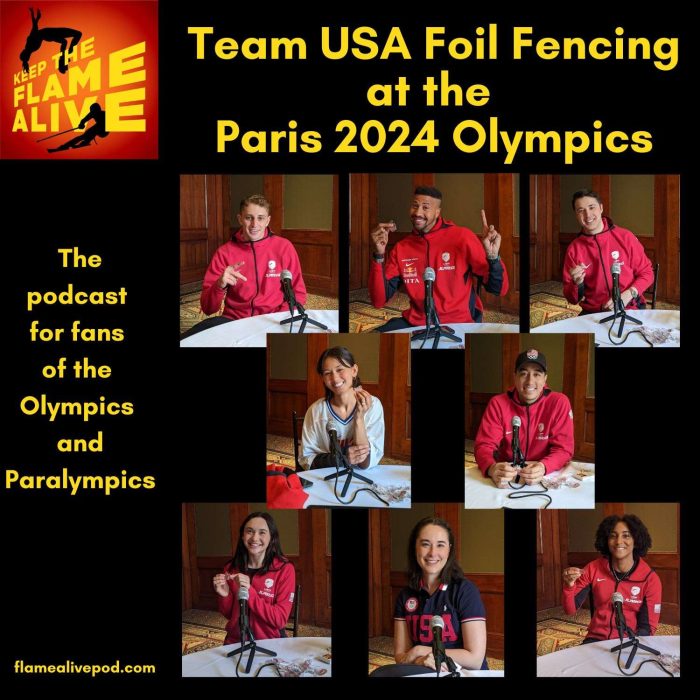
We are en route to Paris for the Summer Olympics–it’s actually here! While we get settled in and adjust to a new time zone, enjoy Alison’s interviews with Team USA’s foil fencers:
- Lauren Scruggs – first-time Olympian, competing in both the team and individual competitions.
- Jackie Dubrovich – Paris will be her second Olympics, where she’s competing in both the team and individual competitions.
- Lee Kiefer – Paris will be her fourth Olympics, and she is the reigning gold medalist in women’s individual foil. She’ll also compete in the team event.
- Maia Weintraub – Paris will be her first Olympics, and she’s competing in the team competition.
- Miles Chamley-Watson – Miles competed at London 2012 and Rio 2016, where he was part of the bronze-winning foil team.
- Nick Itkin – After winning bronze in team foil at Tokyo 2020, Nick is gearing up for his second Olympics.
- Alexander Massialias – Paris will be his fourth Olympics, and he’s a two-time bronze medalist from Rio 2016 and Tokyo 2020.
- Gerek Meinhardt – Gerek’s first Olympics was Beijing 2008, and Paris will mark his fifth Games. He was part of the Rio 2016 and Tokyo 2020 bronze medal teams.
We’ve got all sorts of ways you can be prepared for Paris!
- Paris 2024 Viewing Guide on Apple Books and Amazon. Kindle Unlimited users can read it free of charge!
- Paris 2024 Olympics Travel Journal – can also be used to document your at-home viewing!
- Paris 2024 Paralympics Travel Journal – also great for at-home use!
- Merch – Look good and let people know you keep the flame alive!
Thanks so much for listening, and until next time, keep the flame alive!
TRANSCRIPT
Note: This is an uncorrected machine-generated transcript and may contain errors. Please check its accuracy against the audio. Do not quote from the transcript; use the audio as the record of note.
356-Team USA Foil Fencers
[theme music]
Jill: Hello, and welcome to another episode of Keep the Flame Alive, the podcast for fans of the Olympics and Paralympics.
If you love the games, we are the show for you. Each week we share stories from athletes and people behind the scenes to help you have more fun watching the games. I’m your host, Jill Jaracz, joined as always by my lovely co host, Alison Brown. Alison, hello, how are you?
Alison: I hope I’m not dead. Oh, please. Oh, man, that would be, that would be rough.
That would be really rough.
We’re recording this ahead of time because we’re going to be traveling when this airs. And when this airs, our plane should be landing. That is correct.
So yeah, I hope it’s all going well.
Jill: We’ve had a great flight. We’re going to get through customs with no problems.
Alison: So over the weekend we were talking and I mentioned how we have. About 100 Shukfustanis competing in Paris in both the Olympics and Paralympics. And one of the reasons we got to that number is we have the entire U. S. fencing team now as Shook Flastanis.
Jill: Which is incredible and amazing.
Thank you to USA Fencing for having you down to Media Day. You got just so much time with the whole team. It was incredible. Yeah. So today we’ve been bringing you different weapons in fencing. There’s three weapons, epee, saber, and foil. And today we’ve got the entire foil team, men and women are both competing.
And uh, yeah, it’s, we’re, we’re wrapping up our interviews ahead of when we go to Paris. So we’re going to bring you the rest of our fencing interviews. We don’t have any other news after this because obviously we’re taping early, but this is a longer show anyhow. But yeah. Um, tell us who we’ve got Alison.
Alison: Okay. So we have Jackie Dubrovich is a graduate of Columbia university where she was a four time all American. Jackie was part of the team that won gold at the 2024 world cup and she will be competing in her second Olympics in Paris in both the team and individual events. Lee Kiefer is the reigning Olympic champion in women’s foil, the first American to ever win gold in individual foil.
She has won 11 individual World Cup and Grand Prix gold medals and is currently ranked number one in the world. Maya Weintraub is the 2022 NCAA individual champion. She was representing Princeton and she is the youngest member of the FOIL team. She will be competing in the team competition in Paris. On to the men.
We’ve got Miles Cholmley Watson, who was born in London. Came as a small child. So you will hear a bit of an accent with him. Uh, he has been on the U S men’s senior team since 2011 and first competed at the Olympics in London in 2019. Miles was a member of the first American team to win a senior world title in men’s foil.
Nick Itkin won bronze in the men’s team in Tokyo. He is a two time NCAA individual champion and the reigning world champion. individual silver medalist and also currently ranked number one in the world. And Alexander Meselius is a three time Olympic medalist winning bronze in the team event in Rio and Tokyo and individual silver in Rio.
Paris will be his only medalist. Fourth Olympics. A couple notes in our conversation with Alexander. We talked about his father and coach, but I don’t think we ever gave him a name. And that is three time Olympian, Greg Masialis. And he is, he also mentions race. And that’s his former Olympic teammate, Race M.
Bowden. Last, uh, for the men is Garrick Meinhardt. He is a five time Olympian and two time team bronze medalist. He has won seven world champion medals and 17 world cup medals. But first up, we’ve got Lauren Scruggs, Lauren won the 2023 NCAA individual foil title, and she is competing for Harvard. She will compete in both the team and individual competitions in Paris.
Take a listen to all of our foil fencers.
Lauren Scruggs: And I want to ask you first, why foil? foil, I mean, my brother did it. So I think naturally I just ended up picking that. I wouldn’t say I really had like a choice, but I think it, it just ended up that, you know, that’s what I’m good at.
Alison: And you’re from that fencing hotbed of Queens and both your brother and you fence, how did you get into it?
Lauren Scruggs: Yeah. So my brother is a big fan of Star Wars and you know, he’s six years older than me. So kind of everything he did, I was put into, and then I just stuck with it.
Alison: I love how many times I’m hearing Star Wars people. What about fencing keeps you in it? What about it is the sport for you?
Lauren Scruggs: Yeah, I mean, I think I just like how competitive it is, the nature of the competition. You know, it’s you versus someone else just battling it out. I think that’s something you only, very few sports you get that kind of like personal kind of feeling. I guess maybe like tennis or boxing, but yeah, I just like that whole kind of just you against your opponent and you know, you’re really trying to just fight it out.
I really love that.
Alison: Are you a sneaker or fencing shoe person?
Lauren Scruggs: Sneaker. Why? , just cooler, better, I don’t know. Do you have a favorite? Yeah. Yeah, I mean right now. My sneakers are pretty cool. They’re Isabel Marantz. Love them. So, yeah.
Alison: What are you finding going back and forth between collegiate fencing and international fencing?
Lauren Scruggs: , I think that they’re equally as competitive. Uh, I think collegiate fencing is just like a different type of tournament, but I think I still feel that competitive energy, on the international scene as well.
Alison: So, fencing tournaments are long. The days are long. How are you keeping yourself in it mentally and physically?
Bye.
Lauren Scruggs: Yeah, I mean, listening to music is a big one. I listen to a lot of music. Also, just honestly, not talking to people is a big one. You know, you gotta preserve all the energy you can, and talking takes a lot of that out. Um, and then also just eating, you know, making sure you’re eating the right foods at tournaments.
Also, getting a good night’s rest is important. Yeah.
Alison: Do you have a favorite snack? I have to add, whenever people mention food, because I just ate my snack.
Lauren Scruggs: Yeah, I mean, bananas are just the best. Can’t go wrong with a banana.
Alison: Are you a talker on the strip?
Lauren Scruggs: No. No. Pretty quiet.
Alison: To yourself?
Lauren Scruggs: Nope. Just blank in my head.
Alison: why does that work for you?
Lauren Scruggs: I think because at the end of the day, the best fencing happens when it comes naturally. And I think thinking as a whole means you’re not, things aren’t coming naturally, you have to process it. So for me, I think I offense best when like nothing is going on in my head.
And you know, I’m not interacting with anyone. Not even my coach really that much. So yeah. Do you do a lot of prep work against your opponent? No, you just got to feel it out. That’s my philosophy.
Alison: So you’re just going to go in, see what happens right at the moment.
Lauren Scruggs: I mean, obviously I’ll like think about like, Oh, this is what they like to do.
But honestly, each bout is going to be different. So you can’t, I don’t think it really helps to prep so much because it might kind of block your creativity, you know, throughout the bout. How about being coached during bouts? yeah, like my, my, my coach gets me. I’ve been with him for like 10 years or so.
He gets, you know, is when I, what I want to hear, what I need to hear. but generally I like to be coached throughout the bout, but I don’t like someone constantly yelling at me just like a little, you know,
Alison: And how is that different for individual versus team? Because with team, there’s a lot going on.
Lauren Scruggs: So for team, I think it’s honestly less is better. There’s only so much you can coach, um, and you know, tell the athlete to do. at the end of the day, it’s just how they’re fencing in the team event. Individual, I think there’s a lot more room for improvement, just because of the nature of the tournament, which is a lot different.
Um, but yeah, those are, I’d say the, just the two differences in the tournament just impact the coaching a lot.
Alison: What’s your favorite action?
Lauren Scruggs: definitely a six flick to the back. Okay. Or a runner.
Alison: Okay, explain both of them.
Lauren Scruggs: Yeah, so a six flick is basically like, you kind of just scoop up the blade and then Kind of throw it and hit them on the back.
It’s pretty satisfying and then the runner is honestly as it sounds You just kind of run at them and hit them pretty satisfying Yeah I’m just kidding this. Yeah,
Alison: I Wish we had visuals. Yeah podcast What’s your favorite kind of opponent to face?
Lauren Scruggs: Someone like pretty clean fencer, you know, you know what you’re getting when you get in front of them Yeah, just someone clean
Alison: So I want to ask a little bit about, , your foil equipment. Are you a tinkerer? No. That doesn’t surprise me. Has it been the same long time, keeping everything in line?
Lauren Scruggs: Yeah, a pretty standard setup. I don’t think I’m changing things very often.
Alison: Is that a comfort or is that reliable?
Lauren Scruggs: Not at all. I think it’s in part because I’m a little lazy.
I’d rather just keep it the same and not deal with like fixing it or not. but I mean I guess I’m just used to it by now so I keep it that way. But, I think I’m lazy.
Alison: Did winning the NCAA title feel like pressure or like confidence?
Lauren Scruggs: , definitely just I guess confidence. NCAAs is just a crazy tournament in itself, so I guess to come out of that, just winning it is a big deal.
but also, I feel like there’s no pressure on me to win, it’s just like, it’s a super tough tournament, like anything can happen. So, just, it was just a boost in confidence. How is it different than international? setup is super, it’s just a lot different from the international setup, so it’s all five touches, whereas it’s international, it’s mostly 15 touches.
So, you only fence 15s when you make it through the tournament. You fence everyone in the tournament to five, and then out of that, the top four from that gets sent to the final rounds, and then you do the fifteens like normal. so I’d say it’s actually a lot harder than what we’re used to. Um, so yeah, it’s just a weird format to go from after constantly being abroad.
Alison: How is, you have your college team, and now you have your national team, and how is that switch and kind of coming together?
Lauren Scruggs: Yeah, I mean, a lot of the people on the national team, obviously, you know, I meet them on the NCAA team, like the whole men’s sabre squad. Men’s sabre team is all crimson. Uh, yeah, my, uh, teammates are all there.
I mean, it’s just kind of, like, comforting to see, you know, my friends from college, obviously traveling with me to Paris. Um, but yeah, it’s really nice.
Alison: What are you looking forward to the most in the competition?
Lauren Scruggs: Um, honestly just to represent my country and, you know, show, you know, what I’ve got and try to, you know, make my friends and family back here proud.
and then also I’m really excited to see the other athletes. You know, USA Basketball is a big one. Really love Anthony Edwards, obviously LeBron. So super excited just to support, you know, Team USA.
Alison: Mental during the tournament. You don’t seem like you would be a nervous fencer.
Lauren Scruggs: No.
Alison: Because everyone who I’ve asked that question to, they’re like, yes, everybody’s nervous, except for Lauren Scruggs.
Lauren Scruggs: Yeah, I mean, you just gotta go out there and do what you gotta do. I mean, yeah, you could lose, you could win, but like, you know, you just, it’s better to try and, you know, go in with confidence. And the, if you go into the bout already scared, it’s gonna translate to, I think, the fencing. So it’s best to just go in and say, you know, anything can happen.
I can win, I can lose, whatever. That’s very mentally healthy for you, Lauren.
Alison: Great, that’s perfect. Thank you so much. Thank you. going to have you say your name for the tape.
Jackie Dubrovich: Jackie Dubrovich.
Alison: So this is second Olympics. How has your mental training changed going in now that you kind of know what to expect?
Jackie Dubrovich: Yeah. , I would say it’s definitely an advantage to know how an Olympics Goes. I will say that I was in Tokyo, and Tokyo was definitely not your typical Olympic experience, so I don’t know if I quite really know what the Olympics is about.
but I would definitely say in the last three years I’ve placed a special emphasis on my mental training, especially as an older athlete as well. obviously working on your technique and your, your strength and conditioning, that’s. That’s a big part of the game, but I think the mental training is equally as important.
And I think I’ve realized that later in my career. And so that’s definitely been an emphasis.
Alison: I love how you’re 29 and an older athlete
Jackie Dubrovich: compared to these 21 year old,
Alison: how has that changed your training physically? Like what was your training like at 21 versus 29?
Jackie Dubrovich: I would say it’s definitely smarter now, more efficient, more of an emphasis on rest and recovery as well.
Um, I just can’t, necessarily train as much as I, I still train a lot, but, I’m definitely paying attention to my body. Any signs of fatigue or aches and pains, I’m being very cognizant of that.
Alison: So speaking of aches and pains, we were just in the hallway, you were complaining about your foot.
Yeah. So now I’m concerned for you, Jackie. Is it anything we need to be concerned about?
Jackie Dubrovich: No, no, just part of, you know, it’s a long season. Fencing is It’s such a tough sport in that our season is like pretty much 11 months of the year. We have only one month of break and then we start up again for the national season.
So it’s just part of it, part of the overuse and training and hopefully I’ll be all good to go in a couple of weeks.
Alison: I did not realize that about the season. So where does the Olympic schedule fall in within the season?
Jackie Dubrovich: At the very end. Yeah. So we start typically in September and. we’re going to be competing in end of July, so it’s at the tail end and you’re trying to peak at the right time.
You’re trying to listen to your body and it’s definitely very, very difficult.
Alison: So how do you balance qualifying versus saving yourself for the actual competition?
Jackie Dubrovich: Yeah, that’s a great question. Well, at the beginning of the season, I. We looked at a calendar with my coach and my strength and conditioning coach as well and we kind of mapped it out and we were very, specific about where we wanted to peak, where we wanted to taper down, where are there moments that maybe a competition is not as important, and we’re just very methodical in our approach.
like I said, fencing is hard because it’s 11 months of the year and the Olympics is obviously the main event and so, just being very methodological and very, uh, smart about our preparation.
Alison: And then you’ve got team and individual.
Jackie Dubrovich: Yes,
Alison: that you’re balancing. So how do you balance that during a competition?
Jackie Dubrovich: Yeah, well, the individual event is always the first one. And so you give it your all in the individual event, and then you forget everything the moment the individual competition is over. And fencing is very unique in that we, it’s a very individual score, right? It’s you versus your opponent. But then you kind of have this hybrid where you’re still, competing against one other person, but it’s in a team kind of structure.
And so you kind of have to pivot a little bit mentally where, it’s, it’s different strategies, different, you know, we, we plan for each team accordingly, but you have to think about how your fencing impacts the greater team. Whereas in the individual event, it’s just yourself that’s being impacted.
Alison: This gives me a chance to ask a little bit about team strategy within the team event, because there are individual bouts. Yeah. So. Is it? We just want to win every bout, or is there a more complex strategy going in?
Jackie Dubrovich: It’s pretty complex, and it varies based on the opponent. It also is very dynamic because it’s in real time, so we may have to pivot in real time, where that means maybe a strategy that we went in, into the bout, thinking that we were going to implement, and then let’s say we are losing, and we weren’t anticipating that in that leg we would be losing, and so you have to recalibrate and have a different strategy.
You also have substitutions. And so it’s a very dynamic, like ever changing, strategy that we have to implement.
Alison: How much input as a more veteran athlete are you putting into that strategy versus your coaches coming into it?
Jackie Dubrovich: Yeah, I would say, so Lee Kiefer and myself are the veteran members of the team.
And for us, I mean, I believe, I think Ralph really values our input, um, and our experience. And it’s very collaborative. Ralph is the Women’s Foil National Coach. And it’s a very collaborative experience. Um, he takes our opinions and input into account. But ultimately he is the national coach and he will make the decision.
But we definitely appreciate how collaborative he is in his approach.
Alison: I want to handicap the foil, tournament in Paris a little bit. So obviously the women are, uh, from the U. S. are very strong. What other countries should we be looking at? Paying attention to.
Jackie Dubrovich: Yeah, I would say Italy. Italy is always, a big, tough competitor for us.
France is also and they have the home home court advantage as well. So definitely the two teams to look out for. Japan is also very strong. I mean, it’s a small event, right? It’s only eight teams. And so everybody there deserves their spot. And so even if you may Yeah, definitely. Um, we’ve had had, good team matches against them in the past.
The Olympics is a different ball game, and so we’re taking each opponent very seriously.
Alison: How much are you fencing against your opponent versus fencing your own match?
Jackie Dubrovich: Yes, that’s a great question. I would say, so my mentality is when I, I like to prepare, I watch video, I like to talk about how I’m going to prepare.
Um, I think it’s really important that you know, you’re at your best when you’re fencing your game, and I think as an older athlete, I am very confident in my abilities. I’m very comfortable in who I am as a fencer, and I know what I’m capable of, and I know my strengths and weaknesses. And so just remaining steadfast in that, and not wavering.
I think Is when I really fenced my best.
Alison: What’s your favorite action?
Jackie Dubrovich: my favorite is in fighting. So when you’re in a close distance, I, like to score a lot of touches that way. I’ll score like behind my back. and I just love like in that moment when you’re just like so close to your opponent and like finding the target, , is my favorite action.
Alison: What’s your grip?
Jackie Dubrovich: My grip? it’s just, my fiance, he does all of my, um, my foils. And so he is the person to ask.
Alison: Yeah, but there are the two different grips. The, Oh,
Jackie Dubrovich: Oh, you’re talking about like the pistol versus pistol pistol every year.
Alison: Okay. Why? Yeah.
Jackie Dubrovich: Um, well, because you, so in foil, you very rarely see anybody, , fencing with French grip.
It’s more prevalent in epee, but in foil, no, we, we have pistol grip and it’s just more technical. you feel the blade a lot better. And so there is actually nobody on the circuit that fences with a French grip. Yeah. it’s not common at all in foil.
Alison: And why foil?
Jackie Dubrovich: Well, I started, I’ve always fenced foil.
, I started when I was eight and that was the weapon that I was put in. And I never really considered any other weapon. My build is kind of an epee fencer. I’m tall, I’m 5’10 So, you know, sometimes people would ask me if, I could fence another weapon, what it would be. And that my build is very epee esque.
But I’ve just always fenced foil. I like how technical it is. It’s usually the weapon that most people start off in. So you learn your technique and then you venture off into epee or saber. And so I just, I’ve loved it and want it to stay. Okay.
Alison: What advantage is your height in foil? And is there a disadvantage to being taller than some of the other fencers?
Jackie Dubrovich: I would say overall, it’s probably an advantage. You’ll see that for the most part on the circuit, it’s taller, athletic, more athletically built, muscular women at the top. We have a longer reach. It’s harder for opponents to reach us, especially if you’re fencing a smaller fencer. You’re probably more explosive and just like when you’re lunging, I can cover more distance.
Usually, though, that means I’m a little bit slower than some of my smaller, smaller opponents. And so you have to take that into account. Always working on footwork and recovery from lunges. so it’s, yeah, it’s still very important.
Alison: I want to add, because we’re talking about footwork, and we’re talking about shoes. Yes. Because, do you wear a fencing shoe?
Jackie Dubrovich: No.
Alison: Okay, so what do you wear?
Jackie Dubrovich: Yeah, that’s a really hot, like hotly debated topic in the fencing community. so I had tried fencing shoes, but for me, I found the most success with court shoes.
So I wear Asics shoes. anything that’s like tennis, badminton, I just found that the traction, the support, and there’s a little bit of cushion, but not too much. And so, for me, I’m very particular, and I finally found, at like 28 years old, my ideal shoe. and so, yeah, it’s an A6, , shoe, and I think it’s the best one I’ve ever tried.
So,
Alison: is it the balance between, sort of, stickiness and slide, that,
Jackie Dubrovich: that Yeah, I would say for me the optimal I need to feel I don’t like too much cushion because I like to feel the strip and actually feel my footwork. I guess I feel the articulation of my foot. I want a little bit of cushioning because the blow when you land from a lunge, it can be quite hard.
Um, and I’m also taller, bigger, muscular. And so I come down pretty hard. , but not too much. I don’t want to feel like I’m fencing like hocus, right? Where there’s like so much cushion, it feels like a cloud. Yeah. , and then not too heavy, right? You want to be flight of foot, too, so it’s a delicate balance, and I’ve finally found the model that works for me.
Alison: How many do you bring with you?
Jackie Dubrovich: so to competitions, I only bring one pair, but I do currently have, I four or five pairs of the shoe that I circulate between competitions and training a lot.
Alison: How are you training on the balance in your body?
Jackie Dubrovich: Yeah, that’s a great question. We do a lot of like proprioceptive work.
I
Alison: don’t know what that is.
Jackie Dubrovich: So proprioceptive, it’s like being aware of your body and like where it is in its And it’s it’s surroundings, I guess. , so a lot of like, well, one, we work on a lot of core core is like really important in fencing, especially with footwork with recovery. It’s really, really important.
and keeping the center of balance, right? We’re always changing direction. So you want to know where your body is in its space and also be able to pivot and change directions very quickly. Fencing is so dynamic, right? We’re We’re moving back and forth. Maybe foil fencing. I would say saber fencing right is much faster, but foil fencing I would say there’s a lot more change of direction.
There’s a lot more pushing pulling of the distance and recovery So just being aware of where your body is on the strip is very important
Alison: You said fiance who takes care of your equipment? Yes
Do you ever just want to put the foil on the table and just say Really?
Jackie Dubrovich: Well, I’ll add another wrinkle to it. My fiance is also my coach. So we’ve been together for, I guess, 12, 13 years. And he’s been my coach for this quad or these last three years. So
Alison: how do you balance that when you’re boyfriend, girlfriend, fiance, and when you are coach student?
Jackie Dubrovich: It’s a tricky balance. It is very tricky. I would say Okay. You know, we have to make an active effort to separate fencing in our home life, so we try not to talk about it too much when we’re at home and, you know, we’re just, we’re just together and we’re not talking. I mean, it sometimes comes up in conversation, but, but when we’re at practice, right, that dynamic shifts.
He needs to tell me what to do, and so, It’s still difficult and it’s still a work in progress, but obviously at the end of the day, I know that he is trying to make me the very best that I can be and it’s coming from a good place, so if he yells at me or if he tells me what to do and I don’t like it, I know that ultimately it’s coming from a good place.
So, it’s always a work in progress.
Alison: I’ve been married 27 years. It is always a work in progress.
Jackie Dubrovich: Yes.
Alison: But don’t get too comfortable with that one. What’s next? Next year.
Jackie Dubrovich: What’s next? So I am just focused very much. So on Paris, you know, we have a really great team. We have two younger members as well as two veterans.
, we are very, very excited about what is to come, both individually and the team event. , we have a lot of training camps coming up a lot of really focused training, and I’m just excited to give it my all
Alison: and the next two months look like.
Jackie Dubrovich: A lot of time on planes. Yeah, we just got back from three weeks in Asia, so we’re all a little jet lagged right now.
we have a training camp in two weeks, then we have zonals in Lima, Peru. , and then we’ll have another training camp, and then we leave for Paris July 19th. , one day after my 30th birthday, so it’s a nice little birthday gift for me. but yeah, we, it’s, It’s gonna get crazy and I’m just trying to remind myself to stay grounded as much as possible and also really relish the opportunity.
I’m really taking it all in. I think for me, Tokyo was a very strange experience being my first Olympics. And so, I’m just excited to experience what the Olympics are supposed to be like, in Paris. , yeah, just excited for what’s to come. Who’s coming? My parents are coming. I’m really excited because, again, I couldn’t see them, in Tokyo.
Nobody was there. So, I’ll have my parents, I’ll have Brian, my fiancé and coach there, uh, with me in the box. And, I’ve heard some friends are trying to go as well, so, and also, Former teammates and fencers. So it’s going to be a big reunion in Paris
Alison: at the Grand Palais.
Jackie Dubrovich: I know how lucky are we? It’s I’ve been seeing pictures.
It’s unbelievable. I think we have the best venue out of all the sports.
Alison: I am most excited to see Grand Palais and Versailles. Yes. So basically I’m having like a 17th century Olympics.
Jackie Dubrovich: It’s unbelievable. It’s, I mean, it’s really crazy. And they did, I heard renovations on the Grand Palais. So. I’m really excited.
What a treat. What a treat.
Alison: Excellent. Thank you so much. That’s perfect.
, Lee Kiefer. We saw you at team USA with that brace and I got all nervous. Brian told me not to worry, but what’s going on?
Lee Kiefer: I have been fencing for 20 plus years. I’m almost 30 and it’s not unexpected that I have an overuse injury. I won’t get into the details, but it’s getting better.
We’re thinking about Paris, and we just we want things to get better, not worse, but it’s good. Thank you for asking.
Alison: And Notre Dame, I understand that , Meryl Zagunas was your hero growing up.
Did that play into your decision to go there?
Lee Kiefer: Notre Dame definitely had a, Such amazing reputation. Um, and she’s probably one of the reasons like I even looked at Notre Dame in the first place. So I think that was probably a starting point for me exploring that option.
Alison: Now you are a pocket princess like myself.
So how does your height play as a disadvantage and an advantage for you?
Lee Kiefer: Yeah, I grew up thinking it was only a disadvantage, but. I was able to discover my own style and kind of get creative from a young age because I had to overcome my height. , so now I just think it’s an advantage. And I, if you ask my competitors, they’ll just say she’s so annoying to fence.
She’s so fast and small. She’s so lucky. Um, but I didn’t think that was always the case, but now I do.
Alison: Now we can just like sneak underneath.
Lee Kiefer: Exactly.
Alison: So I understand you and Garrick went to an event this morning where it was, Oh, a couple is going to teach a couple how to fence. Is that nice? Or is that Oh, God, we’re the golden couple of fencing and media is kind of glomming on to that aspect.
Lee Kiefer: Yeah. I would say, Garrick and I, we do train with each other. I would even say we’re each other’s main primary training partners. So that part it’s nice to share with people that we like really are going through this journey together. but we’re pretty shy and we’re pretty private. So when they ask, who asked who out or how long have you been dating?
We’re just like, We’re not telling you.
Alison: That’s for you.
Lee Kiefer: Yeah.
Alison: This was a try versus a quint last time around. So how has that changed your training?
Lee Kiefer: Every Olympics is different. I would say going into the games we know We’re not sure what the atmosphere is going to be like, so in some ways, we’re gonna have less distractions than first timers at the same time.
I think we have the capacity to metal and based off how we mentally prepare ourselves like that can be pressure or it can be positive stress to help us reach those goals.
Alison: So this time, obviously, you’re the defending gold medalist. How has that changed your mental preparation?
Lee Kiefer: like I said in my last answer, I’m so excited for myself individually, and I think I can do it.
But our team is also so good. And we won a few World Cups as a team this year. And I think it would be really cool for us to take home that gold together.
Alison: Did you go through the imposter syndrome after you won?
Lee Kiefer: I would say I have really bad imposter syndrome when it comes to medical school. Fencing, I’ve been around long enough.
I think I’ve put in work and time and all the things to make me feel like I belong. But when it comes to school, I don’t know what I’m doing there. It’s so hard. It’s so hard.
Alison: I doubt that, Dr. Lei. I doubt that. Has your fencing changed since the last quad?
Lee Kiefer: I would say my repertoire has expanded. I, in general, am a very attack heavy fencer, and I really value improving my defense, maybe slowing down at points.
Yeah, there’s a lot of changes I’m working on. Whether or not that comes through in competition, it’s in the works. It’s being worked on in practice.
Alison: What do you want to see from yourself on the strip? What do you think is a successful bout for you?
Lee Kiefer: Yeah. I want to be able to fence free. I want to be able to tap into those actions that make me feel creative and powerful.
And I think the Olympics, it comes around once every four years that we get nervous and maybe hold ourselves back a little bit from tapping into that flow state. So I really want to just mentally and physically set myself up. So I can try to achieve that.
Alison: How do you balance the mental training and the physical training and you actually are, you know, Dr. Kiefer over here?
Lee Kiefer: I’m not Dr. Kiefer yet. Not yet.
I think I have to acknowledge that it changes based off where you are in life, where you are in your career. I’m married now. I’m partway through med school. I’m gonna be 30 years old, not 18 years old. My body feels different. And I need to meet myself where I’m at. And I have a partner who really helps me get through that.
And I also have a sports psychologist who helps me cope with it.
Alison: What does a day look like? It’s very full day, I’m sure, but especially in comparison to prior to Tokyo. What’s changed now that you are so old, Leigh?
Lee Kiefer: rest and recovery is much more prevalent. When I make my schedule for the week, for the day, let’s say in the morning I’ll have an hour blocked off for strength and conditioning. I try to have a nap every day. I definitely eat all three meals to their fullest. And then, three hour practice, after that I have half an hour to an hour of recovery.
And that was not the case before. We just bounced back up in the next day.
Alison: What’s your favorite action?
Lee Kiefer: I would say the most satisfying action is a backline defense where you have one foot off the strip and you’re defending for your life and you get that parry and repost. So satisfying.
Alison: What’s an action that If you can pull it off, you are so proud of yourself because it’s not something you’re comfortable with.
Lee Kiefer: Yeah, I do not do point in line often.
Alison: Okay, what is that?
Lee Kiefer: Point in line is an action where your arm is extended, your blade is straight, and you can establish it. A few different ways. It’s a little complicated, which is why I’m not very good at it. But the best case scenario is when you’re in the right distance, you get your arm out, and your opponent searches for it, and they basically stuff themselves on your blade.
And they feel really bad, and you feel really good.
Alison: What are you most nervous? For in terms of the physical, I mean, besides the brace, but just going into the next two months, what are you, how are you pacing yourself? How are you putting that together?
Lee Kiefer: Yes. The word pace is so important. I would say after every tournament, you kind of go down a little bit.
You rest a little bit mentally, you let yourself off and then you have to work your way back up. So there is. So we’re gonna be doing a lot of those. Those many cycles and those macro cycles. So obviously, the Olympics is like, you know the up you’ve been working for for four years. but all of us competed this past weekend, and we’re gonna Recover.
Try to handle our injuries and then mentally and physically just get back there.
Alison: What are you thinking about on this trip?
Lee Kiefer: Mm. I am more of a take each touch by touch type of gal, but I do notice myself drifting off once in a while, so working on bringing myself back, centering, getting the energy up is really important.
Alison: Are you a prep? I bet you are. You’re a prep. Doing a ton of prep before, about.
Lee Kiefer: I guess it’s all relative. I’m sure you’ve heard a lot of difference.
Alison: Well, Lauren was just in here, so she was like, I don’t prep at all. Oh yeah, Lauren’s
Lee Kiefer: chill. I usually like to do video analysis the day before, and I like to warm up a lot.
I like to eat a lot, because I think that’s the only thing I can beat myself up after a tournament if I literally didn’t like nourish myself or like wake up before. I’ll be like, why did you do that?
Alison: So this will be the first time, Marielle will not be on the Olympic team with you. Do you realize that you’re her now?
That all these little fencers are kind of looking at you. I say that with love, Leah, I really do.
Lee Kiefer: No, I know, it makes, it makes me feel a lot of different ways. I’m so happy that I’m here still fencing. I’m really proud to have helped U. S. Fencing, U. S. Oil, kind of get to this really cool dominant stage that they’re at.
Yeah, it’s also a little bit sad just being the veteran. It just means it’s coming to an end soon.
Alison: Never. You will always be the gold medalist of Tokyo. You’re never a former Olympian. You’re always an Olympian. Good luck in Paris. You’ll be there. Nice to meet you. Maya Weintraub. I want to ask you about the broken leg from 2018.
Maia Weintraub: Oh, yes. Yes. You did your homework. I did do my homework, so I
Alison: read that. How old were you?
Maia Weintraub: Oh, gosh. I think I Middle school age, I remember it was, it happened at a fencing camp, but I was not fencing.
So my parents were very mad. It was actually, I was playing a game of manhunt in the dark. And I slipped on wet concrete, I believe. And I twisted my ankle in a way and banged my fibula into the ground. So I actually fractured my fibula and had a sprained ankle. And I just remember. My parents picked me up from the fencing camp and we drove home and they were very,
Alison: I’m sure.
But then you got to go back and you decide to keep fencing. Yes. What did that look like? I mean, you were so young. I would think that, I mean, you didn’t hurt yourself while fencing, but just coming back from that and, and the mental issue of, is this going to hurt? Is my going to hurt myself again?
Maia Weintraub: I think that fencing already was a big part of my life.
It was incorporated into my daily routine pretty heavily already. Um, so actually, like, not being able to fence for that long of a period of time, where I needed to recover was very different and very jarring. and it made me realize, oh, like, I really, I miss fencing. Like, I enjoy fencing. And that also helped me realize, like, oh, like, This might be something I really have a passion for.
and it made me want to do the physical therapy, like get better, go back into fencing. But yes, there was that fear of, oh, what if it happens again? Especially I’ve had like a history of getting sprained ankles, both like front leg, my back leg. and for a while, like, I wore ankle braces on both my legs, just like as a precaution.
But like as time went on, like I learned to do more, like, balancing exercises, trust myself, and sort of regain that, , confidence, that, like, I’m preparing in a way where I’m protecting my body, and that’s something I learned as I grew older. Like, when you’re young, you think you’re invincible, But as I get older and now, like, I have aches and pains and I need to take care of myself better.
I know that’s crazy for a 21 year old.
Alison: It’s okay. You’re the same age as my daughter. So I could just be like, but I, but it’s true. I mean, 13 is not 21 and collegiate fencing is not junior
Maia Weintraub: fencing. Yes. And so I think that’s something I’ve like learned through injuries in the past, like how to like take care of myself better now.
Alison: How was that change going from junior to collegiate and then international? Kind of at the same time,
Maia Weintraub: I think they all influenced each other. I think me traveling at a very young age helped me grow as a fencer. Like you’re fencing some of the best in the world, watching them compete, how they compete, and it’s influenced me in my fencing domestically.
That turned into collegiate fencing where I sort of was able to experience of a more team oriented environment because fencing is so individual like it’s You and your opponents and yes, we do have a team competition element at some events, but it’s still very much You are fencing someone else and then you sort of rotate with your team like a relay But in college fencing you sort of add up all your bouts So you’re about is just sort of like one point that you can bring in for your team.
You have to learn to trust others, to put your faith in your teammates. and you sort of learn to lose control a little bit in a good way. And I think that has really helped me especially for like team like events and team competitions, and I’m very thankful for um, college fencing for that.
Alison: How would you describe yourself as a fencer?
Maia Weintraub: I think I’m very calm. I’ve been told I have a calming energy when I fence. I’ve actually told, I’ve been told by some of my friends that when I fence, I almost like, lull the other person into like, like fencing slower. Yeah, I’m a slow person.
Alison: No, that’s, that’s So what’s your favorite kind of action?
Maia Weintraub: I don’t know how to start. I don’t know how to describe it. I guess, so, okay. So, preference, what I’m about to say, my fencing coach has a saying where like slow is smooth and smooth is fast. So I really like those actions where it’s very smooth. Like it’s not very, like I would categorize fencing, like I would describe it in like rhythms and tempos and I really like very fluid actions, I would say.
Alison: Why foil?
Maia Weintraub: Why foil? Foil is the weapon I started with. I think a lot of people start with Foil because it shares characteristics with Epee and Saber, so you could go into either of the other weapons potentially. I did try Epee, was bad at Epee, so that’s why Foil.
Alison: I like that you’re talking about being calm and, and smooth. How much thinking are you doing on the strip?
Maia Weintraub: A lot of thinking. I think for me, like, strategy plays like a really important role. Because at a certain level, like, you’re fencing the same people over and over again, people are always changing. Like, at a certain point, everyone knows, like, all the actions there are to do, but it’s about when to do each action.
In Um, I response to the what the other person does, and I think. That strategy is what keeps fencing fun like the game is always changing.
Alison: How are you getting better? Physically? Is it more reps? Is it better? Cross training? What? What is getting you better? results.
Maia Weintraub: Hmm. I think because fencing has both like a mental and physical aspect.
you do need to attain a certain physical fitness, but also fencing good people and people who are better than you helps you work out, like, your mind, your problem solving, part of your brain, and I think That’s also like extremely important in fencing. Like it’s never stagnant and if you’re, if you stop being sort of like creative with your actions, if you stop like thinking and just keep doing the same thing that you always do, which is easy to do if you don’t have people to push you, that’s where like it stops being fun and you can stop your growth.
Alison: how has the mental, Training fitness kind of play on as you’re working changed from when from Tokyo to over the past three years for you.
Maia Weintraub: I think I would say my mental game in fencing has always been relatively strong. , and so in the past, I’ve really worked on like my physical, like endurance, strength, stuff like that.
But I think recently, like I have been fencing for longer periods of time. Like burnout is a thing. It happens, especially when we have such long seasons from like October to May, just continuously fencing. And I think right now in recent years, like I’ve tried to put more of an emphasis on like, like sports psych and like training, like my mental game.
Like it can always be, like you can always get better, like be stronger and just like reemphasizing and like relearning, Tools to help with your confidence like it pays off in the end. I believe
Alison: okay I love asking this a foil because I didn’t know this was a thing sneakers or fencing shoes on the strap
Maia Weintraub: I wear And that is very popular in fencing I believe I’ve worn them since I started fencing I’ve
Alison: why why not fencing shoes
Maia Weintraub: I think I tried fencing shoes in the past, but I don’t know.
I think for me, I like , the chunkier, more solid foundation of like the sneaker. yeah, I, I like using court shoes just better for some reason. Yeah. Thank
Alison: you.
Miles Chamley Watson: Miles Chamley Watson.
Alison: And I love the fact that you’re old. And I say that because I’m still older than you. How has your fencing changed, like technically, from, when you were much younger?
Miles Chamley Watson: Well, I think my fencing’s changed. I think the cool thing about the sport is you can always learn more. That’s why.
still have a love for it. I think, you know, I have a new coach, now, which is really awesome. So learning new things, I think having him implement new things into my regimen has just been really refreshing for me.
Alison: Why foil?
Miles Chamley Watson: There’s no other weapon. Nothing else exists. Foil is the best by far.
Alison: Why?
Miles Chamley Watson: Cause I do it. I think cause it’s just, it’s like chess and boxing combined, right? Where you have to think. And react, but also you can play a little bit, which I think is the beauty of the sport. I think it’s just, also very lovely to watch,
Alison: favorite action.
Miles Chamley Watson: Uh, six flick.
Alison: Okay. What is that?
Miles Chamley Watson: Where you hit them in the back? or I have my own movement after me, which is a multi Watson.
Alison: Okay. What is that?
Miles Chamley Watson: It’s where I hit somebody behind my head. So, yeah, the New York Times coined it that, so I’m one of like three athletes to have their own move, which is pretty cool.
Alison: I have noticed that the foil fencers are much taller. So what about foil and height goes together?
Miles Chamley Watson: Well, I think because we’ve got a longer reach and a longer, and a bigger target, but also there are people that are smaller who also do really well as well. So it’s kind of go hand in hand. So you don’t really need height, but it definitely helps with just the way we fence.
Thanks.
Alison: What has changed in fencing during your career just as a sport as a whole?
Miles Chamley Watson: I think just, the aggressiveness of the sport has changed. I think the way people kind of more, aggressive instead of passive, I think it’s just the nature of the game. It’s just changed a little bit, but it’s kind of like a pendulum swing, right?
Where it’s always going to kind of come back to the root of the sport, which is just the intensity, I think is what is always there for us.
Alison: Sneakers or fencing shoes?
Miles Chamley Watson: Sneakers.
Alison: Okay, why?
Miles Chamley Watson: Because fencing shoes, I’m in them all day and sneakers are way more comfortable.
Alison: But I mean when you’re fencing, do you fence in fencing shoes or do you fence
Miles Chamley Watson: in fencing, in Nike fencing shoes.
Alison: Okay, what about those shoes work for you?
Miles Chamley Watson: Well, I help Nike make them, so. Okay. Sponsored athlete. And just like the way they feel and the way they break in, I think is unique.
Alison: Okay. Now, now you’ve opened a whole Pandora’s box. What is that process like when you’re working with the shoe company to develop a new shoe?
Miles Chamley Watson: Well, luckily I’ve been with Nike for 10 years, and obviously the fencing market is still new. So it’s, you don’t, not really going to be selling many units, but they were able to work with me, on creating a shoe that. I had the feeling of you can feel the floor, but also the heel has to be strong.
’cause we land a lot. So was was pretty cool actually. To, to, have my little 2 cents in a shoe is pretty cool.
Alison: So what is that process like? Are you getting samples? Are you getting pieces? Are they videoing you?
Miles Chamley Watson: Yeah, so I go to campus and I work with the design team and I say, this is what I think the shoe needs. And they kind of have their genius people work on the shoes and say, okay, miles. Um, when I come back and then they’ll send me a sample and I’ll wear it and then I’ll send them my feedback back and I’ll go back to campus. So it’s a really nice, collaboration between the two.
Alison: Are they going to name the shoe after you?
Miles Chamley Watson: Well, we, I am trying to get my own shoe that’s not a fencing shoe. So. That’s awesome. Yeah.
Alison: And what would your not fencing shoe look like? What would it?
Miles Chamley Watson: Well, I think you have to start with a pre existing shoe first and see how that does. Um, but I have a name for it.
But, um, I think the key would be to add, you know, pay homage to the sport in the shoe, but also, try and add a little flair too.
Alison: We did a whole show on volleyball courts. So we could go, we could go off on shoes, don’t even get me started. So this is going to be Olympics number three. Have you been getting a lot of, Oh, you miss Tokyo.
And is that. Um, I’m sorry. I’m asking a question
Miles Chamley Watson: that just not at
Alison: all. Really? Okay. I mean,
Miles Chamley Watson: I’ve got me to questions, but you know, I’ve never had any injuries in my career, so I was the first one. And what’s meant to be what was meant to be. Didn’t change my life in any way. and I’m fortunate that it was a COVID Olympics, so.
I’m gonna miss one that one. But, um, yeah.
Alison: How is it coming back from injury at this point in your career versus 15 years ago?
Miles Chamley Watson: I mean honestly like I’m super healthy and I feel amazing and My body hasn’t really changed. I take care of myself as well So I don’t feel like i’m getting old in that way. I’m very lucky where I haven’t had any injuries really had a little one, but So if you’ve seen for 20 years, I only have one minor injury is pretty Pretty lucky, so.
Please,
Alison: I’ve had one minor injury podcasting today, so.
Miles Chamley Watson: Oh, yeah. I
Alison: tripped over the wire.
Miles Chamley Watson: Really? Oh, wow. I hope you’re okay, though.
Alison: No, I am fine, thank you, but this is why I don’t fence. Maya offered to let me hold her weapon and I said, if I injure one of the US Olympians, they’ll never invite me back.
Miles Chamley Watson: That will be a story, that will be a story.
Alison: How are you training the balance in your body?
Miles Chamley Watson: I mean, I’m lucky where I have a team that, of, you know, nutritionists and PTs that kind of help me. So I can just worry about competing, but you know what you eat, how you train, all those kind of things is just important for longevity, right? Past fencing. I want to be healthy.
So I’ve always kind of been aware of what I put into my body.
Alison: And also just the left and right side, because obviously you’re working one side much more. Okay. How does that work for you?
Miles Chamley Watson: I mean, that’s, that’s, that’s tennis, but that’s there forever. I that’s ever going to go away until I stop fencing. But I think.
Just, you know, understanding like how that is and, okay, how do I kind of try my best to even it out is key, but you know, who knows really how to help yourself that way, right?
Alison: How is it balancing life at this point in your life? And I’m harping on you being old and you’re still, wait 20 years younger than I am. But in terms of like being an elite athlete for this long , and at this point, where does it fit in kind of with everything else? And also just kind of having a life.
Miles Chamley Watson: It’s tough, right? Cause you definitely like miss out on a couple things, right. But ultimately, you know, I still, the rest of my life to do, what I want to do. So you kind of have to sacrifice things for the. But it’s tough, but I think that’s that’s the sacrifice you make to be an elite athlete, right? So I could cry about it, but at the end of the day, it’s been the three Olympics, so pretty grateful.
My name is Nick Aitken.
Alison: So why foil?
Nick Itkin: I just grew up when I was a little kid, choosing fencing. And that’s the one I grew up with. So my dad’s actually a coach for coach. So he’s the one who taught me the sport.
Alison: What’s your favorite action?
Nick Itkin: I like attacking prep. You can ask any of my teammates.
That’s the one I do all the time.
Alison: Okay, what does that mean?
Nick Itkin: So basically, like opponents going forward, starting their attack, and I like surprised them. , like, lunging into their step forward instead of going back.
Alison: Sneakers or fencing shoes?
Nick Itkin: Uh, fencing shoes.
Alison: Okay, why? Because now I’ve only, you’re the first person to say fencing shoes.
Nick Itkin: I like my shoes really thin on the bottom. Like, it’s like feel the strip. And a lot of people like it thicker because we get like a lot of blisters and like stuff like that. But, I like my fencing shoes really thin.
Alison: Why Notre Dame?
Nick Itkin: , so I had a really good connection with the coach. , Bucky Leach, who passed away a couple years ago.
And he knew my father really well. And I think he matched my father’s coaching style really similarly. So it really worked well for me. And I think I grew a lot with him when I was there as well.
Alison: You won a world championship medal. Yeah. Did it change how you’re approaching tournaments?
Nick Itkin: , yeah, absolutely. so I won a silver last year and the year before I won a bronze. Yes. but yeah, I mean, that tournament really crushed me. Like, I always dreamed of being a world champion, um, in the senior event. And yeah, I think I grew a lot of confidence in knowing that I can medal back to back world championships.
and I’m just in great shape going into this summer, and I’m excited to be able to compete on the stage again.
Alison: Did it change your mental prep?
Nick Itkin: , yeah, I mean, I always like competing on those high level tournaments when the crowd is wild. And that’s when I kind of just Can fence without thinking too much, and I’m not too nervous.
And that’s just kind of been always my mental preparation was once I get to that stage, I’m kind of fencing the best possible. but in the earlier actions in the beginning of the day, that’s when I like struggled to mentally be, be ready and fence my best.
Alison: How do you train for that? Because the fencing tournament day is very long.
Yeah.
Nick Itkin: yeah, I mean, I train a lot and it’s even, it’s weird. Like I can, in practice, I can fence so many bouts. So you get a fence. like. All day and I won’t really be tired. But in the tournament offense wanted to bounce and I’m like dying or like not dying, but I’ll feel really tired. And so definitely it’s just a whole nother game.
And I think it’s just experience like tournament after tournament like. I’m growing and I’m getting more adapted to the situation.
Alison: Are you training very differently? This quad versus the last quad?
Nick Itkin: Uh, yeah, I feel like I was just so inexperienced back then, and I was just learning from everything I got from my teammates and from my coach, obviously.
But now I think I kind of like figured out my own routine, my own schedule, and I know like what, what steps I need to do personally , to work that works best for me.
Alison: Are you training less?
Nick Itkin: No, I’m training a lot. , I just, I think back then I was moving around a lot. I was in school and then out of school and coming back.
And now I have like My coaches, my training sessions. I have my sparring partners. We’re really good sparring partners with Miles as well that you’ll probably meet later. So yeah, we got a great system going on right now.
Alison: What did you work on specifically between Tokyo and this time around? In terms of actions you didn’t have before, or, , ways you faced competitors?
Nick Itkin: I think my fencing has definitely grown throughout the years. I’ve definitely been a lot more aggressive now. I think fencing has changed to being really, really aggressive and everyone’s going forward. And I think I’ve adapted my style as well to that.
Alison: Are you a nervous fencer before matches? Uh,
Nick Itkin: it’s weird, like I will be nervous the first two, like the first bout, the second bout, but after that I feel like if I fence well in those first two bouts, or if I win those first two bouts, then I’m not nervous at all and I feel super confident.
Alison: Are you a prepper or a go with the flow?
Nick Itkin: Um, it depends on the situation, but if it’s something that means a lot to me, I’ll definitely be prepping, but In most day to day things, I’m very go to the floor. So,
Alison: are you watching film? You know, you know you’re going to get that schedule and
Nick Itkin: Yeah, yeah, I do watch a lot of film.
, I think it’s, it’s very helpful. Especially, just like, I know all these people are watching me and adapting. And I think fencing, one of the reasons, one of the reasons I love the sport is like, there’s so much of it just figuring out your opponent. Every time I fence these high level people, I feel like it’s a different match, even.
Because we both study each other, we know what happened last match. So every time we go in, it’s a whole nother amount.
Alison: How difficult is it to make adjustments on the fly when you’re on the strip?
Nick Itkin: I mean, that’s a huge, huge part of fencing. That’s basically what changes from being an average fencer to a high level fencer, is being able to adjust and see what your opponent’s doing and change.
Change their actions. , especially when I was a junior fencer, I feel like that’s what changes the gap from a successful junior athlete to a senior athlete and junior athlete. You could be successful with just doing a few things really well, but a senior level is where everyone knows what you’re doing, so you need to be able to adapt and, do different actions.
Alison: So you said you feed off the crowd. Absolutely. So this Oh, absolutely. This is gonna be way better for you than Tokyo.
Nick Itkin: Yeah, no, I, I love the crowd when it’s like quiet and, and there’s no people cheering me on. I don’t fence my best, I think. When it’s a big stage and I have people supporting me and yelling, I can barely hear anything.
I love that. That’s, that’s the moments I dream for. Okay.
Alison: We’ve been handicapping each, weapon. Let’s talk about men’s foil. What other countries besides the U. S. should we be paying attention to?
Nick Itkin: Definitely Italy. Italy has been like our rivalry for a while now. so Italy, our number one rivalry.
That’s definitely the, the best. The main goal to be to beat them this summer. And then also there’s a lot of other good countries out there. Japan is, it’s been doing well recently. France has a good team and yeah.
Alison: What makes American foil different than Italian foil or French foil?
Japanese, no one’s been to Japan before.
Nick Itkin: Yeah, we, we kind of all have our very unique styles, I would say. But we, we both, even with our unique styles, we’re able to like come together and make a very difficult team to fence against because we all have our very different styles that not like a specific, way of fencing.
Alison: When you are a competing team, Where do you like to be within the team?
You know, in terms of order and and bouts?
Nick Itkin: I normally fence right before the anchor bout. So I normally set up, which is the second to last bout.
Alison: Okay. Is that a favorite or are you good at it or both?
Nick Itkin: I’m comfortable in fencing any position I’m put in honestly. but I think we’ve been running this system for a while now, and I think that’s what we’re going to do because we feel comfortable with it and we’re used to it by now.
Alison: So the U. S. Men’s Foil team, very, very experienced. So how much input, how much self coaching are you guys doing?
Nick Itkin: A lot, actually. Um, that’s like one thing I noticed when I was younger is, When I first run the joint during the team at 19. I was the youngest one. I’m still the youngest one But yeah, I was I was just taking in so much information for me from the from my teammates and that helped me so much Especially at that young age and now I’m at the point where I I’m giving feedback as well So yeah, we honestly coach each other a lot in team events, and I think that’s one reason why we’re very successful
Alison: When you’re putting together that team, and it’s so funny because in other disciplines, 24 is the oldest. Yeah, exactly. And you’re the baby in this group. It’s like, Oh, I’ve been to the Olympics before. Yeah, Garrick’s been to five. You know, sit down. But, does that put you in a position of being like, I’ve got a world championship medal, I’ve got NCAA titles, and I’m still, Kind of the baby of the group, you know, in terms of your fencing.
Nick Itkin: Yeah. Yeah. it’s crazy how experienced and like successful this team has been. When I first joined the team, they were like winning every single tournament back to back. So I had to do something crazy to make that team. And that was like motivation and I grew off of them. , but yeah, now I don’t feel like as much as the child anymore.
I feel like I’m basically one of the members just cause we spent so much time together and I’ve been. I’ve been part of the team for so long, but yeah, like when I first joined the team, they, they took me in and I studied everything they did and, and how they treated a team event and I grew so much.
Alison: Are you a thinker or a flow fencer?
Nick Itkin: Uh, I’m definitely a thinker. , I think everyone will tell that we’ll say the same way to, , definitely thinker, but there is a moment in about where something’s working and then I’ll, I won’t think about certain actions just come naturally. But pre bouts, I’m very, very, , I like to calculate a lot, like what they’re doing and stuff.
So it’s hard for me to just go into a bout blind.
Alison: And what, how is that a handicap on the strip in terms of your brain is working over time?
Nick Itkin: Uh, yeah, I mean, that’s just, that’s just how I grew up fencing. Uh, I’ve always felt like I needed some kind of information going into bouts. And it’s hard for me to just be able to go into a bout without any specific plan.
obviously it needs to be adjusted a lot, because bouts change, , often. But yeah, there are a lot of fencers who, they just go forward and they feel the timing to finish. And I don’t think my fencing really works like that, necessarily.
Alison: You’re ranked first in the world right now, so everyone is gunning for you.
And I don’t think that’s a surprise. Does that ever just bring on imposter syndrome? Do you see it like, what is happening here? I’m number one in this field.
Nick Itkin: Yeah, honestly, I mean, this is pretty recent. So it is crazy to think about when it first happened. yeah, I definitely had like a moment where I was like, disbelief and like, not really sure, how this all happened.
But I just got to like, rear myself and, I honestly like being the underdog. I remember when I was a kid, I loved being the underdog, but now I just grow to take a new role and I just treat each tournament differently by itself. So as we come in this, this Olympics, I won’t be thinking about that too much.
Alison: What would be success in Paris for you?
Nick Itkin: I mean, obviously a gold medal. I’ve been dreaming of that since I was a little kid. So, uh, is that the
Alison: only thing like, will you be okay if you fence? Well, but don’t,
Nick Itkin: yeah, of course. I mean, as long as like, I fenced my best and then I’ll be happy, but I think it’s just like there’s gonna be so much pressure the day of the tournament and I, as long as I don’t let that pressure get to me and I can fence my best, then I’ll be happy.
Alison: Okay, so what thing have you been working on that if you can pull it out on the strip in Paris, you’ll be like, that was it. That was the action that I’ve been trying to get.
Nick Itkin: A specific action. I’m just, I feel like any action that I even try to do, they just come naturally. I won’t even think about it.
I’ll just start doing it in a tournament. I’m actually the kind of fencer where like, I’ll see something one time and I’ll just randomly start doing it in tournaments, biggest stage or anything. So it’s just not, there’s not a specific action, honestly.
Alison: Okay. And how cool is the Grand Palais?
Nick Itkin: Oh, it’s going to be beautiful.
It’s going to be sick. I’m so excited.
Alison: I’m excited. Cause we will be there. Will you have a chance to get to see anything else?
Nick Itkin: Yeah, I hope so. Uh, luckily we have a World Cup in Paris, once a year. So I’ve been there a few times, but yeah, definitely, I love the country, love the city, so I’m excited to be there back again.
Alison: Excellent. Thank you so much. Yeah, of course. Thanks for having me.
Alexander Massialas: Alexander Masialis.
Alison: I read a great article where you talked about that you did other sports before you went into fencing.
And I’m curious how that played into. Played into your career as a whole.
Alexander Massialas: I think for a lot of fencers, it’s important to try and branch out because one reason that I end up, you know, I think being so successful in fencing is the fact that I really loved it. And the reason I loved it was, I was offered all these opportunities to play these different sports, right?
But I kept on coming back to the one thing that I loved, and that was fencing. And so, the fact that I wasn’t pushed into training, you know, five days a week, right from the very beginning, and only focusing on one sport, I mean, helped me develop a love for the sport organically. It never felt like it was forced, and I always felt like I had opportunities, and, if I were to come back to fencing, that was my own decision.
and so, being able to try out all these sports, A, as I just noted, Allows me to love fencing organically, but be gave me so many different skills that crossover into fencing, whether it’s the footwork and the hand eye coordination of basketball or the leg strength of skiing or the overall conditioning of swimming.
You know, these are all skills that. apply to fencing and helps me at a young age because we’re not doing strength and conditioning, you know, at seven, eight years old, you hope. Yeah, I hope, I’m building all these skills in these and these muscle memory, just through different sports.
Alison: Obviously, I’m sure the press goes nuts over this.
Your father is your coach. He was an Olympian. So the, the, literally the weapons are around the house as you’re growing up. Talk a little bit about that relationship growing up and just that dad versus coach.
Alexander Massialas: Well, absolutely. I mean, that’s one reason. I was interested in the sport right from the beginning.
You know, it would be a lie to say I was introduced to fencing any other way. But, I just remember walking through the halls of our apartment in San Francisco. It’s a tiny little place, but, you know, there was fencing artwork on the walls. There was old fencing equipment here and there. And I just remember this, this old little trophy case that you used to have that, um, had all these Olympic rings and, you know, Ivy League rings and other, miscellaneous things from his old fencing career and awards from his old fencing career.
And I just remember any time I had a play date, a friend over, ultimately we’d always come back to that spot, right? Like, it was something I could show off to all my friends and it was just something I felt so proud of. And so when the opportunity arose, when my dad started his own program to start fencing, I knew I wanted to do it right from the beginning.
My dad actually pushed me away for the first two years. Um, you know, he had a strict rule that he doesn’t start fencers until they’re seven years old. And one thing from the very beginning that my parents emphasized was, if you want to be a fencer under your dad, you’re going to be like any other student, right?
You don’t get special treatment and you have to follow the same rules. And so if that’s the case, you still have to wait till you’re seven years old. So for two years, I was there, free daycare, half the time, you know, watching and engaged with the sport that I love and I wanted to do in the future, but on other days, you know, sulk in the corner cause I couldn’t start.
So, that’s kind of how my relationship with fencing has started. And I think that compartmentalization of. Of, you know, father at home and coach on the strip is something that I’ve lived. I’ve tried to stay true by my whole career, until I got a little bit older and obviously once you get older and you get your own ideas and you become an adult, things change a little bit, but I think it’s only natural and my dad understands that too, so we both know now, this is more, you know, we know it’s, it’s no longer this, you know, father, there’s.
Father at home, coach on the strip kind of situation is a bit of a mix, but, in the best kind of way that, that there is
Alison: right. Because now this is Olympics number four. You’ve been doing this a very long time. You are coaching also as well. So how does that change when you’re, you know, at first you’re hitting the Olympics when you’re 20 versus hitting the Olympics when you’re 30, but you still have to.
Be coached.
Alexander Massialas: I mean, I don’t think any fencer is the perfect fencer. and so I’m astutely aware of that, of that fact. And so I know I need the coaching. I need someone there to, to right the ship when I’m not seeing things clearly. I like to think that I have a pretty good head on my shoulders, uh, especially for the sport of fencing and, you know, tactically what changes I need to make during the middle of a bout.
But I think Any, fencer would be, wrong if they said that they didn’t need a coach. And for me, that’s my dad. And, obviously the way we operate now is a little bit different than when I was 18, right? Before it was a lot more of a, yes, sir. You know, no, never no, but yes, sir. Okay, sir.
Right. In a minute, sir. Even if I, even if I didn’t agree, I just put my head down and said, yes. Now there’s a little bit more back and forth talk because my dad, he’s always respected me as a fencer, but he knows I’m older now, I have so much experience as a fencer, you know, I’ve been to more Olympic Games now than he has, right, so, he, is such a smart and talented coach that he knows there are times that he has to take my advice, too.
And so, uh, now there is a little bit more of a back and forth, but as a, again, only in the healthiest way. It may look, not look like it sometimes, right? In the heat of the moment. But, ultimately, we both know that we’re here for each other’s best interests, and, I’m not taking anything he says to heart or, you know, the yelling.
I know he’s just trying to get it through to me in a high pressure situation, and I’m trying to relay the information back, you know, what I’m seeing, too, and so I need to make sure he hears it. So sometimes it sounds a little bit worse than it actually is.
Alison: And he’s Greek American, Greek American. Yeah, of course.
He’s yelling. has training changed over these, these years?
Alexander Massialas: I just turned 30 last month. So you’re
Alison: still 20 years young. So,
Alexander Massialas: well, a lot of people say, Oh, 30 is not even that old, especially nowadays in sports, right?
Alison: For fencing, for fencing,
Alexander Massialas: we always were told that 30, you know, once you hit 30, it’s over the hump.
But. as modern medicine has progressed, and sports medicine, and people have just taken care of their bodies better, we’ve seen fencers really still be successful and gain ground up into their mid to late 30s. Heck, Garrett got silver in Shanghai last, you know, a couple days ago, right? So, I wouldn’t call myself old in that capacity, but I have been doing this, on the senior circuit since I was 14 years old.
So there’s a lot of wear and tear. on my body and, for a long time, I never had to deal with any injuries. I felt like I can, you know, wake up fresh and just keep going. Uh, now, as I’ve gotten a little bit older, there’s some little bit more chronic stuff I have to manage. So, yes, I’m not training as much by volume as I was back in the day.
But, you know, I’m still putting in the hours and what I’m, you know, what I’m not doing in physical training, I’m doing in mental preparation, whether it’s watching video, whether it’s, you know, analysis of my own game or other fencers game, or honestly just helping coach at the club because when you, when you look at the game as a coach, you really, you know, have to analyze and think for yourself, which, in turn helps you as a fencer and analyze your own game on the strip when you’re fencing as well.
So I take all of these and kind of use it as mental preparation, mental training, that I wasn’t necessarily as focused on as a younger fencer, but now as a older fencer have to put the emphasis on as my body, you know, I have to listen to my body a little bit more.
Alison: What actions have changed both in terms of what you’re able and not able to do over the years and how the sport has evolved?
Alexander Massialas: You know, I think a lot of the sport is built, been built on aggression, especially men’s foil. And that’s something I, I really like to do ever since I was younger. But, instead of trying to chase people down, like I used to like, just run them down the strip and hit them, which, I still can do right now, more occasionally than regularly.
But now it’s more being more methodical, right? Like, still applying that same level of pressure, but in a different way. Instead of just running my opponent down, really playing with my actions, keeping my opponent on their toes, making sure they don’t know what my next move is, and picking my spots accordingly.
So, I don’t have to go full speed every time. I can slowly push my way down, see an opening, and boom, I’m right there. or I draw out their action and I come back, I have a counter right away. But that takes a lot more experience, a lot more mental preparation. And that’s why now I’m better positioned in that capacity to mix up my actions.
Maybe more so than when I was a younger fencer.
Alison: Are you an equipment fiddler?
Alexander Massialas: Not too much. I mean, I fixed my own equipment, but
Alison: so. You’re fixing your own equipment. Is it because you want to know exactly what it is? Is it that you you’re that kind of person with, with the puzzles or is it just, I don’t want anyone else touching it.
Alexander Massialas: No, I mean, if we have an armor there, I give it to the armors. I have a hundred percent faith in my armors. But, you know, it’s just a matter of necessity, right? At competitions, you don’t always have an armorer. It’s always good to know how, how all the fencing equipment works and how to fix your own stuff in a pinch.
Even if you have an armorer there, maybe they’re busy. Maybe they’re unavailable. So, I like to know exactly what’s going on with my, my equipment. And, when we have an armorer there, I do give it to them. But, I always go back and test it before I compete anyway. Right? I may not have to fiddle with it.
They’ve always come back perfect from the U. S. Armors. shout out to them. but it is something important to for every athlete to at least know the basics of how their equipment works. And as a mechanical engineer, for me, it was a very fat is it was very interesting, at least because, I hated circuits class, but this, you know, helps me at least contextualize it and make it really a real application for the outside the laboratory,
Alison: fencing shoes or sneakers on the strip,
Alexander Massialas: fencing, fencing shoes.
Alison: It’s so funny because all the foil guys are fencing shoes and everyone else is like, oh no, we, we hate fencing shoes. why does that work for you?
Alexander Massialas: I mean, I think there’s just the best shoes for my style of fencing. you know, if there was a sneaker out there that was better and that I liked better, that I thought was better fit for fencing.
Then I’d probably go with that. But I haven’t met a shoe that really fits that. And I think the current fencing shoes that I use are, basically my favorite ones I’ve ever used. So, um, I don’t really see myself straying from those and trying anything out unless they come with rave reviews.
Alison: So you have a very experienced Olympic team coming into men’s foil.
And you guys seem very close. But how is that coming together? Because you’re all sort of, in your own world, and then you’ve got to come back together and do this team competition. And and even though it’s individual, it’s still team dynamics.
Alexander Massialas: I mean, Garrick, Miles and I have been on traveling on the senior circuit and in competing for what, 16 years now.
We better be brothers at this point, right? And, and they, they really are brothers to me. I can go with them to with, go to them with any problem I have on or off a strip. There’ll always be a hundred percent supportive of me, right? Nick younger, but same way. Right. And, he’s someone that from the very beginning, I could tell he’s someone that really gets it and gets that team camaraderie.
And, um, I give an example sometimes that his first world championship team was 2019. And that was the first year, Miles wasn’t on the team and Race was still involved. So it was a big deal, right? Because Miles had been such a staple for so long. And though Nick was, had made the team, he didn’t, still didn’t have a lot of team fencing experience.
And so for the World Championships, my father, who was the coach, was like, Hey, Nick, you’re on the individual event for sure, like you deserve the spot in the team. Look, we want to roll with you, but honestly, Miles has experience. you’re just not quite there yet. We, you know, we don’t know what we have in you in a team fencer yet.
And this is our time to win the World Championships. So I need to roll with Miles. And instead of saying anything, no disagreement, any disagreement, any disappointment, he just took it in stride, he was like, what can I do to help, right? He trained with us up until the day of competition, on the day of competition he was there from the beginning, from the get, cheering, supporting from the, from the very beginning, and we walked home with the world championship medal that gold medal that day and, a lot of people in that position would probably feel a little bit of, just like, you know, not jealousy, but just like a longing to be part of it, right? Especially he made the world championship team. There’s no doubt about that, right? but he understood the decision, and he understood the place it was coming from, and he understood the stakes at hand, and he put the best for the team ahead of the best for himself, and that told me from the very beginning everything I need to know about Nick.
And so, you know, from day one he’s been a brother, and it’s been a pleasure to get to know him better and better over these last several years and, grow our relationship from from what it was back then. So now just, him being a true, a true friend.
Alison: Perfect. They’re waiting for. Okay, great.
Gerek Meinhardt: Garek Meinhardt.
Alison: Also known. Lee Kiefer’s husband. Yes. And I actually want to start there because I know you guys did something with Mark and Kelly this morning.
Is that frustrating to be like, Oh, we’re just the golden couple of fencing. I’m not a five time Olympian with multiple medals.
Gerek Meinhardt: No, it’s not frustrating at all. I think it’s pretty cool, especially obviously meeting Kelly and Mark who are married and, are, it was really fun to see them fence each other today.
Alison: Fifth Olympics.
Gerek Meinhardt: Mm hmm.
Alison: How has your fencing changed and how has fencing changed as a sport? So
Gerek Meinhardt: fencing as a sport is definitely growing, which is awesome to see. my fencing has had to change every year. I think a great thing about fencing is that, There are so many different styles that are effective.
and my opponents obviously have watched video on me because I’ve been around for so long and they know a lot of my weaknesses that I’ve had to adapt my game over the years. And, hopefully I can continue to do that over the next couple of months and come into Paris with some fresh ideas and, that’ll help me to be successful.
Alison: So what does that mean in terms of action and in terms of what you’re actually doing on the strip? Yeah. How have you changed and what’s, what is your strength now versus your strength?
Gerek Meinhardt: They’re, honestly, at this point, they’re, kind of detailed things as far as like, certain target areas that are opponent, that opponents are trying to score, on me against.
And I think over the years, like, I was very passive when I was super young and defensive, and then I think I overcompensated and became really overly aggressive to the point of being reckless sometimes. And I think I’ve, Developed a more balanced fencing style more recently, but you know, some fencing is so up and down like you can be, you can be number one in the world and still have really off days and I think because of that, you get constant reminders of what your weaknesses are and it’s one of the reasons why I’m still doing it is because there’s always room for growth.
There’s, there are always new actions that you can learn. And it’s just really fun to continue trying to improve and strengthen, you know, areas that have been vulnerabilities in the past.
Alison: I love talking about balance and it’s a half body sport in, in that way. So, and the older you get, the harder that becomes to keep that left, right symmetry.
So how do you do that?
Gerek Meinhardt: Unfortunately, I was. required to do that because of the injuries that I’ve had. So I’ve had a few knee surgeries. Thankfully, the last one was over a decade ago. But, you know, even with smaller injuries, I’m, I’ve been in and out of physical therapy, rehab, and we’re always working on trying to even things out, obviously for those injuries, but also just for general health as well to, to try not, try not to get too asymmetrical.
So, I think For those reasons, I’m actually one of the least asymmetrical fencers, especially, being one of the older ones that’s been doing it for so long, so, yeah.
Alison: You mentioned the major injury. How do you overcome the fear of getting hurt again?
Gerek Meinhardt: It takes a while. Definitely after my third surgery, which had me out the longest.
I was physically healthy way before I was ready to, like, mentally, get back to where I knew I could be because you are guarding and you are, unsure and lose a lot of confidence, um, when you come back. I don’t have an answer as to what my little, my, , secret was because it took me just as long, I, I think, as it takes most people and you just kind of have to maintain the hope and just keep putting the work in and I think eventually I got to a point where that wasn’t the case anymore and I don’t know if there was even one moment, uh, it just was Maybe with all the injuries I have too, sometimes I forget about them at a certain point and you’re ready, you’re just focused on getting better and competing.
Alison: What do you want to do on the strip in Paris that will make you feel like, oh, that was a really great bout?
Gerek Meinhardt: I think I want to get on the strip and, uh, I hope I can dispense free, and whether I come out achieving my goal of gold medals or not, I want to go out there, I want to be yelling, I don’t know. If all of your listeners have seen a lot of fencing, but you know, when you’re fencing well, you’re screaming, it’s a passion, it’s a passionate sport, so I, I hope that I’m out there yelling, fighting for my life, and also just enjoying it, and being in the moment, and then whether the results come or not, I know that, like, I’ve done everything I could have to try and accomplish those goals.
Alison: Favorite action?
Gerek Meinhardt: I think my favorite action is attacking my opponent and flicking them on the back.
Alison: So many FOIL people love that move.
Gerek Meinhardt: Yeah.
Alison: I just thought it was me. I love seeing it. No, it’s
Gerek Meinhardt: when it works. It means you’re fencing well because it takes a lot of, it takes a lot of different factors for it to work.
Alison: Okay. Tell me what, what that takes. Cause from the layman, it just looks like you are the coolest person ever to hold a sword, but what is actually happening in that?
Gerek Meinhardt: So you have to time a lot of things in order to get the blade to bend and go over your opponent’s shoulder and hit them with the point on the back in foil.
And on top of that, in order to get that momentum, you often have to make a very big action, which could signal to your opponent that, like, OK, this is coming. So for you to actually be successful and score on that, you have to do a lot of things right, like trick your opponent into leaning over and thinking that you’re going to hit them somewhere else.
And then make sure you have that distance and that point control to actually hit it once you get your opponent to do what you want as well.
Alison: What would you say to people who have never seen Fencing before, want to watch it in Paris, but are overwhelmed by the rules and the things happening?
Gerek Meinhardt: I would say, you know, do a quick search so that you know what the lights mean, and you know what the target areas are for the three different weapons, as well as, like, simple things like the fact that in epee and foil you have to hit with the point, whereas in saber you can hit with the side of your blade.
and then, once you have those basics down, Just appreciate, like, the fact that it is a combat sport. I think a lot of people watch it, and they see it’s so artistic, and they think it’s so creative. But, it is a combat sport, and I don’t know that it always, that it always comes off on the television screen, but try to appreciate that, and see the passion and the screaming that the fencers are having.
Uh, and then, watch the referee, and When they, when an action happens and they’re calling the point, they’ll lift their arm up for the person that gets the point. And then you’ll obviously see the score go up as well. But just try to, try to enjoy the, the physicality of it.
Alison: Okay. Last question for both of us for the day.
Yeah. Why do so many fencers become doctors?
Gerek Meinhardt: I don’t have an answer for that. Is it to
Alison: stitch themselves up again?
Gerek Meinhardt: I don’t know. I mean, I think there are a lot of injuries in fencing. You do have a lot of exposure to that, like you do in a lot of sports, and I think fencers are very, very driven, and I think they just, you know, for some reason, a high percentage of us end up going into medicine.
Alison: Thank you so much. Yeah, thank you.
Jill: Thank you so much, team. So what do you think now after talking with everybody from fencing? But your, what, what you thought of fencing before and what you
Alison: think of fencing
Jill: now?
Alison: Well, I knew almost nothing about fencing before. I mean, I did the research before I went. but I haven’t really watched a heck of a lot of fencing.
Of course, now I’m going to be there because I have to see both. Lee, who. It’s just so lovely. And I did promise the men’s foil team. I would be there because Miles was the first one who said, if we don’t win gold, they’re going to be disappointed. So I promised them that I would come and try to be their good luck charm for that team.
I hope so because they, that team has worked so incredibly hard and come so incredibly close. And they were fantastic. They were all extremely tall, though. Thank God Lee Kiefer came through. I felt so much better afterwards. After all the guys came through. Miles Chomley Watson is a scary individual. He is like 6’5 And he’s so soft spoken and lovely, but they were, the foil guys were tall, but they were just really, really fantastic.
And thank you, USA Fencing for making it so easy for us to get such really great content
Jill: to share with all of you. So we cannot wait to share pictures from the venue, at least with what we can, what we’re allowed to show. But, oh man, that I saw pictures of the venue recently. And it’s, it’s stunning.
They’re at the Grand Palais along with Taekwondo. It will be just amazing in person. So good luck team. Thanks for welcome, or thanks for joining team Schuchwestan. And that’s going to do it for this episode. Let us know what you think of foil fencing.
Alison: You can find us on X, YouTube and Instagram at flamealivepod.
Send us an email at flamealivepod at gmail. com. Call or text us at 208 352 6348, that’s 208 FLAME IT. Chat with us and other fans on our Facebook group. Keep the flame alive podcast All of these will work while we are in Paris So feel free to reach out and last up sign up for our now Soon to be daily newsletter during the games for more info and you can do that on our website flame alive pod calm
Jill: on Monday We will have our first show direct from Paris It will be the last time before the games kicks off that we will be coming to you. It’ll be our Paris preview show. It’s going to be so exciting. So please tune in for that. Please. Don’t forget to tell a friend about the show.
Bye. so we can all watch together. Let us know what you’re, what sports you’re looking forward to watching. We want to see pictures of your screen setups. we want to hear from you for in the U S those of you who get to go watch the opening ceremonies on IMAX. I cannot wait to hear what that is like.
I can’t believe it. It’s we’ve been planning for so long and now it’s here. So thank you so much for listening and until Monday, keep the flame alive.